Active Jul 12 – Aug 23, 2027
Southern Delta Aquariid meteor shower 2027
The Southern Delta Aquariids peak on the night of July 31 – August 1, 2027. From a dark site at 34° S you can count 12–30 meteors an hour around 2 AM, with no Moon in the way.
A steady, mostly faint shower that runs underneath the Perseids every late July, from a radiant beside the star Skat in Aquarius. It is one of the strongest showers of the southern winter, and part of a family of debris around comet 96P/Machholz.
- Peak night
- max
- You'll count
- 12–30/hr
- dark site · 5–11 from suburbs
- Best time
- 2 AM
- radiant 72° up, N
- Moon
- Excellent
- new Moon
For 34° S (Sydney, Cape Town, Buenos Aires), local time. Other latitudes are in the table below; tonight's sky for your own place is on the home page. Updated .
A faint-meteor plateau in late July
The Southern Delta Aquariids have no sharp peak. According to the International Meteor Organization, the ZHR sits near 25 for about two days and stays above 20 for roughly the last week of July. If the peak night is clouded or moonlit, its neighbors do almost as well.
Most of the meteors are faint, averaging around third magnitude, and few leave trains. They arrive at a medium 41 km/s. Faint ones dominate away from the maximum; near the peak a better share of bright meteors appears. Because so many are faint, moonlight and light pollution hit this shower harder than most.
From the southern tropics, with the radiant high, a dark night gives roughly 15 to 20 an hour. From mid-northern latitudes the radiant stays low, and a dark site usually shows fewer than 10.
In the south this is midwinter, with more than ten hours of full darkness at 30°S and often transparent air. In the north it is high summer, and at 50°N the peak night has only about three and a half hours of full darkness.
A comet, two families of sunskirters, and a long cycle
The parent is thought to be comet 96P/Machholz, discovered by Donald Machholz on May 12, 1986. It circles the Sun every 5.3 years on an orbit tilted about 58°. At perihelion it dives to about 0.12 AU from the Sun, well inside Mercury’s orbit.
That orbit does not stay put. In a cycle of about 4,100 years, perihelion swings between about 0.05 AU and nearly 1 AU while the tilt moves between about 15° and 80°. Over about 8,200 years the whole orbit turns around, so its debris crosses Earth’s orbit in several places. Models predict up to eight showers from it, among them the Quadrantids, the daytime Arietids of June, and the southern and northern branches of the Delta Aquariids.
The Marsden and Kracht groups, relatives of 96P, are swarms of small comets that pass within about a dozen solar radii of the Sun. Their members have turned up mainly in coronagraph images from the SOHO spacecraft. In 2005 Zdenek Sekanina and Paul Chodas traced them and 96P to one parent body that broke apart before about AD 950.
A 2018 study that modeled eight of these showers together has Jupiter capturing the ancestor of 96P around 20,000 BCE, and a breakup between AD 100 and 950 creating the Marsden group. It found that most Southern Delta Aquariid meteoroids were shed by 96P itself over thousands of years, while the sunskirters add material mainly near the peak. Some modeling even suggests that 2003 EH1, the parent of the Quadrantids, contributes a share.
96P is chemically odd as well. It is strongly depleted in carbon-bearing molecules such as CN, C2 and C3 relative to OH, a product of water, which has prompted suggestions that it formed under unusual conditions or even outside the solar system.
Low in the south for northerners, high overhead in the south
The radiant lies a few degrees west of Skat (Delta Aquarii), about 14° north of the bright star Fomalhaut. It rises in mid-evening and reaches its highest point around 2 a.m. local standard time (3 a.m. daylight time). At 40°N it gets only about 34° high, so much of the shower stays below the horizon. From 30°S it climbs to about 76°, and around 20°S it passes almost overhead. A 30°S observer gets more than eight dark hours with the radiant above 20°, about twice what 40°N allows.
From the north, the low southern radiant means most visible meteors shoot upward and fan out toward the east, north and west. Direction and speed sort out the other sources active in late July:
- Perseids come from Perseus in the northeast and are faster, at 59 km/s. In the southern half of the sky a Perseid heads roughly southwest, away from its radiant, while a Delta Aquariid there heads north. The two cross the sky in nearly opposite directions.
- Alpha Capricornids come from a radiant about 30° west of the Delta Aquariid one. They are slow, at 23 km/s, and often bright, with occasional fireballs, but only about five an hour at best.
- Antihelion meteors come from a broad area in Capricornus and Aquarius and are also slow, at about 30 km/s.
Medium speed plus a path leading back to the low south, near Skat, marks a Delta Aquariid. The basics of a night out are in how to watch a meteor shower.
Tupman’s plot and the missing northern branch
G. L. Tupman first mapped the shower in 1870, plotting 65 meteors from the Mediterranean between July 27 and August 6 and placing the radiant in Aquarius. Between 1926 and 1933 Ronald McIntosh, working with New Zealand observers, refined the position and found a sharp maximum around July 28.
Cuno Hoffmeister’s observations up to 1938 gave the first hint of a northern branch, a radiant north of the ecliptic. In 1952 Mary Almond measured the first accurate orbit and argued that the activity came from one extended stream. Photographic orbits from the Harvard Meteor Project in the early 1950s linked the two branches, which sit symmetrically on either side of the ecliptic. The weaker northern branch no longer has its own entry on the IMO’s working list, and its meteors are counted with the antihelion source.
The shower has surprised observers twice. Australian observers on the night of July 28–29, 1977, and observers on Crete on the same date in 2003, both reported short outbursts with a ZHR of about 40. Both came a little before the usual maximum.
Visibility by latitude
How high the Aquarius radiant climbs during darkness on the 2027 peak night, and what an observer can realistically count at that hour. Times are local solar time.
| Latitude | HeightRadiant height | Best hour | Dark site | Suburbs |
|---|---|---|---|---|
| 60° NAnchorage, Oslo, Helsinki | 14° bright twilight | 3–7 | 1–3 | |
| 51° NLondon, Calgary, Prague | 22° | 5–11 | 2–4 | |
| 40° NNew York, Madrid, Beijing | 34° | 7–16 | 3–6 | |
| 30° NHouston, Cairo, Shanghai | 44° | 9–20 | 3–8 | |
| 19° NMexico City, Mumbai, Honolulu | 55° | 10–25 | 4–10 | |
| 0°Quito, Nairobi, Singapore | 74° | 12–30 | 5–11 | |
| 23° SSão Paulo, Alice Springs | 83° | 12–30 | 5–12 | |
| 34° SSydney, Cape Town, Buenos Aires | 72° | 12–30 | 5–11 | |
| 45° SDunedin, Queenstown | 61° | 11–25 | 4–10 |
Rates are meteors per hour on the peak night at the radiant's best hour, including this year's moonlight, as a range because real counts scatter. "Not visible" means the radiant never clears 10° in darkness. How this is computed.
Activity, night by night
The next three peaks
The Moon is new (4% lit), so the sky is as dark as your site allows.
| Year | Maximum (UTC) | Moon | At 34° S |
|---|---|---|---|
| 2027 | Jul 31, 19:37 UTC | 4% waning crescent | Excellent |
| 2028 | Jul 31, 01:47 UTC | 74% waxing gibbous | Fair |
| 2029 | Jul 31, 08:04 UTC | 70% waning gibbous | Poor |
Shower facts
- Peak rate (ZHR)
- 25 /hr what's this?
- Active
- Jul 12 – Aug 23
- Speed
- 41 km/s · medium
- Radiant
- Aquarius · 22h 40m −16°
- Parent body
- 96P/Machholz · comet
- Best from
- Both, best from the south
Southern Delta Aquariids: questions
When is the Southern Delta Aquariid meteor shower in 2027?
Maximum is Jul 31, 19:37 UTC, which makes the night of July 31 – August 1 the one to watch in North America (the dates at the top of this page switch to your own time zone). The shower is active from Jul 12 to Aug 23.
Is the night before or after the Southern Delta Aquariid peak worth it?
The night before the peak runs at about 84% of peak strength and the night after at about 88%. If the peak night is cloudy, either is worth a try.
Will the Moon interfere with the Southern Delta Aquariids in 2027?
The Moon is new (4% lit), so the sky is as dark as your site allows.
How do I tell a Delta Aquariid from a Perseid?
Trace the meteor backward. Delta Aquariids come from low in the south, from Aquarius, and move at a medium speed; Perseids come from Perseus in the northeast and are noticeably faster. In the southern half of the sky the two travel in roughly opposite directions.
What is the best time to watch the Southern Delta Aquariids?
The hours around 2 a.m. local standard time (3 a.m. daylight time), when the radiant is highest. Rates are close to their best for several nights around the peak, so the moon-free nights of late July are all worth using.
Why are they called the Southern Delta Aquariids?
The radiant lies near Delta Aquarii, also called Skat. 'Southern' separates this branch from a weaker northern branch on the other side of the ecliptic, which is now counted with the broad antihelion source.
How many Delta Aquariids per hour will I see?
From the southern tropics under a dark, moonless sky, roughly 15 to 20 an hour at best. From mid-northern latitudes, where the radiant stays low, usually fewer than 10, and moonlight or light pollution removes many of the faint ones.
What comet is the parent of the Delta Aquariids?
Comet 96P/Machholz is thought to be the main source. It belongs to a wider complex that also includes two groups of small sunskirting comets and is linked to the Quadrantids.
Sources: IMO, Abedin et al., NASA Science, Gary Kronk and more · reviewed October 13, 2026Show
- IMO — 2027 Meteor Shower Calendar (Southern δ-Aquariids, α-Capricornids)
- Abedin et al. (2018), Formation and past evolution of the showers of 96P/Machholz complex, Icarus 300
- NASA Science — Delta Aquariids
- Gary Kronk, Meteor Showers Online — Delta Aquarids
- EarthSky — Delta Aquariid meteor shower guide
Dates, rates and moon figures are recomputed on every build — see the methodology.
Free app · iPhone & Android
Get told when the Southern Delta Aquariids are worth it
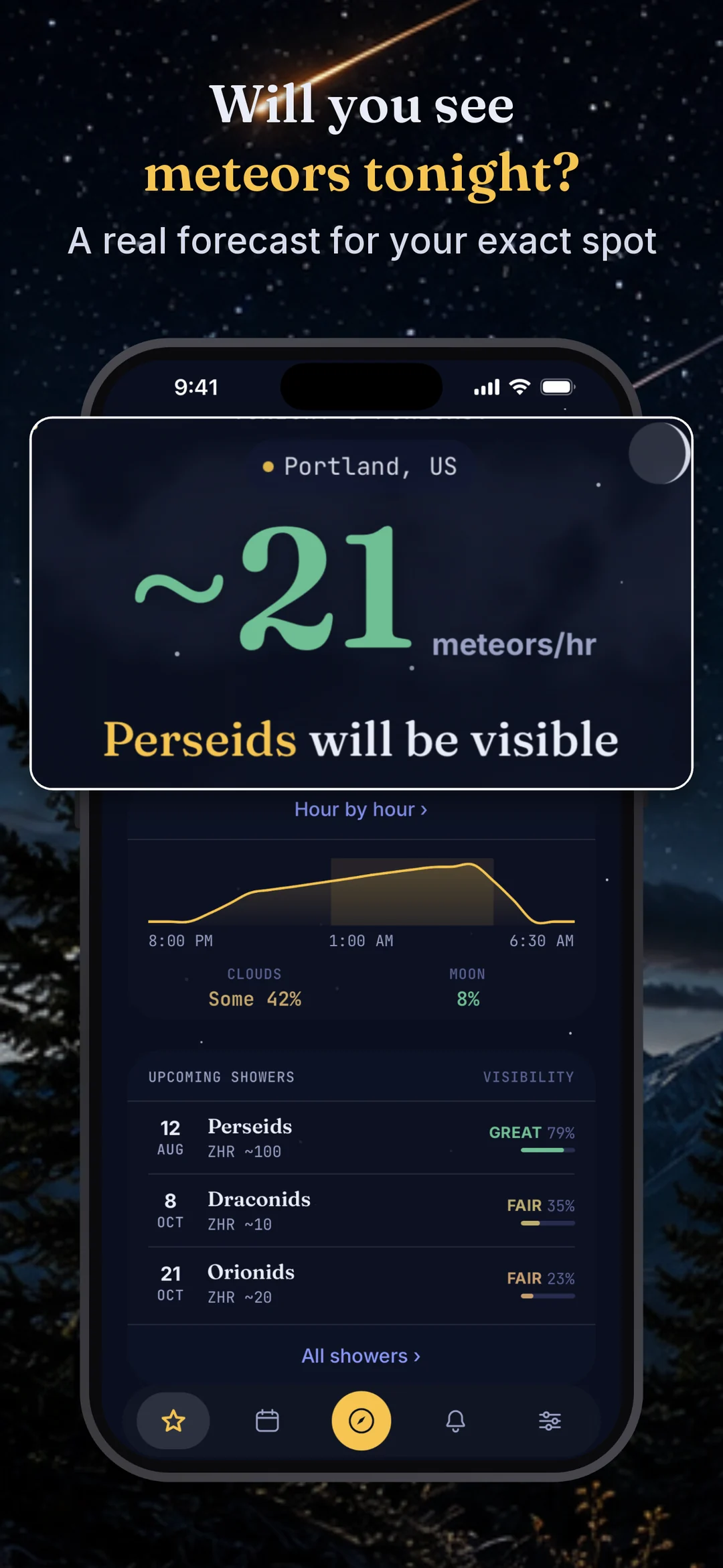
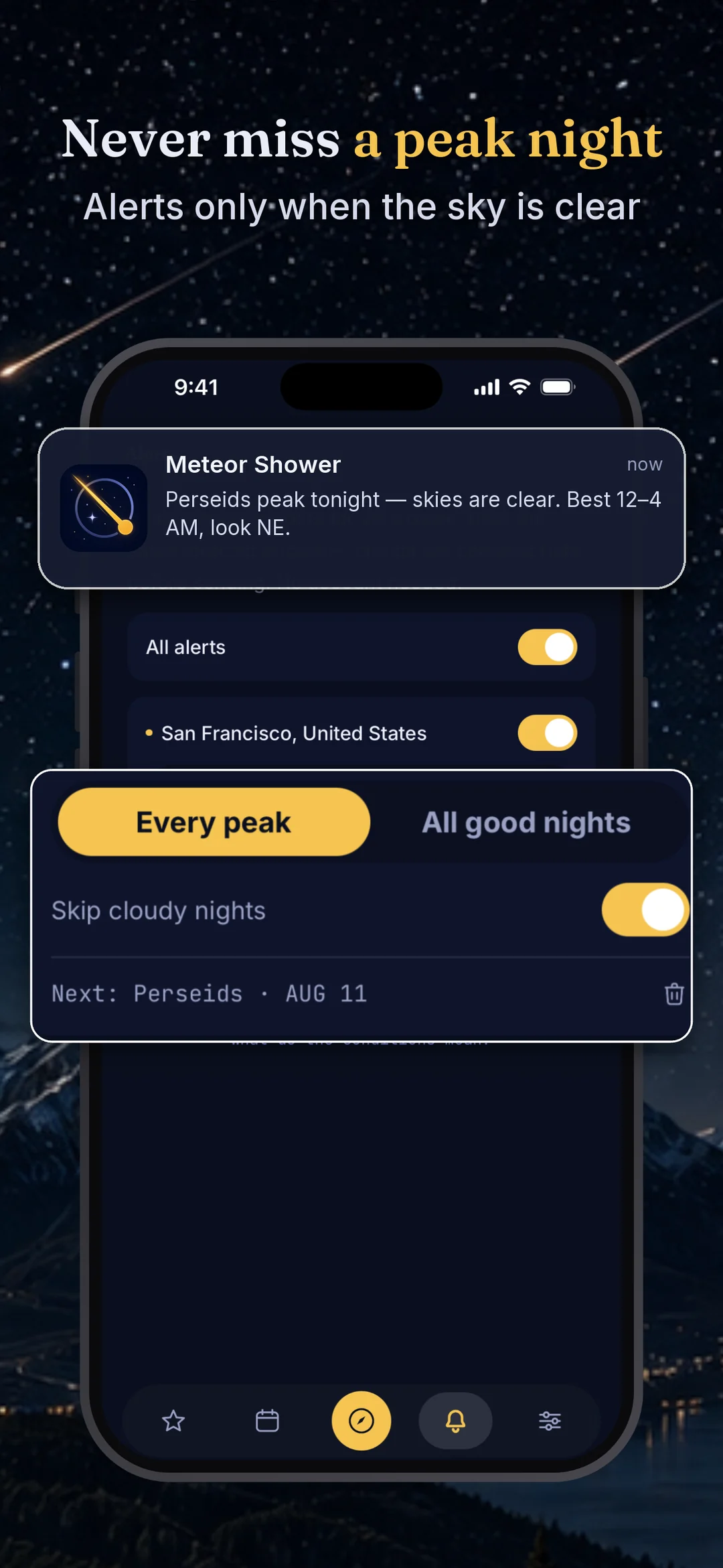
An alert in the evening for your exact location, and a second one when it's time to look up. Every alert checks the clouds first, so you know whether to bother.
- Tonight's forecast for your spot, hour by hour
- Peak-night alerts with a cloud check, free
- More places, widgets and an AR sky scanner with Premium