Active Sep 20 – Nov 20, 2026
Taurid meteor shower 2026
The Taurids peak on the night of November 5–6, 2026. From a dark site at 40° N you can count 3–7 meteors an hour around midnight, and the 12% Moon is down by then.
The Taurids are two broad branches of one old stream from Comet Encke, active together for most of the autumn. They rarely give more than a handful of meteors an hour, but those meteors are slow, and the shower is known for bright ones.
- Peak night
- max
- You'll count
- 3–7/hr
- dark site · 1–3 from suburbs
- Best time
- midnight
- radiant 65° up, S
- Moon
- Excellent
- 12% lit, down in the best hours
For 40° N (New York, Madrid, Beijing), local time. Other latitudes are in the table below; tonight's sky for your own place is on the home page. Updated .
Slow meteors, a few at a time
Taurids arrive at about 27 km/s, slower than any major shower except the Draconids. They drift rather than dart, and a bright one can take a second or more to cross the sky. The numbers are low: around five an hour is a good showing even at the maximum.
Fireballs are the draw. In video records, most Taurid fireballs belong to the Southern branch. In an ordinary year, though, fireballs make up about 1 percent of visual Taurids, roughly the same share as for the Perseids or Geminids. The reputation comes from how unhurried a Taurid fireball is, and from swarm years, when that share can approach 2.4–4.6 percent near the maximum. The stream is also the only major shower known to contain meter-sized meteoroids.
The season is long and flat. Taurids appear from late September into early December, with the Southern branch peaking around November 5–6 and the Northern branch around November 12–13. The Southern branch also shows a weaker early bump in mid-October. The Northern maximum seems to be a plateau of about ten days rather than a single night.
November nights at mid-northern latitudes last about fourteen hours, and the radiant is up for nearly all of them.
Comet Encke and a stream split in two
The parent is 2P/Encke, a comet with one of the shortest orbital periods known, about 3.3 years. Its nucleus is about 4.8 km across, and at perihelion it passes closer to the Sun than Mercury’s average distance. Pierre Méchain first saw it in January 1786, but sightings over the following decades were not recognized as a single comet until Johann Franz Encke computed its orbit in 1819.
The stream is old and has fanned out so widely that Earth meets it along two separate branches: the Southern Taurids, whose radiant lies a few degrees south of the ecliptic, and the Northern Taurids, a few degrees north of it. Earth meets the same complex again in June, as two daytime showers detected mainly by radar: the Beta Taurids and the Zeta Perseids.
The dates, rates and radiant on this page follow the Southern branch, the stronger of the two: the IMO lists it as active from September 20 to November 20 with a ZHR of about 7. The Northern branch runs from October 20 to December 10 at a ZHR of about 5 and peaks about a week later, from a radiant roughly 7° farther north.
Embedded in the stream is the Taurid swarm, a clump of larger meteoroids held in a 7:2 resonance with Jupiter: seven orbits around the Sun for every two of Jupiter’s. Earth passes close to it only in certain years.
Two fuzzy radiants in Taurus, up from dusk to dawn
In early November the two radiants lie side by side in western Taurus, about 6° apart. The Southern radiant sits roughly 10° south of the Pleiades. By mid-November the Northern radiant sits just a few degrees south of the cluster. Both drift a little under a degree east each night, and in October they lie in Aries.
Neither radiant is a point: the IMO treats each as an oval about 20° by 10°, so a slow meteor whose path leads back to the area around and south of the Pleiades is probably a Taurid.
The radiant rises within about an hour of sunset, so Taurids are possible all night. From 40°N it is above 45° from about 10 p.m. to 3 a.m. local standard time, peaking near 60° in the south around 12:30 a.m. From 30–35°S it reaches 40–45° in the north at about the same hour. The IMO rates northern observers somewhat better placed, since the radiant stays usefully high through more of their long November night.
Faster showers overlap the season. The Orionids in late October trace back to the east of Taurus, near Betelgeuse, and move more than twice as fast. The Leonids in mid-November come from Leo, which rises around midnight, and are faster still. The November Orionids, late in the month, have a radiant near the Northern Taurid one, but their higher speed gives them away. For general setup, see how to watch a meteor shower; with the radiant up all night, this is also a good shower for leaving a camera running in hope of a fireball (how to photograph meteor showers).
From Whipple’s orbits to the 2015 swarm
Historical records suggest the Taurids may have been one of the most important sources of fireballs around the 11th century. In 1940 Fred Whipple used photographic meteor orbits to tie the stream to Comet Encke. In 1984 Victor Clube and Bill Napier proposed that Encke is the largest surviving fragment of a much bigger comet that broke apart some 20,000 years ago, an idea still debated.
The swarm hypothesis came from David Asher and Victor Clube’s work on the 7:2 resonance in the early 1990s. Using Nippon Meteor Society fireball records, kept since 1972, Asher and Izumi showed in 1998 that activity was enhanced in the predicted years. Researchers now count 1988, 1991, 1995, 1998, 2005 and 2015 as swarm returns.
The 2015 return was the best documented. The European Fireball Network photographed about 200 Taurid fireballs, and a study of 144 of them found 113 on a distinct new branch inside the 7:2 resonance. Meteoroid masses ranged from a tenth of a gram to over 1,000 kg. The authors identified two asteroids, 2015 TX24 and 2005 UR, each 200–300 m across, as probable members. A later study of 16 Taurid fireballs, mostly from that swarm, found the material too weak to reach the ground as meteorites.
The same resonance model flagged 2022 and 2025 as swarm years, and it puts Earth very close to the swarm’s center in 2032.
Visibility by latitude
How high the Taurus radiant climbs during darkness on the 2026 peak night, and what an observer can realistically count at that hour. Times are local solar time.
| Latitude | HeightRadiant height | Best hour | Dark site | Suburbs |
|---|---|---|---|---|
| 60° NAnchorage, Oslo, Helsinki | 45° | 2–6 | 1–2 | |
| 51° NLondon, Calgary, Prague | 54° | 3–7 | 1–3 | |
| 40° NNew York, Madrid, Beijing | 65° | 3–7 | 1–3 | |
| 30° NHouston, Cairo, Shanghai | 75° | 3–8 | 1–3 | |
| 19° NMexico City, Mumbai, Honolulu | 86° | 3–8 | 1–3 | |
| 0°Quito, Nairobi, Singapore | 75° | 3–8 | 1–3 | |
| 23° SSão Paulo, Alice Springs | 52° | 3–6 | 1–3 | |
| 34° SSydney, Cape Town, Buenos Aires | 41° | 2–5 | 1–2 | |
| 45° SDunedin, Queenstown | 30° | 2–4 | 1–2 |
Rates are meteors per hour on the peak night at the radiant's best hour, including this year's moonlight, as a range because real counts scatter. "Not visible" means the radiant never clears 10° in darkness. How this is computed.
Activity, night by night
The next three peaks
The waning crescent Moon (12% lit) is below the horizon during the best hours — moonlight is not a factor.
| Year | Maximum (UTC) | Moon | At 40° N |
|---|---|---|---|
| 2026 | Nov 5, 18:54 UTC | 12% waning crescent | Excellent |
| 2027 | Nov 6, 01:02 UTC | 47% first quarter | Excellent |
| 2028 | Nov 5, 07:11 UTC | 92% waning gibbous | Poor |
Shower facts
- Peak rate (ZHR)
- 7 /hr what's this?
- Active
- Sep 20 – Nov 20
- Speed
- 27 km/s · slow
- Radiant
- Taurus · 3h 28m +15°
- Parent body
- 2P/Encke · comet
- Best from
- Both hemispheres
Taurids: questions
When is the Taurid meteor shower in 2026?
Maximum is Nov 5, 18:54 UTC, which makes the night of November 5–6 the one to watch in North America (the dates at the top of this page switch to your own time zone). The shower is active from Sep 20 to Nov 20.
Is the night before or after the Taurid peak worth it?
The night before the peak runs at about 100% of peak strength and the night after at about 86%. The run-up is the better spare night. If the peak night is cloudy, either is worth a try.
Will the Moon interfere with the Taurids in 2026?
The waning crescent Moon (12% lit) is below the horizon during the best hours — moonlight is not a factor.
When do the Taurids peak?
Each branch has its own broad maximum: the Southern Taurids around November 5–6 and the Northern Taurids around November 12–13. This site's dates and rates follow the Southern branch, the stronger of the two, but the whole first half of November is the core of the season.
What are the Halloween fireballs?
A nickname for bright Taurids, which NASA notes are frequently seen from mid-October to mid-November. Late October and early November, when both branches are active, is the likeliest time to catch one.
How many Taurids per hour can I expect?
Few: around five an hour at best, even at the maximum. The appeal is quality rather than quantity, since a slow, bright Taurid can take a second or more to cross the sky.
What is a Taurid swarm year?
A year when Earth passes close to a clump of larger meteoroids held together by a 7:2 resonance with Jupiter, seven Taurid orbits for every two of Jupiter's. Overall rates barely change, but fireballs, normally about 1 percent of Taurids, can approach 2.4–4.6 percent near the maximum.
Can you see the Taurids from the Southern Hemisphere?
Yes. The radiant lies close to the ecliptic and rises for nearly everyone; from 30–35°S it reaches about 40–45° around half past midnight. The Northern Hemisphere is somewhat better placed because its November nights are long.
Sources: IMO, Egal et al., Spurný et al., American Meteor Society and more · reviewed October 13, 2026Show
- IMO — 2027 Meteor Shower Calendar
- Egal et al. (2022), An observational synthesis of the Taurid meteor complex, MNRAS
- Spurný et al. (2017), Discovery of a new branch of the Taurid meteoroid stream, A&A
- American Meteor Society — Will There Be a Swarm of Taurid Meteors This Year?
- NASA Watch the Skies — Halloween Fireballs, Also Known as Taurid Meteors
Dates, rates and moon figures are recomputed on every build — see the methodology.
Free app · iPhone & Android
Get told when the Taurids are worth it
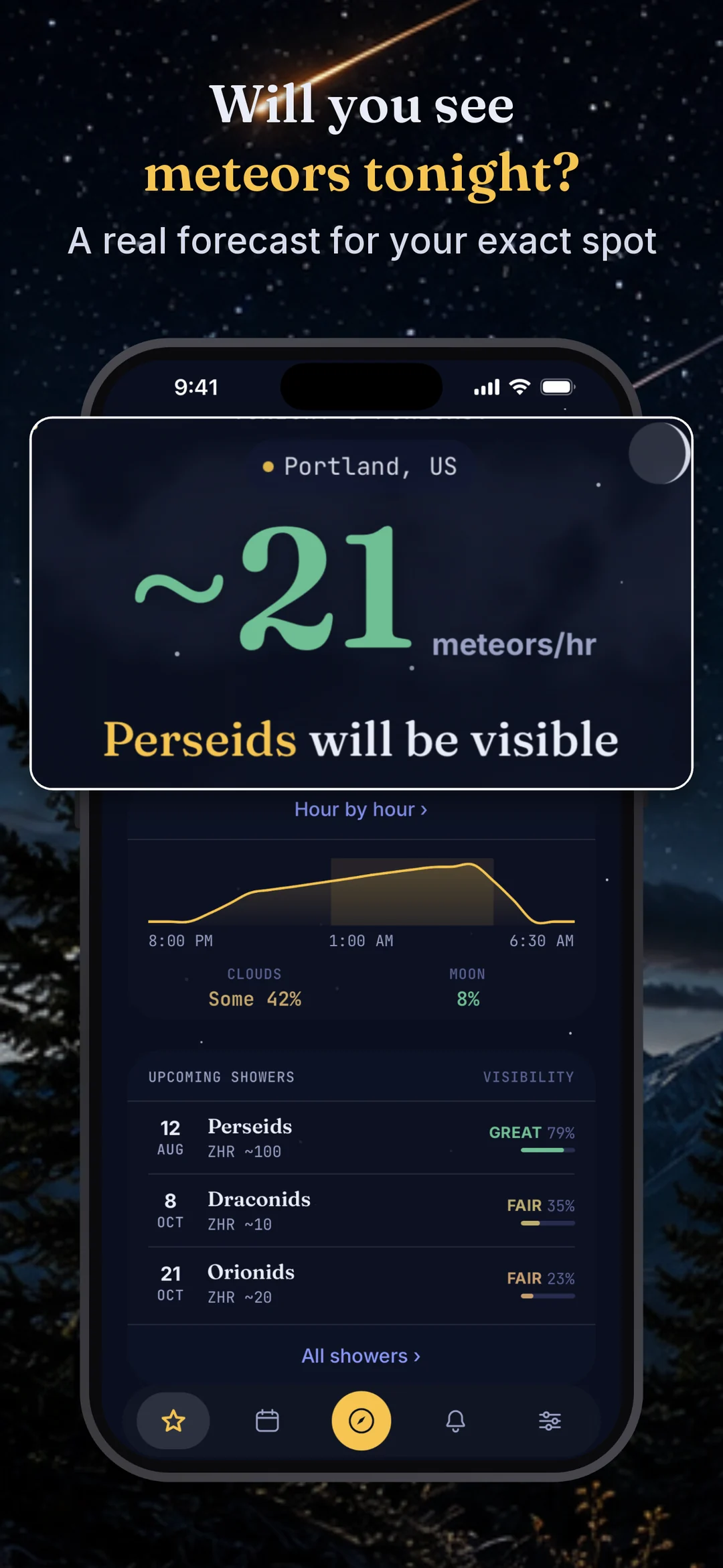
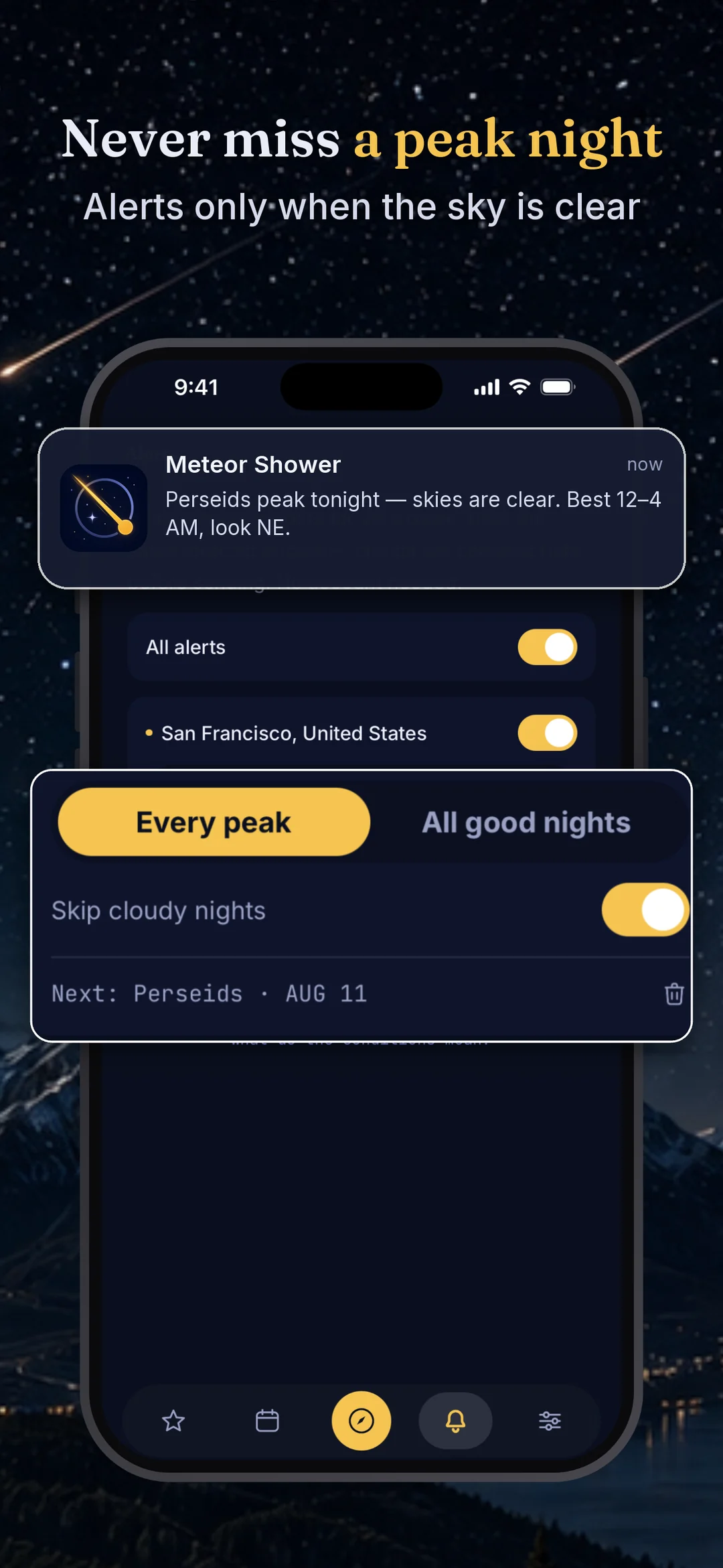
An alert in the evening for your exact location, and a second one when it's time to look up. Every alert checks the clouds first, so you know whether to bother.
- Tonight's forecast for your spot, hour by hour
- Peak-night alerts with a cloud check, free
- More places, widgets and an AR sky scanner with Premium