Active Dec 17 – Dec 26, 2026
Ursid meteor shower 2026
The Ursids peak on the night of December 22–23, 2026. From a dark site at 40° N you can count <1 meteors an hour around 6 AM, though a 98% Moon will wash out the fainter ones.
A modest shower on the longest nights of the northern year. The radiant sits beside Kochab in the Little Dipper and never sets from mid-northern latitudes, and every so often old dust from comet 8P/Tuttle sets off an outburst.
- Peak night
- max
- You'll count
- <1/hr
- dark site · <1 from suburbs
- Best time
- 6 AM
- radiant 50° up, NNE
- Moon
- Poor
- 98% lit, up in the best hours
For 40° N (New York, Madrid, Beijing), local time. Other latitudes are in the table below; tonight's sky for your own place is on the home page. Updated .
A quiet shower on the longest nights
The Ursids peak within a day of the December solstice, so they fall on the longest nights of the northern year: about 14.7 hours from sunset to sunrise at 40°N and nearly 16 at 50°N. That is a lot of dark sky for a shower that, in most years, delivers little. The ZHR is about 10, and because the radiant never climbs very high from mid-latitudes, real counts run at roughly half that. Expect around five an hour from a dark site, more toward dawn.
The meteors arrive at about 33 km/s, close to the speed of the Geminids a week earlier, and they look similar in pace: medium-speed, easy-to-follow streaks. Most are faint, though. Ursid meteoroids are fragile comet dust that begins to burn noticeably higher in the atmosphere than the dense Geminid grains, and bright Ursids are uncommon outside outbursts.
The annual maximum is short, with rates above half their peak for only about half a day, and its timing wanders a little from year to year. Some years add a brief burst on top of it. Those occasional jumps, rather than the usual trickle, are why dedicated observers keep watching the Ursids.
Comet Tuttle and dust that waits for aphelion
The parent is comet 8P/Tuttle, which orbits the Sun every 13.6 years on a path tilted 55° to Earth’s. At perihelion it comes to just outside Earth’s distance from the Sun, and at aphelion it reaches about 10.4 AU, a little beyond the orbit of Saturn. Arecibo radar imaging in 2008 showed a nucleus about 10 km long with two lobes, consistent with a contact binary, and picked up an echo from slow-moving grains a centimeter or more across, of the kind expected to feed the Ursid stream.
The shower’s oddest habit is when its outbursts happen. Many come when the comet is near aphelion, far from Earth, rather than in the years around perihelion, when Leonid outbursts, for example, tend to happen. Modeling by Peter Jenniskens, Esko Lyytinen and colleagues explains why. Some of the dust released centuries ago is trapped in a mean-motion resonance with Jupiter, which keeps it clumped. It takes about six centuries for the dust’s perihelion distance to shrink enough to cross Earth’s path, and by then it trails the comet by about six years. Their model matched the 1945 and 1986 outbursts to dust released in 1392 and 1378.
Following the Little Dipper through the night
The radiant lies about 2° from Kochab, the brighter of the two stars at the outer end of the Little Dipper’s bowl, and only about 15° from the north celestial pole. North of about 15°N it is circumpolar: it never sets, so Ursids can appear at any hour of the night. From 40°N the radiant sits roughly 25° high in the north in the evening, below Polaris, and swings up to about 50° in the north-northeast by the start of morning twilight. Rates follow it, so the hours before dawn are best.
The farther north you are, the better the shower works. At 50°N the radiant is never lower than about 35° and reaches nearly 60° before dawn; in Scandinavia and Canada it stays higher still. From the tropics it hugs the northern horizon, and south of roughly 15°S it never rises at all, which effectively makes this a Northern Hemisphere shower.
Face north and let the Little Dipper anchor your view. Late Geminids are still around in the first days of the Ursid window, but their radiant lies in Gemini, well away from the pole, and the faster Comae Berenicids come from north of Leo. A meteor that traces back toward the Little Dipper is an Ursid. Cold is the main practical problem on a solstice night; the how-to-watch guide covers staying comfortable for hours.
Bečvář’s outburst and the trail predictions
Comet Tuttle was first seen by Pierre Méchain in Paris on January 9, 1790, and found again by Horace Tuttle on January 5, 1858. Alexander Herschel listed it as a possible meteor source in 1874, but the shower drew little attention until December 1945, when Antonín Bečvář’s team at Skalnaté Pleso Observatory in what is now Slovakia recorded an outburst. Bečvář’s first report gave 169 meteors per hour; a later reanalysis by Zdeněk Ceplecha found a 10-minute peak of about 108 per hour.
A second major outburst came in December 1986, recorded by radio observers and by visual observers in Norway and the United Kingdom. Estimates of its strength range from about 50 to more than 100 per hour, depending on the analysis.
Jenniskens and Lyytinen used the same trail calculations to predict an outburst for December 22, 2000. Observers in California saw the ZHR climb to about 90 at 08:06 UT, close to the predicted times, which was strong support for the idea. Smaller enhancements have since been reported in several years, including 2014, when Canadian radar data suggested a ZHR above 50.
The shower is also called the Ursa Minorids, after the constellation that holds its radiant. Even now it is one of the less-observed showers on the calendar: winter weather keeps many observers indoors, and the International Meteor Organization notes that further outbursts may simply have been missed.
Visibility by latitude
How high the Ursa Minor radiant climbs during darkness on the 2026 peak night, and what an observer can realistically count at that hour. Times are local solar time.
| Latitude | HeightRadiant height | Best hour | Dark site | Suburbs |
|---|---|---|---|---|
| 60° NAnchorage, Oslo, Helsinki | 71° | <1 | <1 | |
| 51° NLondon, Calgary, Prague | 62° | <1 | <1 | |
| 40° NNew York, Madrid, Beijing | 50° | <1 | <1 | |
| 30° NHouston, Cairo, Shanghai | 40° | <1 | <1 | |
| 19° NMexico City, Mumbai, Honolulu | 28° | <1 | <1 | |
| 0°Quito, Nairobi, Singapore | 8° | not visible | — | |
| 23° SSão Paulo, Alice Springs | — | not visible | — | |
| 34° SSydney, Cape Town, Buenos Aires | — | not visible | — | |
| 45° SDunedin, Queenstown | — | not visible | — |
Rates are meteors per hour on the peak night at the radiant's best hour, including this year's moonlight, as a range because real counts scatter. "Not visible" means the radiant never clears 10° in darkness. How this is computed.
Activity, night by night
The next three peaks
A full Moon (98% lit) is up through the best hours and will hide the fainter meteors. Keep it behind you or a building.
| Year | Maximum (UTC) | Moon | At 40° N |
|---|---|---|---|
| 2026 | Dec 22, 22:09 UTC | 98% full | Poor |
| 2027 | Dec 23, 04:21 UTC | 21% waning crescent | Good |
| 2028 | Dec 22, 10:20 UTC | 36% first quarter | Excellent |
Shower facts
- Peak rate (ZHR)
- 10 /hr what's this?
- Active
- Dec 17 – Dec 26
- Speed
- 33 km/s · medium
- Radiant
- Ursa Minor · 14h 28m +75°
- Parent body
- 8P/Tuttle · comet
- Best from
- Northern Hemisphere
Ursids: questions
When is the Ursid meteor shower in 2026?
Maximum is Dec 22, 22:09 UTC, which makes the night of December 22–23 the one to watch in North America (the dates at the top of this page switch to your own time zone). The shower is active from Dec 17 to Dec 26.
Is the night before or after the Ursid peak worth it?
The night before the peak runs at about 60% of peak strength and the night after at about 60%. If the peak night is cloudy, either is worth a try.
Will the Moon interfere with the Ursids in 2026?
A full Moon (98% lit) is up through the best hours and will hide the fainter meteors. Keep it behind you or a building. The next peak with a darker sky is in 2027.
Where do I look for the Ursids?
Face north. The radiant is about 2° from Kochab, the brighter of the two stars at the end of the Little Dipper's bowl, and from mid-northern latitudes it stays above the horizon all night.
Can you see the Ursids from the Southern Hemisphere?
Not in practice. The radiant is only about 15° from the north celestial pole, so it never rises south of roughly 15°S and stays low in the north even from the tropics.
What time is best for the Ursids?
The hours before dawn. At 40°N the radiant is about 25° high in the evening and climbs to about 50° by morning twilight, so rates improve through the night.
How many Ursids will I see?
In a typical year the ZHR is about 10, and a single observer at a dark mid-northern site sees around five an hour. Outbursts, such as those of 1945, 1986 and 2000, have pushed rates far higher for a few hours.
Why are Ursid outbursts hard to predict?
They often come from old dust held in a resonance with Jupiter, and they tend to arrive when comet 8P/Tuttle is far from the Sun. Those trails are hard to model, and stormy December weather means some outbursts have probably gone unrecorded.
Sources: IMO, Jenniskens et al., P. Roggemans, Sky & Telescope and more · reviewed October 13, 2026Show
- IMO — 2027 Meteor Shower Calendar (Ursids)
- Jenniskens et al. (2002) — Dust trails of 8P/Tuttle and the unusual outbursts of the Ursid shower
- P. Roggemans — Ursids: major or minor shower? (eMeteorNews)
- Sky & Telescope — Spot December's Ursid meteors
- Harmon et al. (2010) — Radar observations of 8P/Tuttle, a contact-binary comet
Dates, rates and moon figures are recomputed on every build — see the methodology.
Free app · iPhone & Android
Get told when the Ursids are worth it
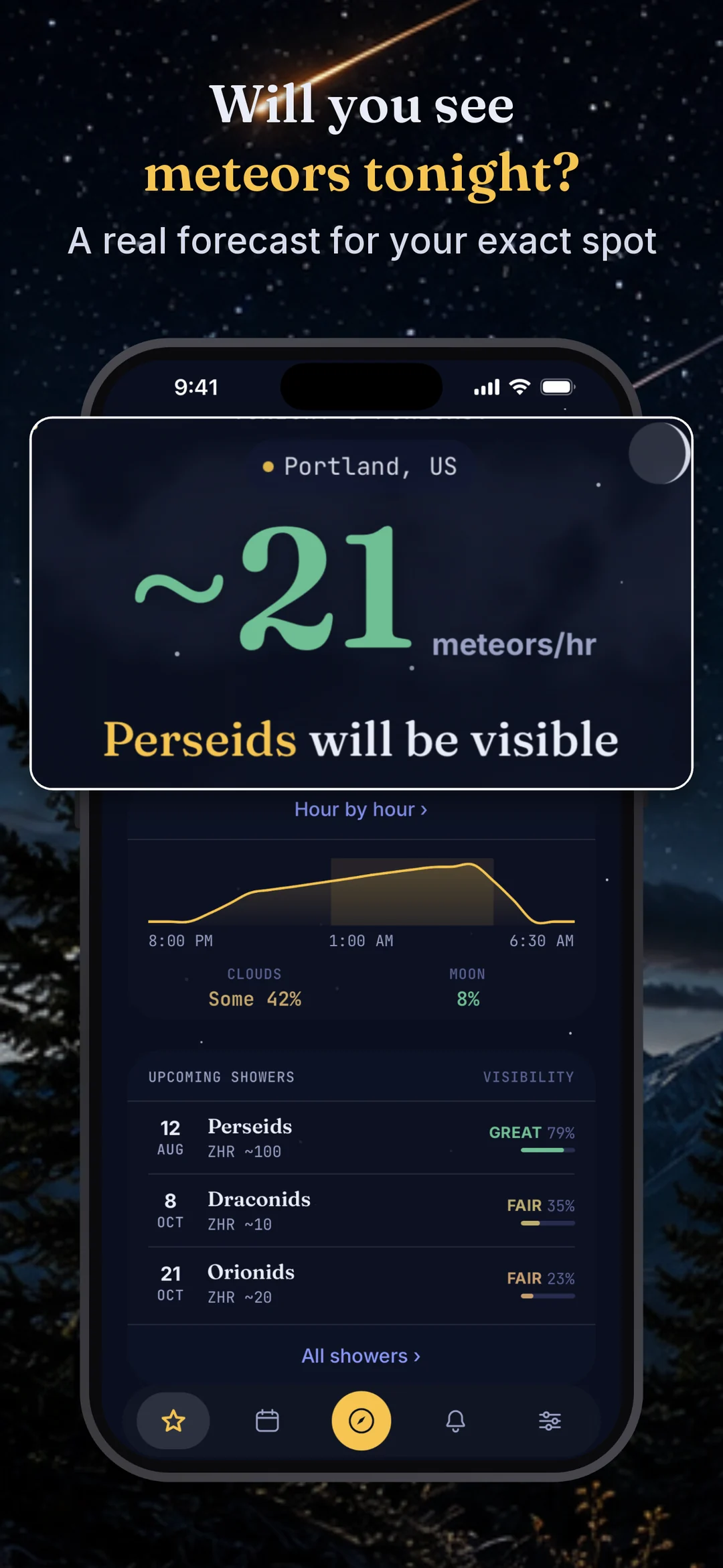
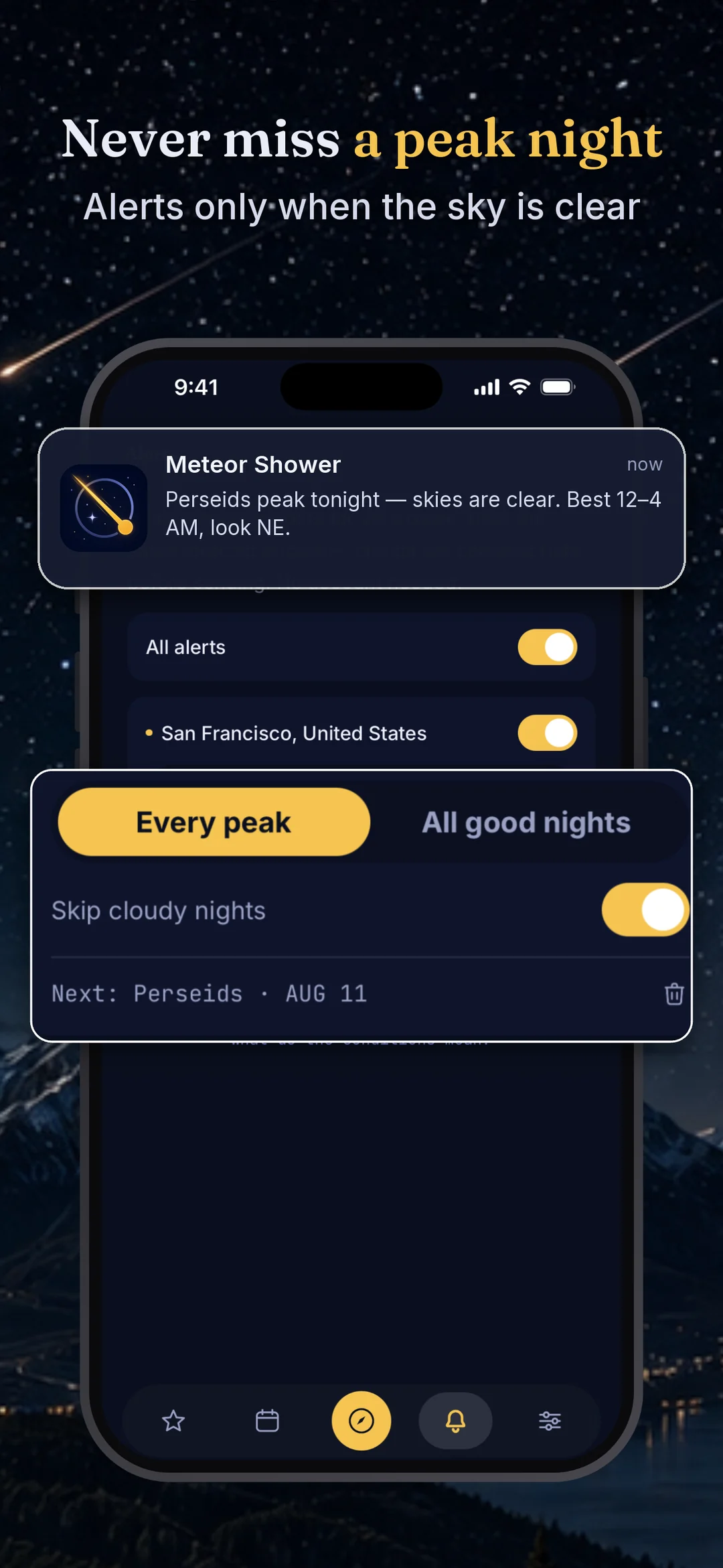
An alert in the evening for your exact location, and a second one when it's time to look up. Every alert checks the clouds first, so you know whether to bother.
- Tonight's forecast for your spot, hour by hour
- Peak-night alerts with a cloud check, free
- More places, widgets and an AR sky scanner with Premium