Active Oct 2 – Nov 7, 2026
Orionid meteor shower 2026
The Orionids peak on the night of October 21–22, 2026. From a dark site at 40° N you can count 9–20 meteors an hour around 4 AM, and the 79% Moon is down by then.
The Orionids are Halley's Comet's October shower: some of the fastest meteors of the year, often leaving glowing trains, from a radiant near Betelgeuse that both hemispheres see well in the hours before dawn.
- Peak night
- max
- You'll count
- 9–20/hr
- dark site · 4–8 from suburbs
- Best time
- 4 AM
- radiant 66° up, S
- Moon
- Excellent
- 79% lit, down in the best hours
For 40° N (New York, Madrid, Beijing), local time. Other latitudes are in the table below; tonight's sky for your own place is on the home page. Updated .
Fast meteors that leave glowing trains
Orionids strike the atmosphere at 66 km/s. Only the Leonids are faster among the major showers, and the Eta Aquariids, from the same comet, arrive at the same speed. At that speed most Orionids are brief, sharp streaks.
The brighter ones often leave a train: a faint glowing trail that can hang in the sky for several seconds and occasionally for minutes. After a bright Orionid, look back along its path: the train may still be there, slowly twisting.
The peak is a plateau, not a spike. Activity runs from October 2 to November 7, and the maximum spreads over several days around October 21, often with two sub-peaks separated by a dip. A night or two either side of the nominal date is usually nearly as good.
Expectations should be modest. The ZHR is about 20, and NASA puts a typical dark-site count at 10 to 20 an hour before dawn. Some years run well above that, for reasons covered below.
Late-October nights are long, and the pre-dawn hours when the shower is best are also the coldest of the night.
Halley’s Comet, met twice a year
The parent is 1P/Halley, which orbits the Sun about every 76 years. It last passed perihelion in 1986 and returns in 2061. Its nucleus measures about 15 by 8 km and is one of the darkest objects known in the solar system.
Halley orbits the Sun backward relative to the planets, on a path tilted about 162° to Earth’s. Its debris therefore meets Earth almost head-on, hence the 66 km/s. Earth crosses the Halley stream at two points each year, producing the Eta Aquariids in early May and the Orionids in October.
The October crossing is not a close one: there, the comet’s own path stays well away from Earth’s orbit. The Orionids we meet were shed many returns ago and have since drifted onto orbits that do cross ours. Modeling by Auriane Egal and colleagues suggests the Orionid stream holds even more old material than the Eta Aquariids, which they estimate at somewhat over 5,000 years old.
Jupiter shapes the stream. Studies by Aswin Sekhar and David Asher found that Halley was locked in a 1:6 resonance with Jupiter, one Halley orbit for every six of Jupiter’s, from about 1404 to 690 BC. It sat in a 2:13 resonance from about 240 BC to AD 1700. Meteoroids released in those eras stay bunched together instead of spreading out, and Earth’s occasional passage through such a clump produces an enhanced year.
Orion rising after midnight, from both hemispheres
The radiant lies about 10° northeast of Betelgeuse, near Orion’s raised club and the border with Gemini. It creeps east by about two-thirds of a degree a day, so in early October it sits north of Betelgeuse and slightly to the west.
From 40°N the radiant rises around 9:30 p.m. local standard time. It stands about 30° high at midnight and 50° by 2 a.m., and peaks near 65° in the south shortly after 4 a.m., just as astronomical twilight begins. In late October most of North America and Europe are still on daylight saving time, so on the clock that peak comes after 5 a.m.
The radiant sits only 16° north of the celestial equator, so observers at almost any latitude see it rise. From 30–35°S it comes up around 11 p.m. and reaches about 40–45° in the northern sky before dawn. In the tropics it passes nearly overhead. NASA suggests facing southeast from the Northern Hemisphere and northeast from the Southern.
Three other showers are active at the same time. The Epsilon Geminids, active from mid- to late October, have a radiant only about 13° from the Orionid one and are about as fast, so only careful path plotting separates them. The Leonis Minorids, peaking around October 25, are also fast but come from the northeast. The Southern Taurids are slow and trace back to Taurus, west of Orion. For general setup, see how to watch a meteor shower.
From Herrick and Herschel to the resonant years
The October meteors were noticed independently in 1839 by Edward Herrick in Connecticut and Adolphe Quetelet in Brussels. Alexander Herschel fixed the first precise radiant in Orion in 1864 and 1865. A link to Halley was proposed in 1868, and in 1911 Charles Olivier noted how closely the Orionids and the May Eta Aquariids resemble each other. Because of the wide gap at the October crossing, the connection took decades to win acceptance.
The record since then is uneven. Enhanced years came around 1934–1936, 1946–1948 and 1966–1968, at two to four times normal activity. Sekhar and Asher tie a broad run of enhanced years in the 1930s to the 1:6 resonance, and outbursts in 1916 and 1993 to the 2:13 resonance.
The most striking modern return came on October 21, 2006. Several peaks approached a ZHR of 60, observers reported unusually many bright meteors and some fireballs, and 2007 reached about 80 by one analysis. Rates stayed above normal through the end of the decade. Sekhar and Asher link this run to meteoroids released while Halley sat in the 1:6 resonance, roughly 2,700 to 3,400 years ago.
Some researchers have proposed a roughly 12-year cycle in Orionid activity, close to Jupiter’s 11.9-year orbital period. Canadian radar data since 2002 are consistent with it, but the Egal team’s analysis treats the cycle as unconfirmed. Their model predicts no major Orionid outburst before 2050.
Visibility by latitude
How high the Orion radiant climbs during darkness on the 2026 peak night, and what an observer can realistically count at that hour. Times are local solar time.
| Latitude | HeightRadiant height | Best hour | Dark site | Suburbs |
|---|---|---|---|---|
| 60° NAnchorage, Oslo, Helsinki | 46° | 7–17 | 3–7 | |
| 51° NLondon, Calgary, Prague | 55° | 8–19 | 3–8 | |
| 40° NNew York, Madrid, Beijing | 66° | 9–20 | 4–8 | |
| 30° NHouston, Cairo, Shanghai | 76° | 10–25 | 4–9 | |
| 19° NMexico City, Mumbai, Honolulu | 87° | 10–25 | 4–9 | |
| 0°Quito, Nairobi, Singapore | 74° | 10–20 | 4–9 | |
| 23° SSão Paulo, Alice Springs | 51° | 8–18 | 3–7 | |
| 34° SSydney, Cape Town, Buenos Aires | 39° | 6–15 | 3–6 | |
| 45° SDunedin, Queenstown | 27° | 5–11 | 2–4 |
Rates are meteors per hour on the peak night at the radiant's best hour, including this year's moonlight, as a range because real counts scatter. "Not visible" means the radiant never clears 10° in darkness. How this is computed.
Activity, night by night
The next three peaks
The waxing gibbous Moon (79% lit) is below the horizon during the best hours — moonlight is not a factor.
| Year | Maximum (UTC) | Moon | At 40° N |
|---|---|---|---|
| 2026 | Oct 21, 18:20 UTC | 79% waxing gibbous | Excellent |
| 2027 | Oct 22, 00:37 UTC | 58% last quarter | Fair |
| 2028 | Oct 21, 06:39 UTC | 13% waxing crescent | Excellent |
Shower facts
- Peak rate (ZHR)
- 20 /hr what's this?
- Active
- Oct 2 – Nov 7
- Speed
- 66 km/s · very fast
- Radiant
- Orion · 6h 22m +16°
- Parent body
- 1P/Halley · comet
- Best from
- Both, best from the north
Orionids: questions
When is the Orionid meteor shower in 2026?
Maximum is Oct 21, 18:20 UTC, which makes the night of October 21–22 the one to watch in North America (the dates at the top of this page switch to your own time zone). The shower is active from Oct 2 to Nov 7.
Is the night before or after the Orionid peak worth it?
The night before the peak runs at about 85% of peak strength and the night after at about 85%. If the peak night is cloudy, either is worth a try.
Will the Moon interfere with the Orionids in 2026?
The waxing gibbous Moon (79% lit) is below the horizon during the best hours — moonlight is not a factor.
Are the Orionids really from Halley's Comet?
Yes. Earth crosses the debris of 1P/Halley twice a year: in October for the Orionids and in early May for the Eta Aquariids. The meteoroids left the comet centuries to thousands of years ago, not during its 1986 visit.
What time should I watch the Orionids?
From about midnight until dawn. The radiant rises around 10 p.m. local standard time and is highest at about 4 to 5 a.m., just as morning twilight begins, so the last two hours of darkness are the most productive.
Can you see the Orionids from the Southern Hemisphere?
Yes. The radiant is only about 16° north of the celestial equator, so it rises almost everywhere. From 30–35°S it climbs to about 40–45° in the northern sky before dawn, compared with about 65° from 40°N.
How many Orionids will I see per hour?
In a normal year, about 10 to 20 an hour from a dark site in the hours before dawn, against a ZHR of about 20. The late 2000s ran well above normal, with peak ZHRs of about 60 in 2006 and about 80 in 2007.
Where is the Orionid radiant?
About 10° northeast of Betelgeuse, near Orion's raised club and the border with Gemini. You don't need to look at it: Orionids cross the whole sky, and their paths trace back to that spot.
Sources: IMO, NASA, Egal et al., Sekhar & Asher and more · reviewed October 13, 2026Show
- IMO — 2027 Meteor Shower Calendar
- NASA — Orionids
- Egal et al. (2020), Activity of the Eta-Aquariid and Orionid meteor showers, A&A
- Sekhar & Asher (2014), Resonant Behavior of Comet Halley and the Orionid Stream
- Egal et al. (2020), Modeling the past and future activity of the Halleyids meteor showers, A&A
Dates, rates and moon figures are recomputed on every build — see the methodology.
Free app · iPhone & Android
Get told when the Orionids are worth it
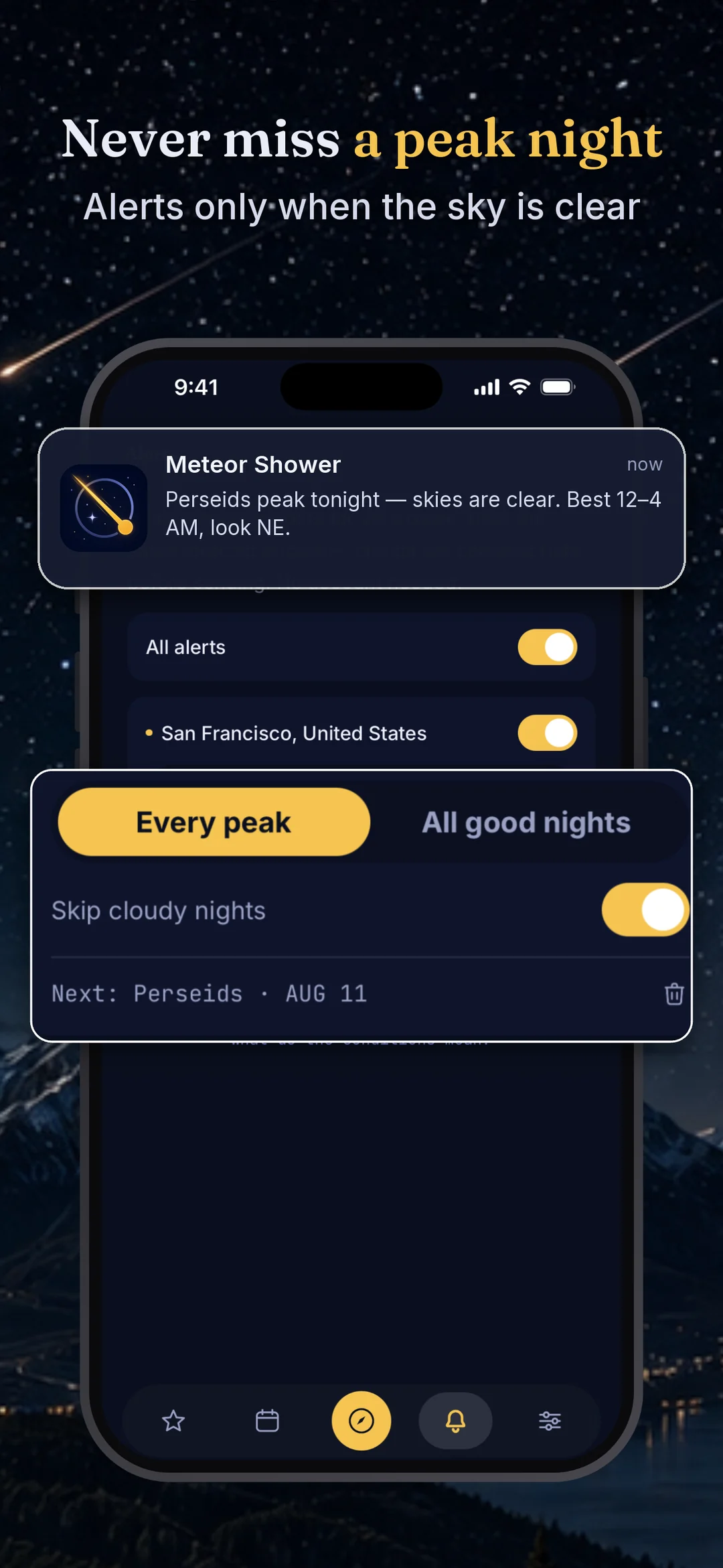
An alert in the evening for your exact location, and a second one when it's time to look up. Every alert checks the clouds first, so you know whether to bother.
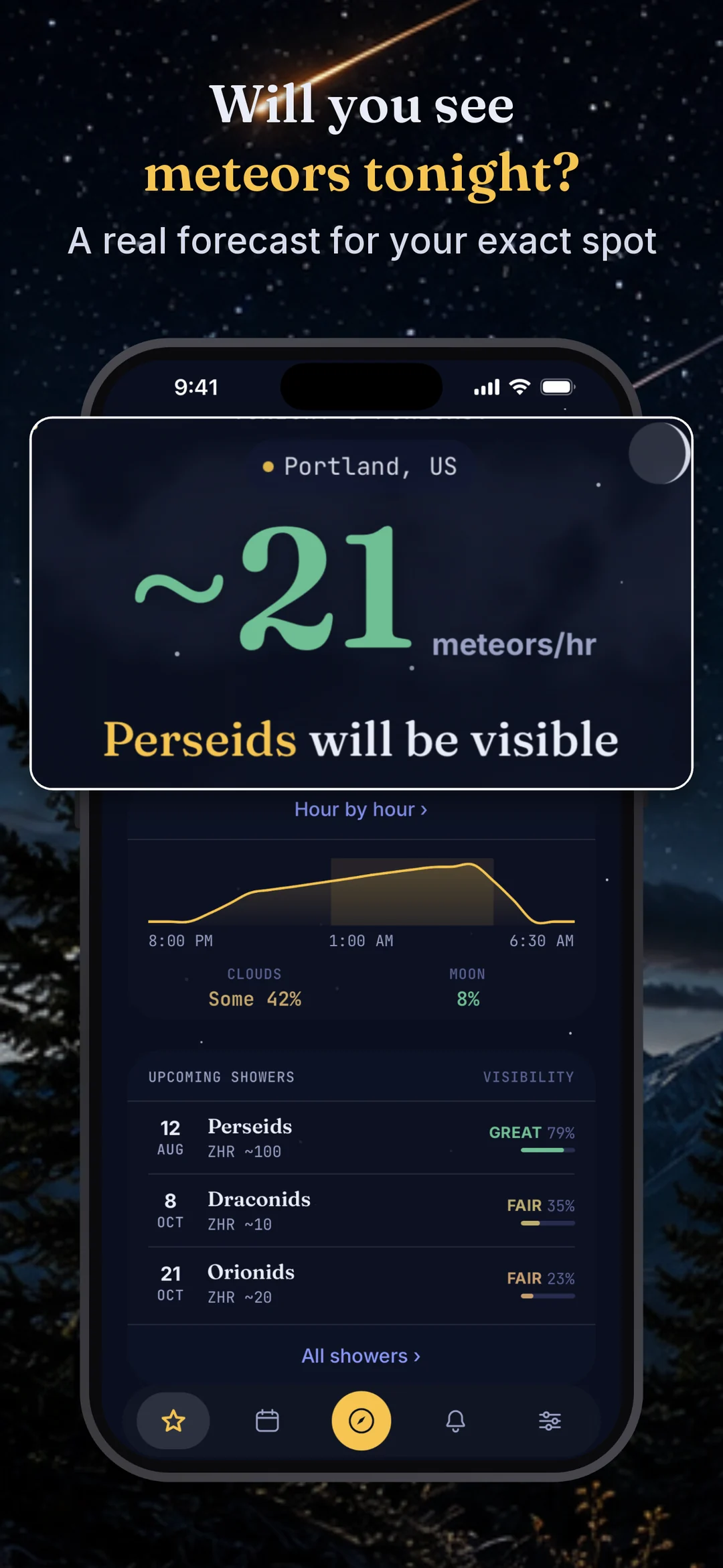
- Tonight's forecast for your spot, hour by hour
- Peak-night alerts with a cloud check, free
- More places, widgets and an AR sky scanner with Premium