Active Nov 6 – Nov 30, 2026
Leonid meteor shower 2026
The Leonids peak on the night of November 17–18, 2026. From a dark site at 40° N you can count 7–16 meteors an hour around 5 AM, and the 55% Moon is down by then.
The fastest meteors of any major shower, hitting the air at 71 km/s. Most Novembers bring about 10 an hour before dawn, but near the 33-year returns of comet Tempel–Tuttle the Leonids have stormed at thousands per hour.
- Peak night
- max
- You'll count
- 7–16/hr
- dark site · 3–6 from suburbs
- Best time
- 5 AM
- radiant 66° up, SE
- Moon
- Excellent
- 55% lit, down in the best hours
For 40° N (New York, Madrid, Beijing), local time. Other latitudes are in the table below; tonight's sky for your own place is on the home page. Updated .
Seventy-one kilometers a second
Leonids strike the atmosphere at about 71 km/s, faster than the meteors of any other major shower. They look it: short, sharp streaks that are gone almost before you register them. Many of the brighter ones leave persistent trains, glowing wisps that hang along the path for seconds after the meteor has vanished, and photographers often record a green tint in the brightest.
In most years this is a modest shower. The zenithal hourly rate is about 15, and a single observer at a dark site usually sees around 10 an hour in the last hours before dawn, a handful from a suburb. Activity is noticeable for about a week from the middle of November, with a gentle maximum.
What makes the Leonids famous is the exception. When Earth runs into a young, dense ribbon of comet dust, the gentle hump becomes a spike: rates of thousands per hour that build and collapse within an hour or two. Storms come only in the few years around a return of the parent comet, and not at every return.
A backward orbit and a 33-year comet
The parent is comet 55P/Tempel–Tuttle, a nucleus about 3.6 km across that rounds the Sun every 33 years. Its orbit is tilted 162° to Earth’s, which means it travels the opposite way around the Sun from the planets. Leonid meteoroids therefore meet Earth nearly head-on, and that is where the 71 km/s comes from. The orbit swings in to just inside Earth’s distance from the Sun and out to about 19.7 AU, near the orbit of Uranus.
Each perihelion passage lays down its own narrow trail of dust. The trails stay distinct for centuries, and Jupiter and Saturn steer each one differently, so a storm depends on where one particular trail has been pushed. Resonances with Jupiter can keep a trail compact far longer than expected: the fireball-rich display of 1998 came from dust released in 1333.
Historically, Leonid storms have come only within a few years either side of a perihelion passage, and only when the comet’s path ran very close to Earth’s orbit. Tempel–Tuttle last passed perihelion in early 1998; the meteoroids Earth meets in the years before its next return are running ahead of it.
Waiting for the Lion to rise
The radiant lies in the Sickle, the backward question mark of stars that outlines Leo’s head, a few degrees from the star Algieba. At mid-northern latitudes it rises in the east-northeast around 11 p.m., so evening watching is mostly wasted. Rates build as it climbs: from 40°N the radiant is about 30° up by 2 a.m. and around 65° high in the southeast when morning twilight begins. The last two hours of darkness are the productive ones.
Soon after the radiant rises, watch low in the east for earthgrazers: rare Leonids that skim the upper atmosphere almost horizontally and draw the longest paths of the night.
Both hemispheres can see the shower, though not equally. From around 35°S the radiant rises only a couple of hours before the short late-spring night ends and has climbed just 15° to 25° by the time the sky brightens, so counts there run well below northern ones. Near the equator the radiant still climbs past 60° before dawn.
The Taurids are active through the same weeks and are easy to separate: Taurids are slow, unhurried meteors from Taurus, while a Leonid traced backward points to the Sickle and is over in a flash. For the basics of a cold November watch, see how to watch a meteor shower.
From the 1833 storm to dust-trail forecasts
Before dawn on November 13, 1833, a Leonid storm was seen across eastern North America. Denison Olmsted of Yale collected accounts and noted that the meteors radiated from a point in Leo that moved with the stars, evidence that they came from space rather than from the atmosphere. His analysis is counted as the starting point of meteor-shower science. Yale’s Hubert Newton, working from old records, predicted a return for 1866, and storms arrived in 1866 and 1867. Orbit calculations soon matched the stream to comet Tempel–Tuttle, found in 1865–66, the second shower tied to a comet after the Perseids.
Confident predictions for 1899 failed: Jupiter and Saturn had shifted the storm-producing part of the stream away from Earth’s path. The next great storm came on November 17, 1966, over the western United States, where observers at Kitt Peak, Arizona, estimated about 40 meteors per second for roughly 20 minutes. Later modeling traced it to dust released in 1899.
At the 1998–2002 returns, forecasters learned to time Leonid storms to within minutes. After the 1998 fireballs were traced to the 1333 trail, David Asher and Robert McNaught, building on earlier trail calculations by Kondrat’eva and Reznikov, predicted the 1999 peak for 02:08 UT on November 18, give or take five minutes. It arrived within minutes of that, with thousands of meteors per hour over Europe and the Middle East. Storms followed in 2001 over North America and then East Asia and Australia, and in 2002 two peaks with ZHRs of roughly 2,500 to 3,000 came from trails released in 1767 and 1866. The models timed those peaks well; their rate estimates were less reliable.
There has been no Leonid storm since 2002. Forecasters expect the shower to strengthen as Tempel–Tuttle returns, and several published models single out 2033–2035 for the strongest encounters. Their predicted rates range from a few hundred per hour to storm level, so treat any forecast as provisional.
Visibility by latitude
How high the Leo radiant climbs during darkness on the 2026 peak night, and what an observer can realistically count at that hour. Times are local solar time.
| Latitude | HeightRadiant height | Best hour | Dark site | Suburbs |
|---|---|---|---|---|
| 60° NAnchorage, Oslo, Helsinki | 51° | 6–13 | 2–5 | |
| 51° NLondon, Calgary, Prague | 58° | 6–15 | 3–6 | |
| 40° NNew York, Madrid, Beijing | 66° | 7–16 | 3–6 | |
| 30° NHouston, Cairo, Shanghai | 69° | 7–16 | 3–7 | |
| 19° NMexico City, Mumbai, Honolulu | 68° | 7–16 | 3–6 | |
| 0°Quito, Nairobi, Singapore | 54° | 6–14 | 2–6 | |
| 23° SSão Paulo, Alice Springs | 30° | 4–9 | 2–4 | |
| 34° SSydney, Cape Town, Buenos Aires | 17° | 2–5 | 1–2 | |
| 45° SDunedin, Queenstown | 2° | not visible | — |
Rates are meteors per hour on the peak night at the radiant's best hour, including this year's moonlight, as a range because real counts scatter. "Not visible" means the radiant never clears 10° in darkness. How this is computed.
Activity, night by night
The next three peaks
The first quarter Moon (55% lit) is below the horizon during the best hours — moonlight is not a factor.
| Year | Maximum (UTC) | Moon | At 40° N |
|---|---|---|---|
| 2026 | Nov 17, 23:43 UTC | 55% first quarter | Excellent |
| 2027 | Nov 18, 05:59 UTC | 80% waning gibbous | Poor |
| 2028 | Nov 17, 12:01 UTC | 1% new | Excellent |
Shower facts
- Peak rate (ZHR)
- 15 /hr what's this?
- Active
- Nov 6 – Nov 30
- Speed
- 71 km/s · very fast
- Radiant
- Leo · 10h 09m +22°
- Parent body
- 55P/Tempel–Tuttle · comet
- Best from
- Both, best from the north
Leonids: questions
When is the Leonid meteor shower in 2026?
Maximum is Nov 17, 23:43 UTC, which makes the night of November 17–18 the one to watch in North America (the dates at the top of this page switch to your own time zone). The shower is active from Nov 6 to Nov 30.
Is the night before or after the Leonid peak worth it?
The night before the peak runs at about 80% of peak strength and the night after at about 80%. If the peak night is cloudy, either is worth a try.
Will the Moon interfere with the Leonids in 2026?
The first quarter Moon (55% lit) is below the horizon during the best hours — moonlight is not a factor.
When is the next Leonid meteor storm?
No one can promise one. Comet 55P/Tempel–Tuttle next reaches perihelion in May 2031, and published dust-trail forecasts point to 2033–2035 for the strongest encounters, with predicted rates ranging from a few hundred per hour to storm level.
What time should I watch the Leonids?
After the radiant in Leo rises, around 11 p.m. at mid-northern latitudes, and ideally in the last two hours before dawn, when it stands high in the southeast and rates are at their best.
Why are Leonid meteors so fast?
Their parent comet orbits the Sun in the opposite direction to the planets, so its debris meets Earth almost head-on. Earth's orbital speed adds to the meteoroids' own, giving an entry speed of about 71 km/s.
How many Leonids can I expect in a normal year?
The ZHR is about 15. From a dark site in the hours before dawn, a single observer typically sees around 10 an hour, fewer from a suburb or from southern mid-latitudes.
Can you see the Leonids from the Southern Hemisphere?
Yes, but at a disadvantage. From around 35°S the radiant rises only a couple of hours before morning twilight and climbs just 15° to 25°, so rates are a fraction of what northern and tropical observers see.
Sources: IMO, NASA, P. Brown, Society for Popular Astronomy and more · reviewed October 13, 2026Show
- IMO — 2027 Meteor Shower Calendar (Leonids)
- NASA — Leonids
- P. Brown — Formation and evolution of the Leonid stream (thesis chapter, UWO)
- Society for Popular Astronomy — Leonids 2002
- S. Abe (2026) — Dust-trail forecasts of the 2031–2035 Leonids (arXiv)
Dates, rates and moon figures are recomputed on every build — see the methodology.
Free app · iPhone & Android
Get told when the Leonids are worth it
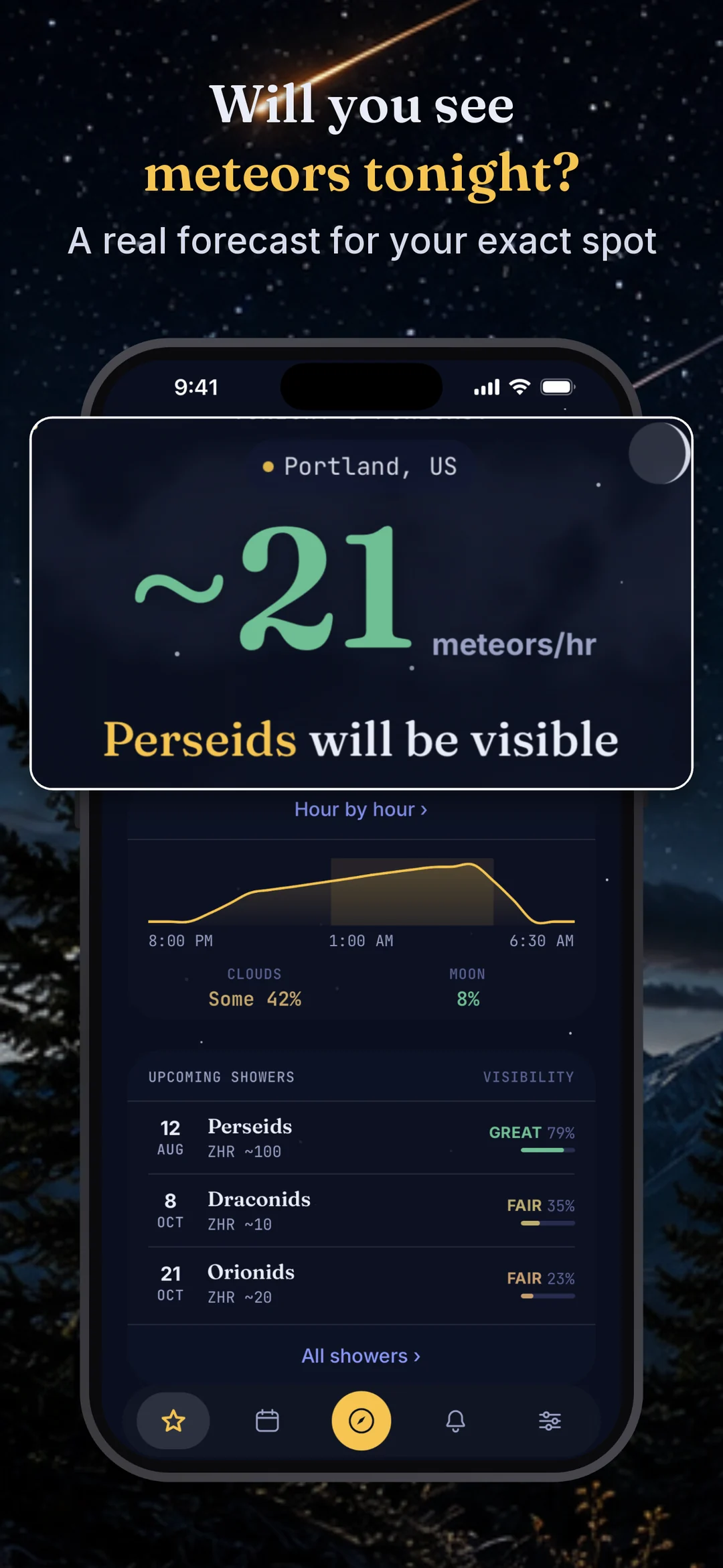
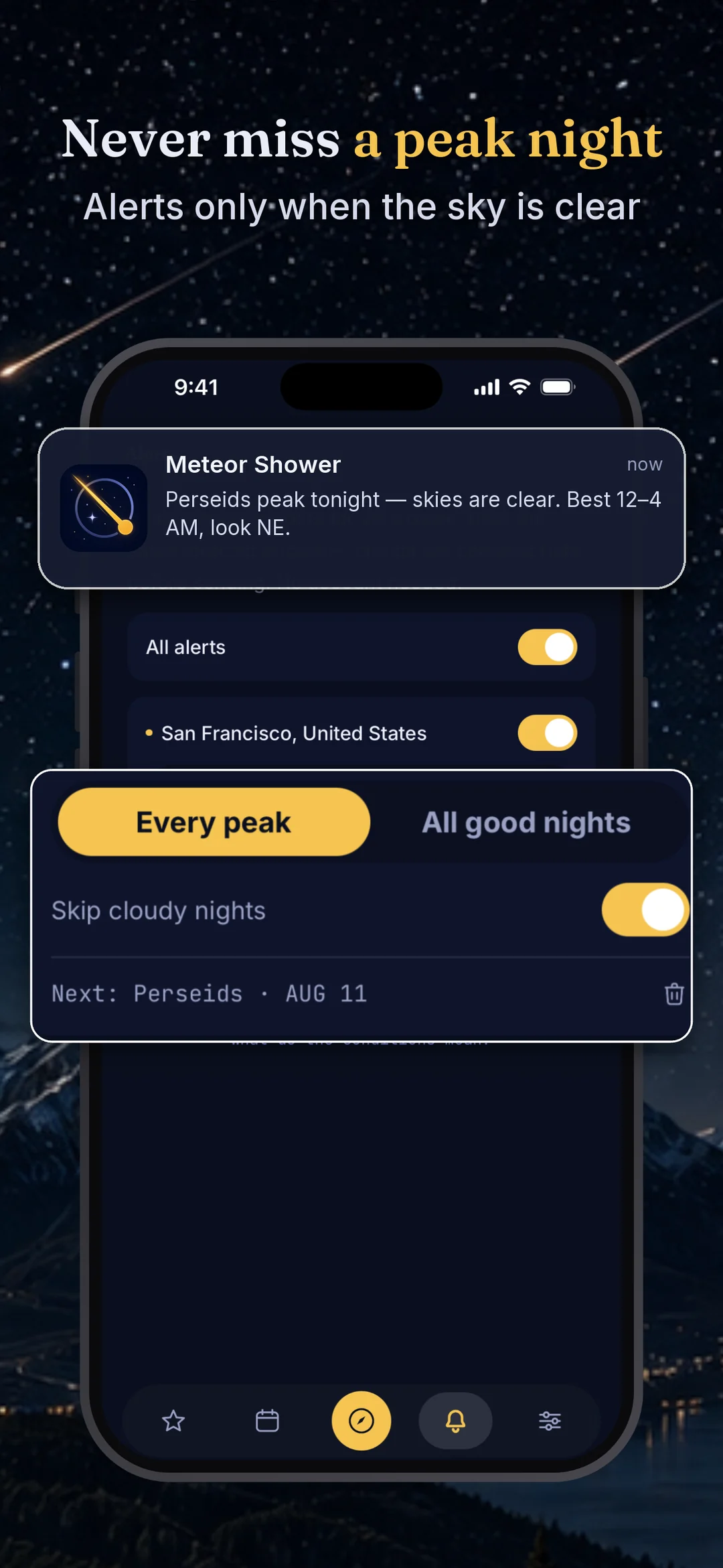
An alert in the evening for your exact location, and a second one when it's time to look up. Every alert checks the clouds first, so you know whether to bother.
- Tonight's forecast for your spot, hour by hour
- Peak-night alerts with a cloud check, free
- More places, widgets and an AR sky scanner with Premium