Active Apr 14 – Apr 30, 2027
Lyrid meteor shower 2027
The Lyrids peak on the night of April 22–23, 2027. From a dark site at 40° N you can count 1–2 meteors an hour around 4 AM, though a 95% Moon will wash out the fainter ones.
The Lyrids carry one of the oldest written records of any meteor shower, a Chinese chronicle from 687 BCE. Most years they are modest, but debris from a comet that returns every 415 years has thrown brief bursts of 90 an hour or more.
- Peak night
- max
- You'll count
- 1–2/hr
- dark site · 1–2 from suburbs
- Best time
- 4 AM
- radiant 80° up, SE
- Moon
- Poor
- 95% lit, up in the best hours
For 40° N (New York, Madrid, Beijing), local time. Other latitudes are in the table below; tonight's sky for your own place is on the home page. Updated .
Modest rates, with a history of surprises
In an ordinary year the Lyrids are a mid-sized shower. The International Meteor Organization uses a working ZHR of 18. Its analysis of returns since 1988 found that the peak arrives at a slightly different moment each year, spread over about seven hours. Years when the peak hit the usual position reached ZHRs near 23, and years when it drifted reached closer to 14, a pattern the IMO says still needs confirming. From a good rural site with the radiant high before dawn, that works out to roughly 10 meteors an hour.
The peak is neither knife-edged nor broad. Rates stay above half their maximum for about a day and a half on average, though that has ranged from 15 to 62 hours. The very best rates usually last only a few hours.
Lyrids enter the atmosphere at 49 km/s, quicker than the Geminids and slower than the Perseids. Most don’t leave long glowing trains, though the shower turns out an occasional fireball. Near the highest rates, observers sometimes notice a brief rise in the number of faint meteors, a hint of the fine structure described below.
The season shapes the night. In the north the shower falls in mid-spring, mild compared with the January and December showers, but the nights are already shrinking. At 50°N full darkness lasts only about five and a half hours on the peak night.
Old dust from a 415-year comet
The parent is comet C/1861 G1 (Thatcher), found by A. E. Thatcher on April 5, 1861. It is a long-period comet. Its orbit stretches out to about 110 AU and brings it back roughly every 415 years, tilted almost 80° to Earth’s orbit. At its closest it passes 0.92 AU from the Sun, just inside Earth’s distance. Dust released in 1861 is still traveling with the comet far out along that orbit, and Thatcher is not due back for more than two centuries. The Lyrids seen today come from dust shed on earlier passes.
The comet’s orbit nearly grazes our own. In the 1860s the Austrian astronomer Edmund Weiss computed that it passes within about 0.002 AU of Earth’s orbit, at the point Earth reaches around April 20. Old dust spread all the way around that orbit gives the reliable annual shower.
The outbursts point to something finer. A review of the best-timed outbursts found them packed into a very narrow slice of Earth’s orbit, about six hours ahead of the normal maximum. They were made up mostly of faint meteors. That suggests a thin filament of small particles, perhaps 100,000 km across, which Earth crosses in about an hour. Because the filament doesn’t produce a burst every year, its particles must be clumped along its length.
Watching the radiant climb past Vega
The radiant sits in Lyra near the Hercules border, about 8° southwest of Vega, less than a fist’s width at arm’s length. At 40°N it rises in the northeast around 8 p.m. local standard time (9 p.m. daylight time). Watching is worthwhile from about 10:30 p.m. By midnight the radiant is roughly 40° up, and by the time morning twilight begins it is nearly overhead. The pre-dawn hours are the best by a wide margin.
Southern observers can still see the shower, at a cost. From 30°S the radiant rises close to midnight and is only about 25° high when the sky starts to brighten, which cuts rates to less than half. From the tropics it does better, climbing above 50° by dawn near the equator. Far north, the problem is the reverse: at 55°N the radiant is well placed, but the night gives only about four hours of full darkness.
Two other showers share the late-April sky. The weak, variable π-Puppids come from far southern Puppis and are slow, at 18 km/s. They are mostly a Southern Hemisphere, before-midnight affair. The Eta Aquariids begin in the second half of April. Their much faster meteors come from low in the east in the last hours before dawn. A Lyrid traces back toward Vega and moves at a middling speed between the two. The general basics, from dark adaptation to what to bring, are in how to watch a meteor shower.
Twenty-seven centuries of Lyrid records
The oldest record attributed to the shower comes from China in 687 BCE and describes stars falling like rain at midnight. In 1867 Johann Gottfried Galle confirmed that the Lyrids and comet Thatcher share an orbit. He also traced the shower’s history back to that ancient entry.
The modern story starts in 1803. In the early hours of April 20, newspaper accounts from Richmond, Virginia, and elsewhere in the eastern United States described meteors falling for hours. A later reconstruction put the rate at roughly 670 an hour, a true storm. Those reports led Edward Herrick to suspect a regular April shower, and in 1839 his own observations confirmed it.
The 20th century brought short, sharp outbursts instead of storms. In 1922 an observer in Greece counted about 96 an hour. In 1945 observers in Japan logged 112 meteors in 67 minutes, most of them Lyrids. The best-studied burst came in 1982, when observers in the United States recorded a short-lived ZHR of about 90. Radar at the Springhill Meteor Observatory in Canada showed that the strongest part lasted only about 22 minutes between half-maximum points. As with the earlier bursts, faint meteors made up most of it.
Visibility by latitude
How high the Lyra radiant climbs during darkness on the 2027 peak night, and what an observer can realistically count at that hour. Times are local solar time.
| Latitude | HeightRadiant height | Best hour | Dark site | Suburbs |
|---|---|---|---|---|
| 60° NAnchorage, Oslo, Helsinki | 59° twilight only | 1–2 | 1–2 | |
| 51° NLondon, Calgary, Prague | 66° | 1–2 | 1–2 | |
| 40° NNew York, Madrid, Beijing | 80° | 1–2 | 1–2 | |
| 30° NHouston, Cairo, Shanghai | 86° | 1–3 | 1–2 | |
| 19° NMexico City, Mumbai, Honolulu | 75° | 1–2 | 1–2 | |
| 0°Quito, Nairobi, Singapore | 56° | 1–2 | 1–2 | |
| 23° SSão Paulo, Alice Springs | 33° | <1 | <1 | |
| 34° SSydney, Cape Town, Buenos Aires | 22° | <1 | <1 | |
| 45° SDunedin, Queenstown | 12° | <1 | <1 |
Rates are meteors per hour on the peak night at the radiant's best hour, including this year's moonlight, as a range because real counts scatter. "Not visible" means the radiant never clears 10° in darkness. How this is computed.
Activity, night by night
The next three peaks
A waning gibbous Moon (95% lit) is up through the best hours and will hide the fainter meteors. Keep it behind you or a building.
| Year | Maximum (UTC) | Moon | At 40° N |
|---|---|---|---|
| 2027 | Apr 23, 01:40 UTC | 95% waning gibbous | Poor |
| 2028 | Apr 22, 07:52 UTC | 6% waning crescent | Excellent |
| 2029 | Apr 22, 14:01 UTC | 58% first quarter | Excellent |
Shower facts
- Peak rate (ZHR)
- 18 /hr what's this?
- Active
- Apr 14 – Apr 30
- Speed
- 49 km/s · medium
- Radiant
- Lyra · 18h 05m +34°
- Parent body
- C/1861 G1 (Thatcher) · comet
- Best from
- Both, best from the north
Lyrids: questions
When is the Lyrid meteor shower in 2027?
Maximum is Apr 23, 01:40 UTC, which makes the night of April 22–23 the one to watch in North America (the dates at the top of this page switch to your own time zone). The shower is active from Apr 14 to Apr 30.
Is the night before or after the Lyrid peak worth it?
The night before the peak runs at about 72% of peak strength and the night after at about 72%. If the peak night is cloudy, either is worth a try.
Will the Moon interfere with the Lyrids in 2027?
A waning gibbous Moon (95% lit) is up through the best hours and will hide the fainter meteors. Keep it behind you or a building. The next peak with a darker sky is in 2028.
Where in the sky do the Lyrids come from?
The radiant is in Lyra, about 8 degrees southwest of Vega, the brilliant blue-white star that rises in the northeast on April evenings. Lyrids can appear anywhere in the sky, but their paths trace back to that spot.
How many Lyrids can I expect to see per hour?
In a typical year, about 10 an hour from a dark rural site in the hours before dawn, when the radiant is high. On rare occasions the shower has produced short outbursts of 90 or more an hour, most recently in 1982.
What is the best time to watch the Lyrids?
The last few hours before morning twilight on the peak morning. From mid-northern latitudes the radiant rises in mid-evening and is close to overhead by the time dawn begins.
Can the Lyrids be seen from the Southern Hemisphere?
Yes, but at lower rates. From 30°S the radiant rises close to midnight and climbs only about 25 degrees before dawn, so you will see fewer than half as many as an observer at the same sky darkness in the north.
What comet causes the Lyrid meteor shower?
Comet C/1861 G1 (Thatcher), discovered in April 1861. It orbits the Sun roughly every 415 years, so the meteors we see now were shed on earlier passes, long before the comet was found.
Sources: IMO, NASA Science, Lindblad & Porubčan, Gary Kronk · reviewed October 13, 2026Show
- IMO — 2025 Meteor Shower Calendar (April Lyrids), archived copy
- NASA Science — Lyrids
- Lindblad & Porubčan (1992), Activity of the Lyrid meteor stream (NASA NTRS)
- Gary Kronk, Meteor Showers Online — Lyrids
Dates, rates and moon figures are recomputed on every build — see the methodology.
Free app · iPhone & Android
Get told when the Lyrids are worth it
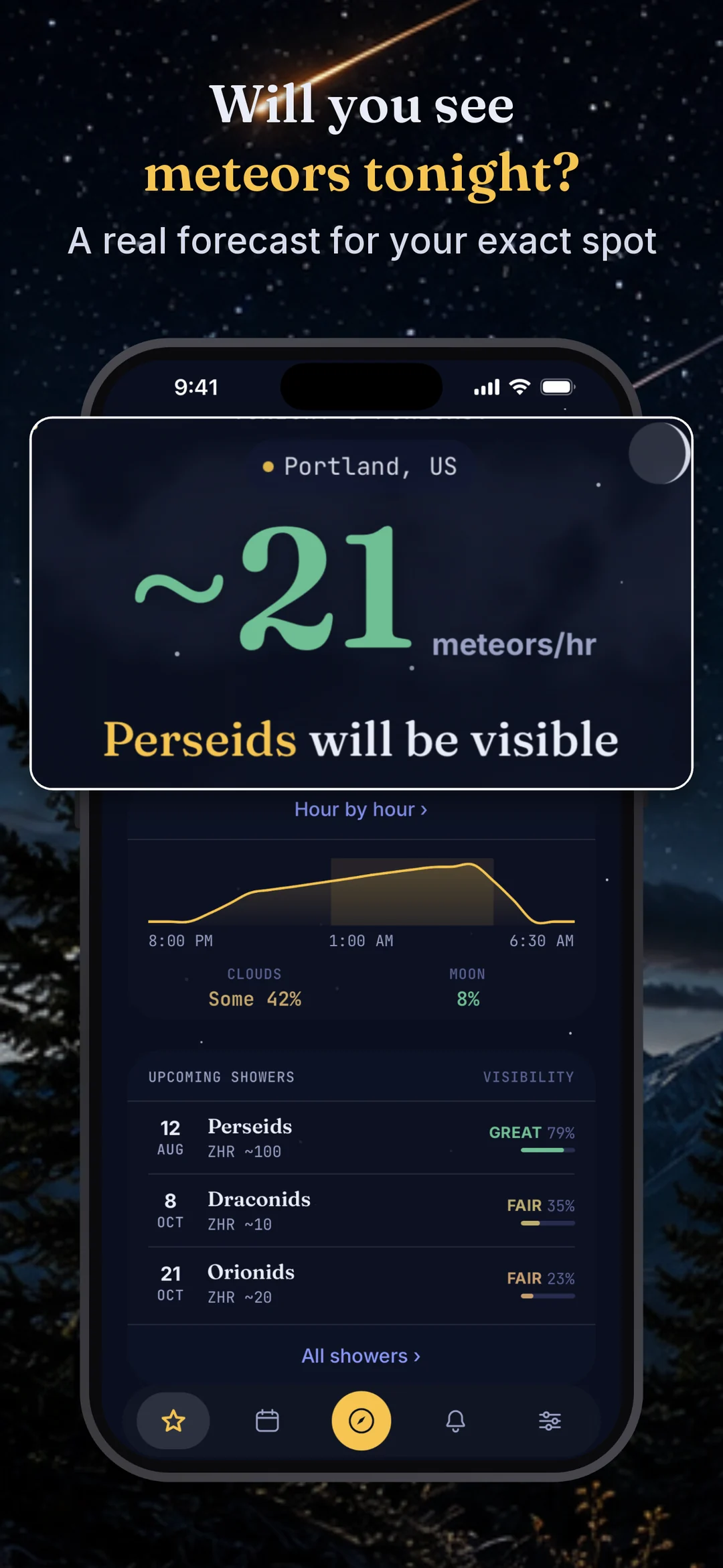
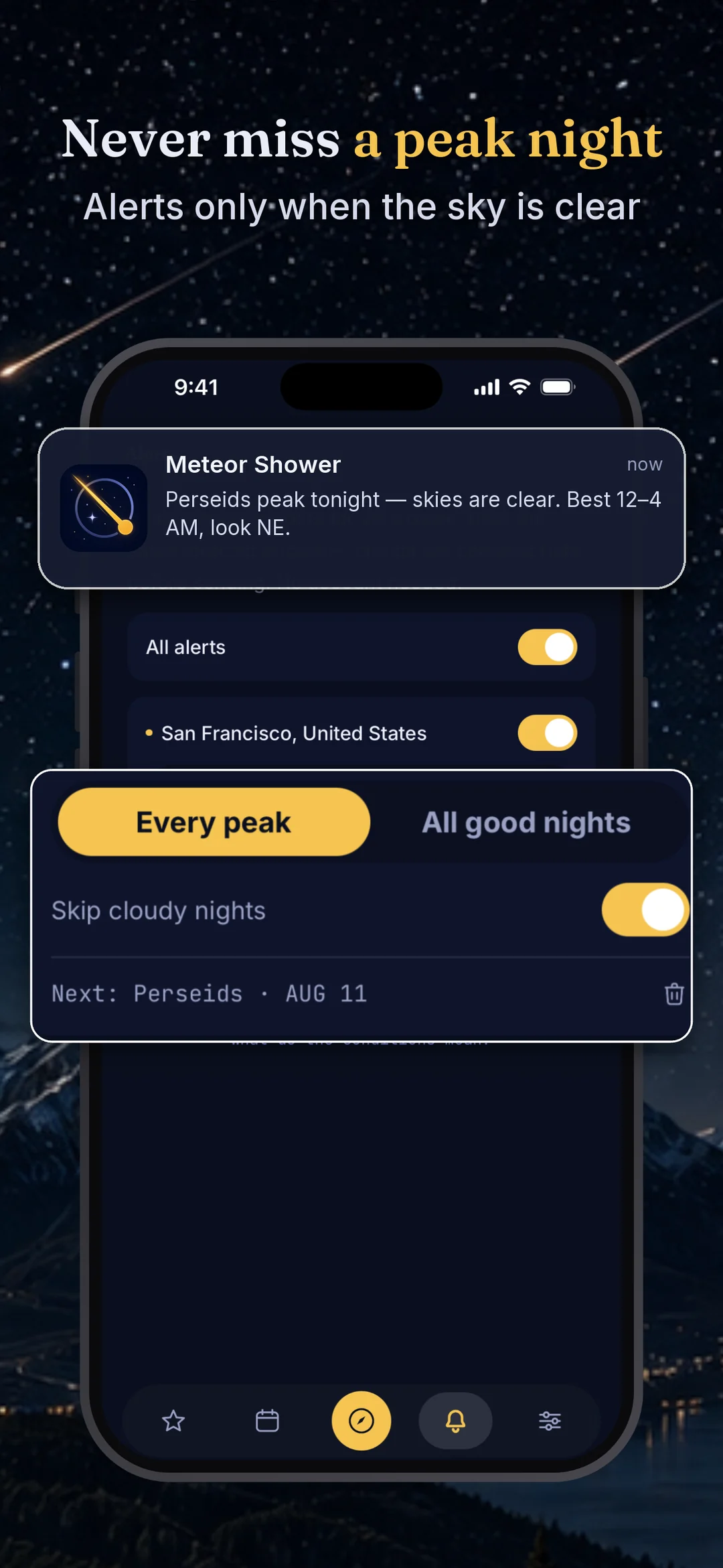
An alert in the evening for your exact location, and a second one when it's time to look up. Every alert checks the clouds first, so you know whether to bother.
- Tonight's forecast for your spot, hour by hour
- Peak-night alerts with a cloud check, free
- More places, widgets and an AR sky scanner with Premium