Guide · 6 min read
The best time to see meteor showers
The same shower, seen from the same field, can give a few meteors an hour at 10 p.m. and three times as many before dawn. Meteor timing is predictable to the hour, and it matters more than any equipment.
By Ilsur Gabdulkhakov · updated
Contents · 6 sections Show
Why the hours before dawn win
Two separate effects push the best viewing toward the end of the night.
The first is Earth’s motion. Earth moves along its orbit at about 30 km/s, and after local midnight your side of the planet faces forward, into the direction of travel. That side sweeps up meteoroids head-on, the way a car’s windshield collects more rain than its rear window. In the evening you ride on the trailing side, where only particles that catch up with Earth can reach you. The effect shows most clearly in the random, sporadic meteors: the observing guide of the Association of Lunar and Planetary Observers (ALPO) puts the midnight rate at perhaps a quarter of the rate in the last dark hour before dawn. It also explains why the fastest showers, the Leonids (71 km/s) and the Orionids and Eta Aquariids (66 km/s each), have radiants that climb high only in the morning sky: their meteoroids come at Earth from nearly the direction it is heading.
The second effect is the radiant’s altitude. A given shower’s meteors arrive at the same speed whatever the hour; what changes is how high the radiant stands, and the visible rate scales with the sine of that altitude. A radiant 15 degrees up yields about a quarter of the rate it would give overhead; at 60 degrees it yields almost nine-tenths. From 40° north, the Perseid radiant sits about 16 degrees up at 10 p.m. daylight time and near 58 degrees by 4 a.m., roughly three times the rate on the same night from the same spot.
The practical rule: for most showers, the last two or three hours before morning twilight are the best of the night. Meteor observers stop when nautical twilight begins, with the Sun 12 degrees below the horizon, because the brightening sky erases faint meteors from then on.
The showers that break the rule
- Geminids. From mid-northern latitudes the Geminid radiant is about 30 degrees up by 9 p.m. and nearly overhead around 2 a.m., so the evening is already productive. That is why NASA singles them out for young viewers.
- Draconids. As the International Meteor Organization (IMO) notes, the Draconid radiant in Draco stands highest in the evening. After midnight it sinks toward the northern horizon, so this is an evening shower.
- Eta Aquariids. The opposite case. The radiant culminates around 8 a.m. local time, so the IMO notes the meteors are visible only in the hours shortly before dawn.
- Earthgrazers. When a radiant sits just above the horizon, usually in the evening, the few meteors that appear skim the upper atmosphere almost horizontally. They are rare, but long and slow, and late evening is the time to look for them.
Which night: the shape of the peak
Every shower has an active period of days to weeks, but the rate inside that period follows one of a few shapes.
- Sharp. The Quadrantids deliver most of their meteors in a window about six hours wide around the peak, according to the ALPO, and the IMO quotes about four hours at half strength or more. If the peak falls in your daytime, you get the tail, and the nights either side give little.
- Broad. The Perseids build from a few meteors an hour in July to their August maximum, and the ALPO notes the night after maximum still gives good rates before activity falls off steeply.
- Lopsided. The Geminids climb toward their peak more slowly than they decline after it. Rates are strong on both of the two nights around maximum, and if the peak lands in your daytime, the night before is usually the better bet.
- Flat. The Taurids have no sharp peak at all, giving a few meteors an hour across several weeks. Any clear, moonless night in their range is as good as another.
Peak times are published in Universal Time, they move by a few hours from one year to the next, and the calendar date of a peak can shift by a day. The calendar gives each year’s peak in your local time. When a peak lands in your local afternoon, compare the night before and the night after using the shapes above.
The moon: phase and timing
Moonlight brightens the sky the way light pollution does, and the faint meteors go first. A bright moon can hide more than half the meteors you would otherwise see, and the darker your site, the more it costs you, because there is more faint sky for it to wash out. What matters is not only how full the moon is but when it is up:
| Moon phase | Up in the night sky | Cost to a pre-dawn shower |
|---|---|---|
| New | not at all | none |
| Waxing crescent | early evening | none; sets before the good hours |
| First quarter | sunset to about midnight | small; sets as the best hours begin |
| Waxing gibbous | sunset to between midnight and dawn | moderate to large; the fuller it is, the later it sets |
| Full | all night | large |
| Waning gibbous | late evening to morning | large |
| Last quarter | about midnight to morning | large; rises into the best hours |
| Waning crescent | the hours before dawn | moderate; low, but in the pre-dawn sky |
So two peaks with the same illumination can play out very differently. A half-lit moon at first quarter is nearly harmless for a morning shower; the same half-lit moon at last quarter sits in the sky through the best hours. For evening showers such as the Draconids, the pattern reverses.
A bright-moon peak is not always a write-off. Showers rich in bright meteors hold up better: the ALPO guide reports counts of up to 25 Geminids an hour with a full moon in the sky. If the moon is up, find a spot where a building, tree line or hill blocks it while leaving a wide stretch of sky open.
Season and latitude
Night length. December gives the Northern Hemisphere long nights, so the Geminids, Ursids and Quadrantids can be watched for many hours of full darkness. June nights are short, and in summer the dark window shrinks fast as you go north.
Twilight at high latitudes. Full astronomical darkness needs the Sun at least 18 degrees below the horizon. Around the June solstice, places north of about 48.5° never get there; by mid-August the line has moved only to about 57°. That is why the IMO says the Perseids cannot be properly viewed from north of about 60°N, even though their radiant is high there.
Who sees which radiant. A radiant’s greatest altitude is 90 degrees minus the difference between your latitude and its declination. The Perseid radiant, at +58°, climbs to about 72 degrees from 40°N but never rises at all south of about 32°S. The Southern Delta Aquariid radiant, at −16°, reaches about 71 degrees from 35°S but only 34 from 40°N. The radiant needs to be about 30 degrees up before rates are worth the effort, which is the ALPO’s own threshold for starting a count.
The sporadic background. Random meteors follow their own yearly cycle. In the Northern Hemisphere they peak from July through December and are lowest in spring; in the Southern Hemisphere the pattern is reversed. The ALPO puts dark-site pre-dawn sporadic rates at about 15 an hour in the rich season and as few as 5 near the low point.
Choosing your night
- Shortlist by the moon. Start with the calendar and keep the peaks where the moon is down, or a thin crescent, during the hours that matter for that shower.
- Check the radiant. Work out how high it climbs from your latitude, or read it off the shower page. Below about 30 degrees, rates drop off steeply.
- Match the peak to your night. For sharp peaks there is only one night. For broad peaks, any of two or three nights will do, which also gives you a backup if it’s cloudy. For lopsided peaks, favor the side the shower favors.
- Watch the weather on the day. Check the cloud forecast in the afternoon and again at dusk; forecasts firm up quickly.
Once you have the night, how to watch a meteor shower covers what to do when you get there.
Questions
What time of night is best to see a meteor shower?
For most showers, the last two or three hours before morning twilight. Your side of Earth then faces into its orbital motion, and most radiants stand highest. The Geminids and Draconids are the main exceptions, with good evening hours.
Can you see a meteor shower in the evening?
Yes, but for most showers the evening rate is a fraction of the pre-dawn rate because the radiant is still low. The Geminids are productive from mid-evening, and the Draconids are best in the evening. Low radiants also produce earthgrazers, rare meteors that skim the atmosphere in long, slow paths.
Is the night before or the night after the peak better?
It depends on the shower's profile. The Quadrantids are worth watching only on the peak night itself. The Perseids still give good rates the night after maximum. The Geminids rise to their peak more slowly than they fall, so the night before usually holds up better.
Does a full moon ruin a meteor shower?
It costs a lot, often more than half the meteors you would otherwise see, but it rarely leaves nothing. Showers rich in bright meteors, like the Geminids, still deliver; keep the moon behind you or blocked by a building or hill.
Sources: IMO, ALPO Meteors Section, EarthSky, NASA and more · reviewed October 13, 2026Show
- IMO — 2027 Meteor Shower Calendar (PDF)
- ALPO Meteors Section — Observing Guide (PDF)
- EarthSky — Meteors in moonlight: tips for watching
- EarthSky — How to shoot photos of meteors
- NASA — Geminids
Dates, rates and moon figures are recomputed on every build — see the methodology.
Free app · iPhone & Android
Get told when to look up
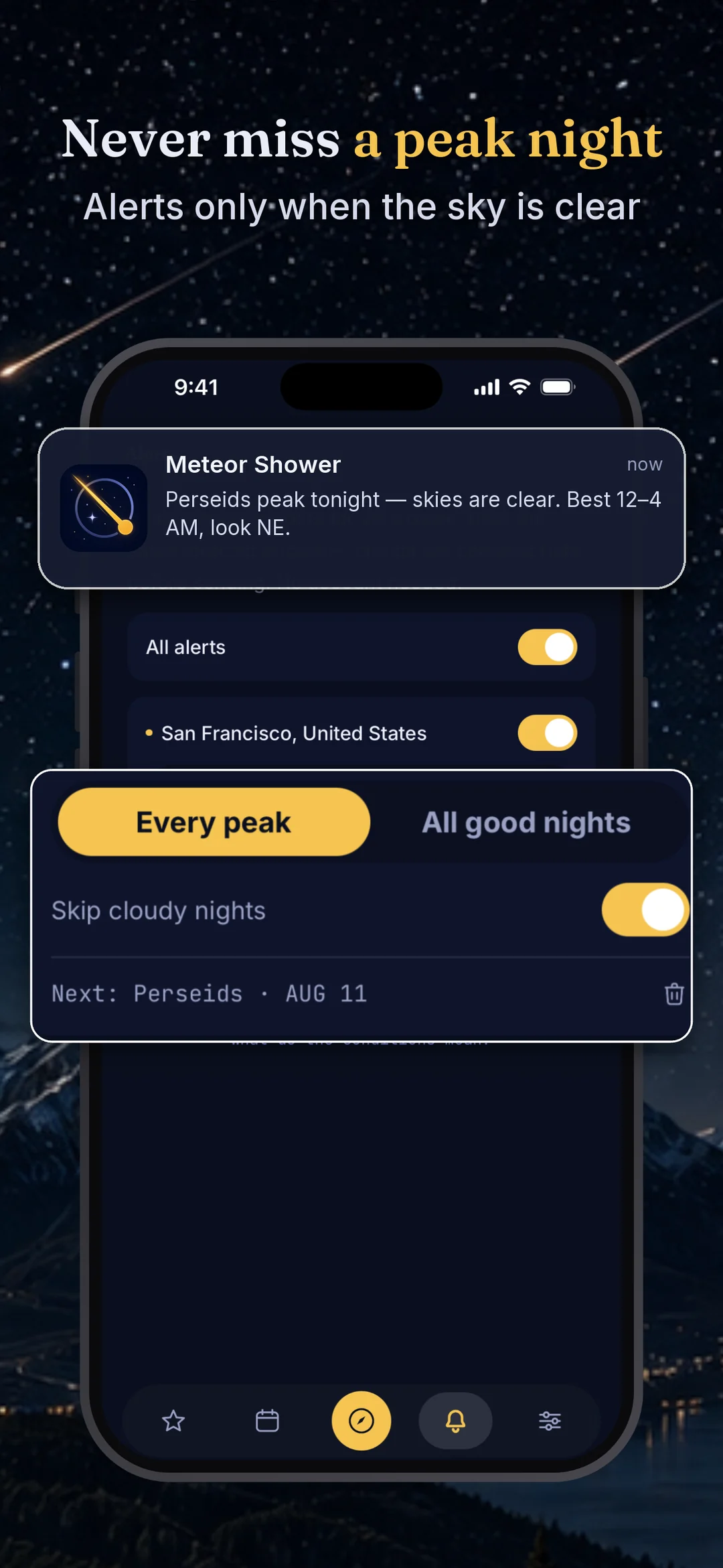
An alert in the evening for your exact location, and a second one when it's time to look up. Every alert checks the clouds first, so you know whether to bother.
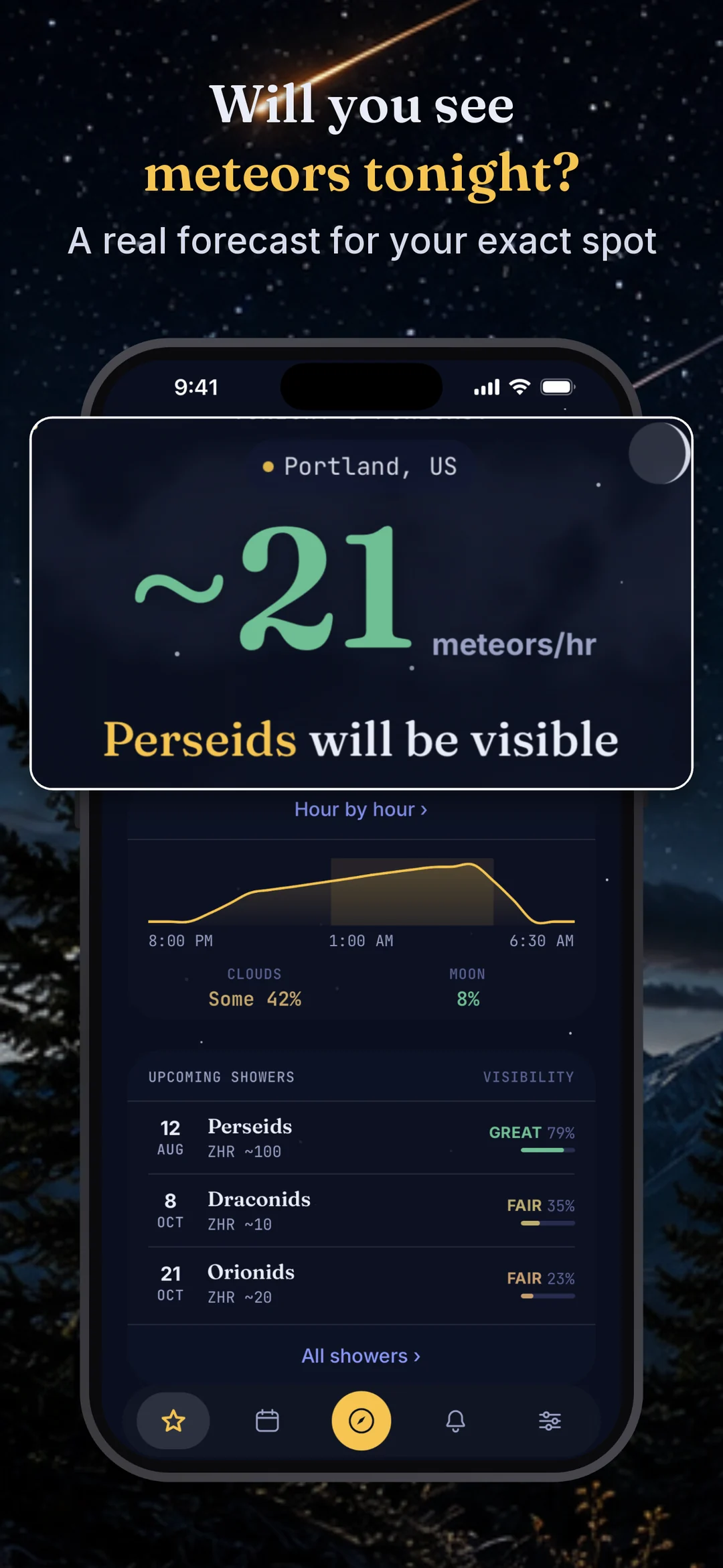
- Tonight's forecast for your spot, hour by hour
- Peak-night alerts with a cloud check, free
- More places, widgets and an AR sky scanner with Premium