Active Apr 19 – May 28, 2027
Eta Aquariid meteor shower 2027
The Eta Aquariids peak on the night of May 5–6, 2027. From a dark site at 34° S you can count 17–40 meteors an hour around 5 AM, with no Moon in the way.
Comet Halley's dust meets Earth twice a year, and this is the stronger encounter. Eta Aquariids are among the fastest meteors of the year and often leave glowing trains, but they belong to the last dark hours before dawn and to observers south of about 40°N.
- Peak night
- max
- You'll count
- 17–40/hr
- dark site · 7–16 from suburbs
- Best time
- 5 AM
- radiant 43° up, NE
- Moon
- Excellent
- new Moon
For 34° S (Sydney, Cape Town, Buenos Aires), local time. Other latitudes are in the table below; tonight's sky for your own place is on the home page. Updated .
Fast meteors with trains, in the last dark hours
Eta Aquariids hit the atmosphere at about 66 km/s, among the fastest of any annual shower. The stream is rich in small particles, so most meteors are modest in brightness and fireballs are scarce. Their speed makes up for it. Roughly a third leave a persistent train, a glowing streak that lingers for a second or more after the meteor itself has gone.
The shower has no single best night. Activity builds slowly from late April and stays strong for about a week, with ZHRs above 30 from about May 3 to 10. Radar records show the main peak near May 6 and, in some years, secondary bumps a few days later. The mornings either side of the peak are nearly as good as the peak itself.
The International Meteor Organization’s working ZHR is 50, but the shower varies. Resonant meteoroids lifted it to about 85 in 2008, and recent returns have peaked lower, near 40 to 45. Actual counts depend heavily on latitude. Observers in Australia and New Zealand typically report 30 to 40 an hour at a good return, and mid-northern observers about 10. From northern sites, the first meteors after the radiant rises are often earthgrazers: long streaks that skim upward from the eastern horizon.
Early May is autumn in the south, with long, cool nights. In the north, the late-spring nights are already shrinking.
Comet Halley’s closer crossing
The parent is 1P/Halley, which orbits the Sun about every 76 years and last passed through the inner solar system in 1986. Earth meets its debris twice a year, in May for this shower and in October for the Orionids. Today Earth passes about 0.065 AU, roughly 10 million km, from Halley’s orbit during the Eta Aquariids. In October the gap is about 0.15 AU. The May shower is usually two to three times stronger.
The meteoroids don’t simply follow the comet’s present path. A long-standing model of Halley’s streams holds that dust released centuries or millennia ago drifts at different rates under planetary tugs. The debris spreads into a broad ribbon, partly along orbits the comet itself occupied long ago. Several such ribbons stacked together may explain the shower’s long duration and its multiple peaks. Consistent with that picture, the comet’s 1985–86 return brought no extra meteors: what Earth meets now is old dust.
The geometry also shifts over time. The comet’s orbit crossed closest to Earth’s orbit at this point around AD 500, which may explain the strong displays found in ancient Chinese records. Jupiter shapes the stream in a finer way too. Its gravity herds some meteoroids into resonant clumps, and those clumps account for unusually strong years.
Why the tropics and the south get the better show
The radiant lies about a degree from the star Eta Aquarii, in the Water Jar. This small Y of four stars (Gamma, Zeta, Eta and Pi Aquarii) sits just east of Sadalmelik in northern Aquarius. It is faint and needs a dark sky to pick out.
Because the radiant sits almost on the celestial equator, it rises due east at nearly the same local time everywhere, around 1:30 to 1:45 a.m. local time (an hour later on daylight time). It culminates near 8 a.m., in full daylight. What differs from place to place is when dawn arrives. On the peak morning, astronomical twilight begins around 3 a.m. at 40°N, when the radiant is still under 20° high. At 30°S the sky stays dark until after 5 a.m., and by then the radiant is about 45° up.
The result is close to three hours of dark sky with the radiant more than 10° high from the tropics and southern mid-latitudes, against less than one hour at 40°N. At 50°N there is essentially none, which is why the shower is close to a write-off from the UK, Canada and northern Europe. Northern observers can still catch it: start as soon as the radiant clears the eastern horizon and keep going until twilight.
The late-April and May sky has a few other sources. Until the end of April, the last Lyrids come from high overhead near Vega and are slower. The weak eta Lyrids, around May 10, come from northern Lyra. Slow antihelion meteors trace back to Scorpius and Ophiuchus. A swift meteor that traces back to the low east, especially one that leaves a train, is very likely an Eta Aquariid. For general technique, see how to watch a meteor shower.
From Herschel’s prediction to Maya inscriptions
Chinese chronicles have been matched to strong displays in 74 BCE and repeatedly between AD 401 and 934. A 2017 study that modeled past outbursts found matches with dates in Classic Maya inscriptions, suggesting the Maya noticed them too.
The modern radiant was first plotted in 1870 by G. L. Tupman, a British officer recording meteors at sea in the Mediterranean. In 1876 Alexander Stewart Herschel calculated that Halley’s orbit should produce a radiant in Aquarius in early May, close to where Tupman had plotted his. That made the Eta Aquariids the first shower tied to Halley. The link was firmly established by Charles Olivier around 1910. In 1947 the shower was among the first streams detected by radar, at Jodrell Bank in England.
A 2013 outburst, forecast in advance by dust-trail modeling, reached about 135 meteors an hour. A popular idea that peak rates rise and fall on Jupiter’s 12-year cycle has not been confirmed by long-term analyses of visual and radar data.
Visibility by latitude
How high the Aquarius radiant climbs during darkness on the 2027 peak night, and what an observer can realistically count at that hour. Times are local solar time.
| Latitude | HeightRadiant height | Best hour | Dark site | Suburbs |
|---|---|---|---|---|
| 60° NAnchorage, Oslo, Helsinki | — twilight only | not visible | — | |
| 51° NLondon, Calgary, Prague | 1° | not visible | — | |
| 40° NNew York, Madrid, Beijing | 17° | 7–17 | 3–7 | |
| 30° NHouston, Cairo, Shanghai | 26° | 11–25 | 4–10 | |
| 19° NMexico City, Mumbai, Honolulu | 35° | 14–35 | 6–13 | |
| 0°Quito, Nairobi, Singapore | 45° | 18–40 | 7–16 | |
| 23° SSão Paulo, Alice Springs | 47° | 18–40 | 7–17 | |
| 34° SSydney, Cape Town, Buenos Aires | 43° | 17–40 | 7–16 | |
| 45° SDunedin, Queenstown | 36° | 15–35 | 6–14 |
Rates are meteors per hour on the peak night at the radiant's best hour, including this year's moonlight, as a range because real counts scatter. "Not visible" means the radiant never clears 10° in darkness. How this is computed.
Activity, night by night
The next three peaks
The Moon is new (0% lit), so the sky is as dark as your site allows.
| Year | Maximum (UTC) | Moon | At 34° S |
|---|---|---|---|
| 2027 | May 6, 15:11 UTC | 0% new | Excellent |
| 2028 | May 5, 21:22 UTC | 89% waxing gibbous | Fair |
| 2029 | May 6, 03:38 UTC | 43% last quarter | Fair |
Shower facts
- Peak rate (ZHR)
- 50 /hr what's this?
- Active
- Apr 19 – May 28
- Speed
- 66 km/s · very fast
- Radiant
- Aquarius · 22h 32m −1°
- Parent body
- 1P/Halley · comet
- Best from
- Both, best from the south
Eta Aquariids: questions
When is the Eta Aquariid meteor shower in 2027?
Maximum is May 6, 15:11 UTC, which makes the night of May 5–6 the one to watch in North America (the dates at the top of this page switch to your own time zone). The shower is active from Apr 19 to May 28.
Is the night before or after the Eta Aquariid peak worth it?
The night before the peak runs at about 80% of peak strength and the night after at about 84%. If the peak night is cloudy, either is worth a try.
Will the Moon interfere with the Eta Aquariids in 2027?
The Moon is new (0% lit), so the sky is as dark as your site allows.
Why are the Eta Aquariids better from the Southern Hemisphere?
The radiant sits on the celestial equator, so it rises at about the same local time everywhere, around 1:30 a.m. The difference is dawn: in early May the sky stays dark two hours longer at 30°S than at 40°N, so the radiant gets much higher before twilight.
What time should I look for Eta Aquariid meteors?
From the time the radiant rises, around 1:30 a.m. local time, until morning twilight begins. At 40°N that leaves about an hour and a half, much of it with the radiant very low; in the tropics and the Southern Hemisphere the window runs to about three and a half hours.
Are the Eta Aquariids really from Halley's Comet?
Yes. They are dust shed by 1P/Halley on returns over many centuries. The same comet produces the Orionids in October, when Earth crosses a different part of its debris.
How many Eta Aquariids will I see per hour?
From the tropics and southern mid-latitudes, a good return gives roughly 30 to 40 an hour before dawn. From mid-northern latitudes, expect about 10, many of them long meteors skimming up from the eastern horizon.
Can I see the Eta Aquariids from the UK or Canada?
Only a handful. At 50°N morning twilight begins before the radiant is more than a few degrees up, and even at 45°N it is only about 10 degrees high, so the shower is mostly lost in the brightening sky.
Sources: IMO, Egal et al., NASA Science, Gary Kronk and more · reviewed October 13, 2026Show
- IMO — 2027 Meteor Shower Calendar (eta Aquariids)
- Egal et al. (2020), Activity of the Eta-Aquariid and Orionid meteor showers, A&A 640, A58
- NASA Science — Eta Aquarids
- Gary Kronk, Meteor Showers Online — Eta Aquarids
- EarthSky — Find the radiant for the Eta Aquariids
Dates, rates and moon figures are recomputed on every build — see the methodology.
Free app · iPhone & Android
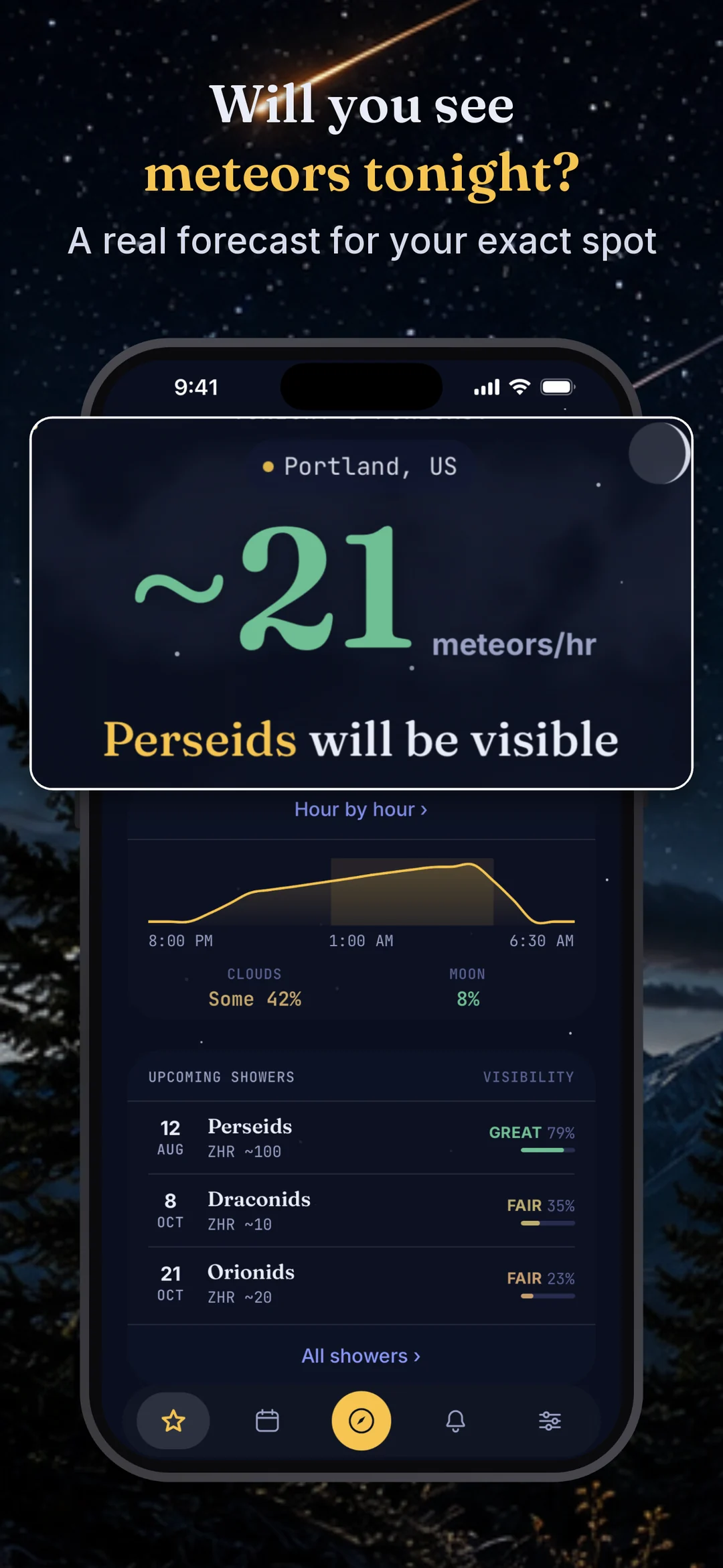
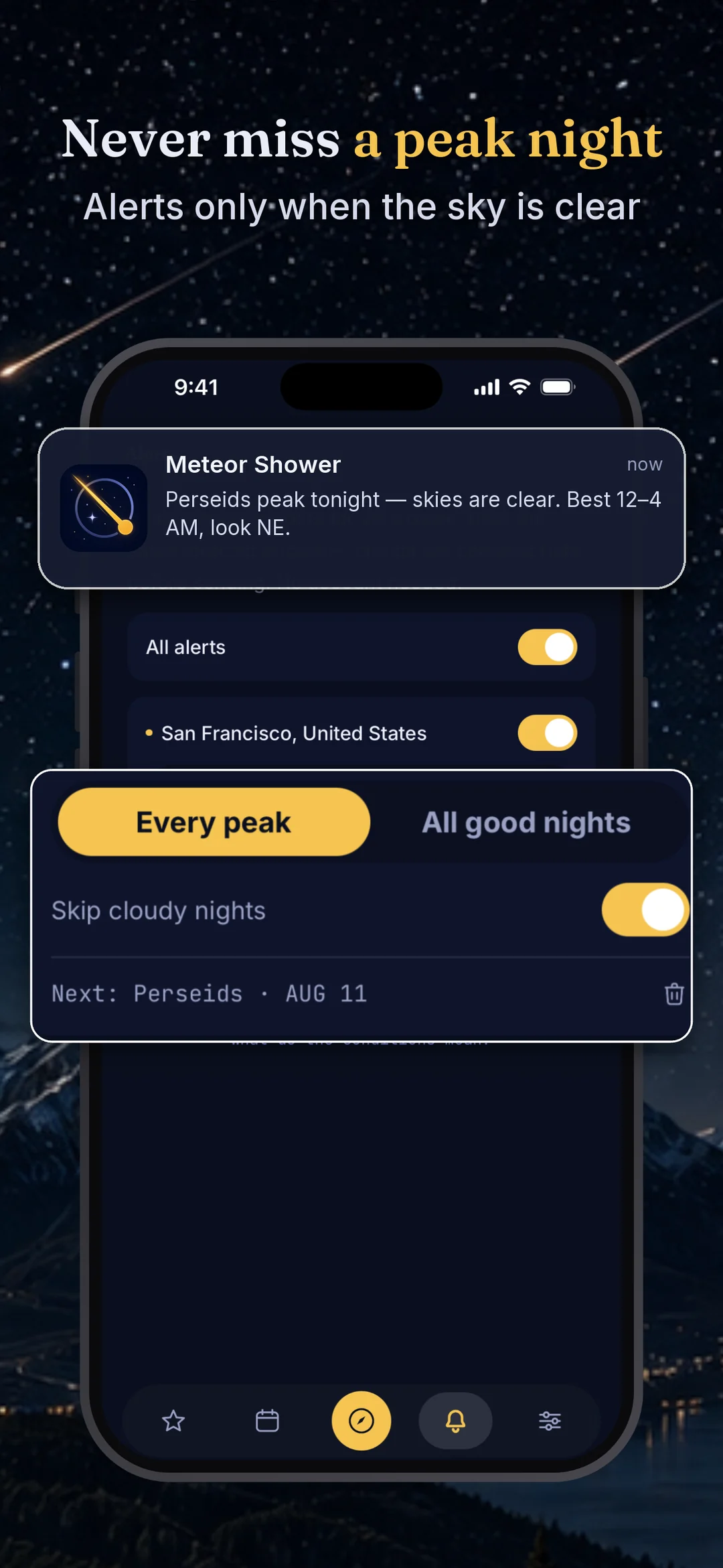
Get told when the Eta Aquariids are worth it
An alert in the evening for your exact location, and a second one when it's time to look up. Every alert checks the clouds first, so you know whether to bother.
- Tonight's forecast for your spot, hour by hour
- Peak-night alerts with a cloud check, free
- More places, widgets and an AR sky scanner with Premium