Active Jul 17 – Aug 24, 2027
Perseid meteor shower 2027
The Perseids peak on the night of August 12–13, 2027. From a dark site at 40° N you can count 50–110 meteors an hour around 3 AM, and the 87% Moon is down by then.
The Perseids are the Northern Hemisphere's summer shower: fast, often bright meteors from Comet Swift–Tuttle, with rates that keep climbing all night as Perseus rises toward dawn.
- Peak night
- max
- You'll count
- 50–110/hr
- dark site · 19–45 from suburbs
- Best time
- 3 AM
- radiant 61° up, NE
- Moon
- Excellent
- 87% lit, down in the best hours
For 40° N (New York, Madrid, Beijing), local time. Other latitudes are in the table below; tonight's sky for your own place is on the home page. Updated .
Fast streaks, frequent fireballs
Perseids hit the atmosphere at 59 km/s, so most are quick streaks, gone in well under a second. The brighter ones often leave a glowing wake that hangs in the sky for a moment after the meteor itself has vanished.
Fireballs are the shower’s signature. Over the first years of NASA’s all-sky fireball camera network, which began tracking in 2008, the Perseids produced more fireballs than any other annual shower. The runner-up Geminids were slightly fainter at their brightest: magnitude −2.0 on average, against −2.7 for a Perseid.
A ZHR of about 110 is what you would count with the radiant overhead under a perfect sky (see what ZHR means). NASA’s deliberately cautious planning figure for a dark rural site in the United States is about 40 Perseids in the hour before dawn on the peak nights. The latitude table below gives the range an attentive observer can count this year, from a dark site and from the suburbs.
The season is long and lopsided. The first Perseids appear around July 17, rates creep upward through late July and early August, and the shower is over by about August 24: four weeks of build-up against less than two weeks of decline. The timing of the broad maximum varies by about half a day from year to year, so the nights either side of the nominal peak are usually close behind.
These are northern-summer nights, warm but short. At 50°N the sky is fully dark for only about five hours in mid-August, and north of about 60°N it never gets fully dark at all.
Comet Swift–Tuttle and its 26-kilometer nucleus
The parent is 109P/Swift–Tuttle, found independently by Lewis Swift and Horace Tuttle in July 1862. Its nucleus is about 26 km across, while most comets measure only a few kilometers, and NASA credits that size for the many fireball-sized grains in the stream.
Swift–Tuttle takes about 133 years to orbit the Sun, on a path tilted about 113° to Earth’s: it circles the Sun opposite to the planets, so its debris meets Earth nearly head-on at 59 km/s. The comet last passed perihelion in December 1992 and is next due back in the 2120s.
Each of Swift–Tuttle’s passages leaves a fresh trail of dust along its orbit. What Earth crosses every August is mostly an old, broad stream built up over many returns, and the IMO notes that trails more than 20 orbits old are still part of it. Narrow trails from single returns sometimes lie in Earth’s path too, and Jupiter’s gravity slowly shifts parts of the stream toward or away from Earth’s orbit; both make rates differ from year to year.
Following Perseus up the northeastern sky
On peak night the radiant sits in northern Perseus, east of the W of Cassiopeia and about 8° north of Mirfak, the constellation’s brightest star. It drifts roughly a degree east each night, so in late July a Perseid traces back to a point some 25° farther west, toward Cassiopeia.
From 40°N the radiant never sets. It stands about 15° up at 9 p.m. local standard time, 35° at midnight and 65° by 4 a.m.; add an hour for daylight saving time. The visible rate scales roughly with the sine of the radiant’s altitude, so that climb alone more than triples what you see.
The radiant lies only about 40° from the apex, the point Earth is moving toward in its orbit, which rises around midnight and stands highest at dawn; that closeness is also why Perseids arrive so fast. In the evening, while the radiant is low, watch for earthgrazers: Perseids that skim the upper atmosphere on long, unhurried paths up from the northeast.
Mid-northern latitudes are best placed. From the equator the radiant reaches about 30° before dawn. From 20°S it rises around 2 a.m. and gets to only about 10°. From roughly 32°S southward it never clears the horizon, although a stray Perseid can still shoot up from below the northern horizon. Southern observers do better with the Southern Delta Aquariids in the same weeks.
Three other showers overlap the Perseids. The Southern Delta Aquariids and the slow Alpha Capricornids come from radiants low in the south, and the slow Kappa Cygnids peak in mid-August from high in the northwest. A Perseid traces back toward the northeast and is faster than any of them. For general setup, see how to watch a meteor shower.
From the Tears of St. Lawrence to Schiaparelli
Chinese records mention the shower in AD 36. In Europe it became tied to August 10, the feast of St. Lawrence, a deacon martyred in Rome in AD 258. In 1839 the American astronomer Edward Herrick wrote of a belief, held “for ages” in parts of England and Germany, that “the burning tears of St. Lawrence” appear in the sky on that night.
Several astronomers are credited with independently recognizing the August meteors as an annual shower in the 1830s. Within a few years of the comet’s 1862 appearance, the Italian astronomer Giovanni Schiaparelli showed that the Perseid stream travels in Swift–Tuttle’s orbit. It was the first direct link found between a meteor shower and a particular comet.
The comet was expected back around 1982 but did not appear on schedule. Tsuruhiko Kiuchi recovered it in September 1992, and the shower responded. For several years observers recorded a new, sharp maximum alongside the traditional broad peak, and the IMO describes strong activity from it through the 1990s. Earth crossed several separate dust trails for an enhanced return in 2016, and in 2018, 2020 and 2021 observers reported high activity a day or so after the main peak.
Visibility by latitude
How high the Perseus radiant climbs during darkness on the 2027 peak night, and what an observer can realistically count at that hour. Times are local solar time.
| Latitude | HeightRadiant height | Best hour | Dark site | Suburbs |
|---|---|---|---|---|
| 60° NAnchorage, Oslo, Helsinki | 60° twilight only | 50–110 | 19–45 | |
| 51° NLondon, Calgary, Prague | 59° | 45–110 | 19–45 | |
| 40° NNew York, Madrid, Beijing | 61° | 50–110 | 19–45 | |
| 30° NHouston, Cairo, Shanghai | 56° | 45–105 | 18–40 | |
| 19° NMexico City, Mumbai, Honolulu | 48° | 40–95 | 16–40 | |
| 0°Quito, Nairobi, Singapore | 31° | 30–65 | 11–25 | |
| 23° SSão Paulo, Alice Springs | 9° | not visible | — | |
| 34° SSydney, Cape Town, Buenos Aires | — | not visible | — | |
| 45° SDunedin, Queenstown | — | not visible | — |
Rates are meteors per hour on the peak night at the radiant's best hour, including this year's moonlight, as a range because real counts scatter. "Not visible" means the radiant never clears 10° in darkness. How this is computed.
Activity, night by night
The next three peaks
The waxing gibbous Moon (87% lit) is below the horizon during the best hours — moonlight is not a factor.
| Year | Maximum (UTC) | Moon | At 40° N |
|---|---|---|---|
| 2027 | Aug 13, 08:10 UTC | 87% waxing gibbous | Excellent |
| 2028 | Aug 12, 14:29 UTC | 59% last quarter | Fair |
| 2029 | Aug 12, 20:36 UTC | 10% waxing crescent | Excellent |
Shower facts
- Peak rate (ZHR)
- 110 /hr what's this?
- Active
- Jul 17 – Aug 24
- Speed
- 59 km/s · fast
- Radiant
- Perseus · 3h 13m +58°
- Parent body
- 109P/Swift–Tuttle · comet
- Best from
- Northern Hemisphere
Perseids: questions
When is the Perseid meteor shower in 2027?
Maximum is Aug 13, 08:10 UTC, which makes the night of August 12–13 the one to watch in North America (the dates at the top of this page switch to your own time zone). The shower is active from Jul 17 to Aug 24.
Is the night before or after the Perseid peak worth it?
The night before the peak runs at about 86% of peak strength and the night after at about 72%. The run-up is the better spare night. If the peak night is cloudy, either is worth a try.
Will the Moon interfere with the Perseids in 2027?
The waxing gibbous Moon (87% lit) is below the horizon during the best hours — moonlight is not a factor.
What time is best to watch the Perseids?
The last two or three hours before dawn on the peak night. From mid-northern latitudes the radiant is low in the northeast at nightfall and passes 60° by morning twilight, so rates keep rising until the sky starts to brighten.
How many Perseids will I actually see per hour?
Fewer than the ZHR of about 110, which assumes a perfect sky with the radiant overhead. NASA's cautious planning figure for a dark rural site is about 40 an hour before dawn; an experienced observer under an excellent, moonless sky counts more, and a suburb gives roughly a third of a dark site. The latitude table on this page has this year's range.
Can you see the Perseids from the Southern Hemisphere?
Only from the tropics, and only before dawn. The radiant reaches about 30° from the equator and about 10° from 20°S. From roughly 32°S southward, including Sydney, Cape Town and Buenos Aires, it never rises.
Why are the Perseids called the Tears of St. Lawrence?
The shower is active around August 10, the feast of St. Lawrence, a deacon martyred in Rome in AD 258. A European folk belief, already old when an astronomer recorded it in 1839, held that his burning tears appear in the sky that night.
Do the Perseids really produce more fireballs than other showers?
In NASA's fireball camera records, yes: over the network's first years, starting in 2008, the Perseids produced more fireballs than any other annual shower, with the Geminids a close but slightly fainter second. NASA credits Swift–Tuttle's unusually large nucleus, about 26 km across.
Sources: IMO, NASA, NASA Watch the Skies, National Geographic and more · reviewed October 13, 2026Show
- IMO — 2027 Meteor Shower Calendar
- NASA — Perseid Fireballs
- NASA — Comet 109P/Swift–Tuttle
- NASA Watch the Skies — Best Meteor Shower of the Year Peaks This Weekend
- National Geographic — The Perseids and the Tears of St. Lawrence
Dates, rates and moon figures are recomputed on every build — see the methodology.
Free app · iPhone & Android
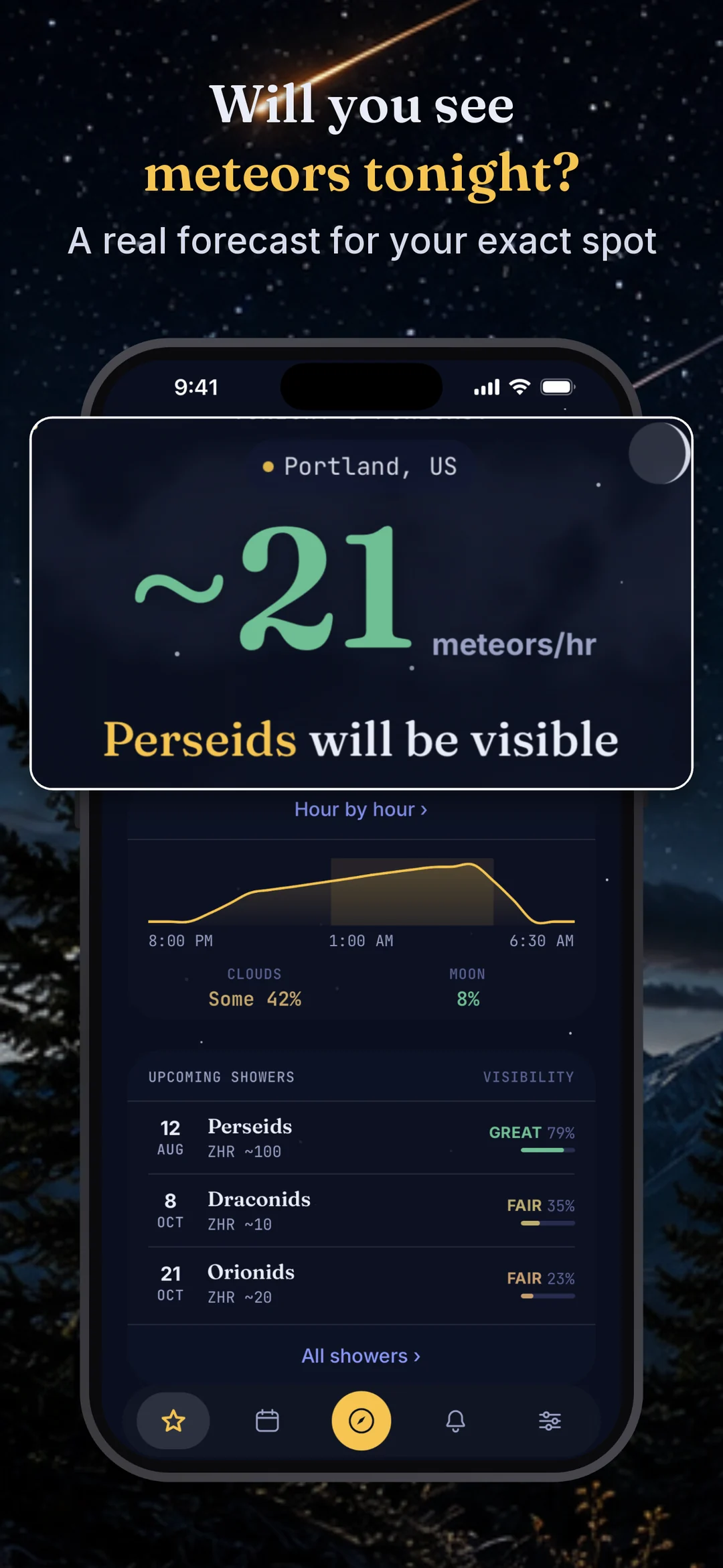
Get told when the Perseids are worth it
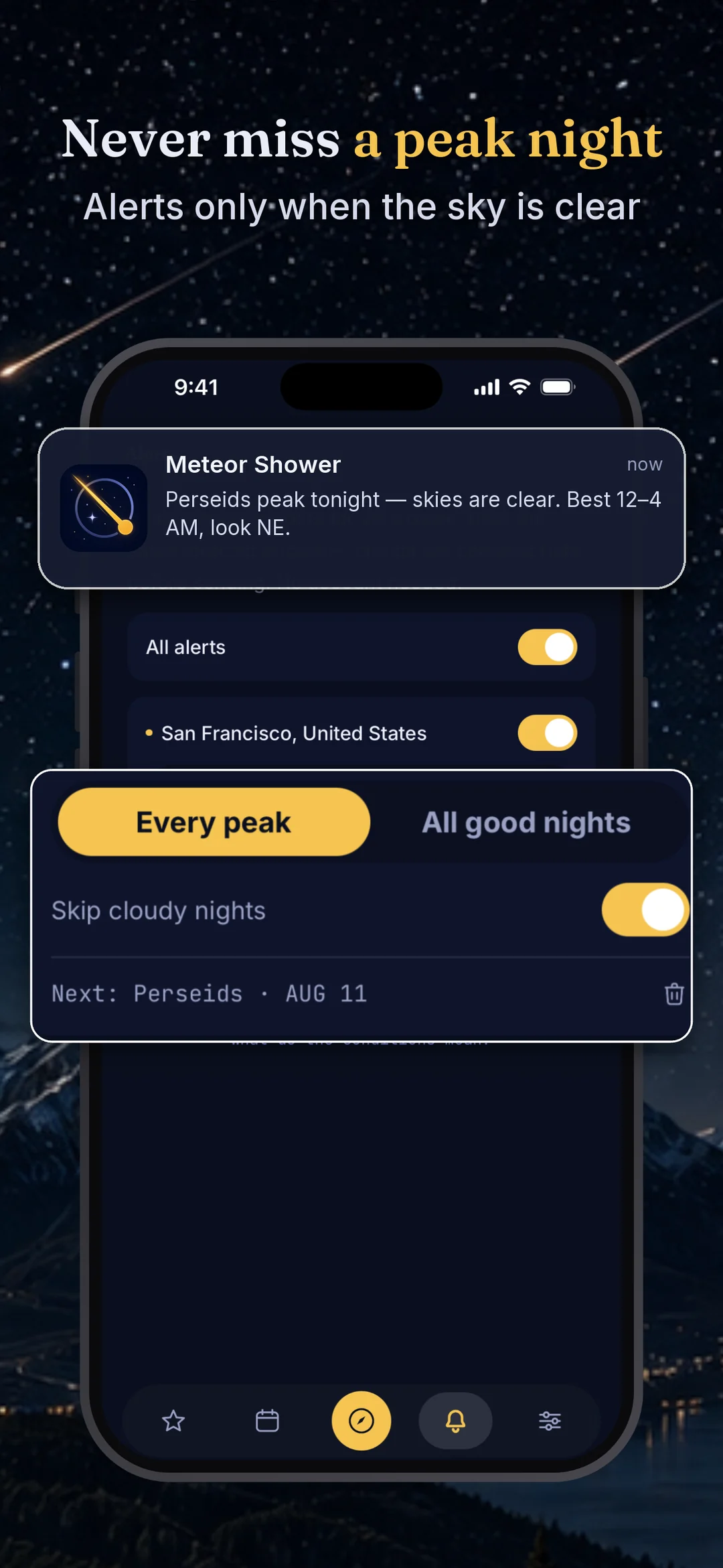
An alert in the evening for your exact location, and a second one when it's time to look up. Every alert checks the clouds first, so you know whether to bother.
- Tonight's forecast for your spot, hour by hour
- Peak-night alerts with a cloud check, free
- More places, widgets and an AR sky scanner with Premium