Active Dec 28 – Jan 12, 2027
Quadrantid meteor shower 2027
The Quadrantids peak on the night of January 3–4, 2027. From a dark site at 40° N you can count 30–75 meteors an hour around 6 AM, and the 12% Moon barely interferes.
The year's first major shower is also its most fleeting. Quadrantid rates surge for a few hours and fall away, from a radiant in a constellation that no longer exists, so where the peak lands in your night decides what you see.
- Peak night
- max
- You'll count
- 30–75/hr
- dark site · 13–30 from suburbs
- Best time
- 6 AM
- radiant 60° up, ENE
- Moon
- Excellent
- 12% lit, up in the best hours
For 40° N (New York, Madrid, Beijing), local time. Other latitudes are in the table below; tonight's sky for your own place is on the home page. Updated .
A shower measured in hours, not nights
Most major showers build over a couple of nights. The Quadrantids rise and fall within a single morning: rates stay above half their maximum for only about four to six hours, and a day before or after the peak a dark sky shows fewer than 10 an hour. The crest itself varies a lot from year to year. Recent returns have peaked anywhere from a ZHR of about 60 to 200.
Even a well-timed peak delivers far less than the ZHR. Unless the crest falls in your pre-dawn hours, the radiant is low while the stream is densest, and January weather often gets in the way. The American Meteor Society puts a realistic dark-sky count nearer 25 an hour. The latitude table below assumes the crest lands in your best hour, so treat it as the ceiling for a well-placed year rather than a typical night.
The meteors arrive at a moderate 41 km/s. Most are faint to middling, and few leave a lingering train. The peak hours bring a larger share of bright meteors, and the stream has a habit of producing fireballs. Some have been seen days after the peak, when rates are otherwise low.
For northern observers this is a deep-winter shower: early January, with more than eleven hours of full darkness at 40°N. There is plenty of night to wait for the crest, and plenty of time to get very cold.
A young stream from a stalled comet
By the end of the 20th century the Quadrantids were the only major shower with no known parent. That changed in March 2003, when the Lowell Observatory Near-Earth Object Search found the small body now called 2003 EH1. Peter Jenniskens noticed that its orbit closely matched the meteoroids’. The object shows no comet activity, but it is probably a comet nucleus that has gone dormant, roughly 3 km across.
Its orbit takes about 5.5 years and is tipped about 71° to the plane of the planets. It swings from just outside Earth’s orbit, at 1.19 AU from the Sun, out to about 5 AU, close to Jupiter’s distance. Repeated close passes to Jupiter reshape the orbit quickly.
The sharp peak is a sign of youth. Photographic orbits showed meteoroids still traveling in a tight bundle, and Jupiter would have scattered them long ago if the stream were old. Jenniskens estimated that the parent broke apart about 500 years ago and that 2003 EH1 is a large surviving piece. The debris forms a ribbon that is thin along Earth’s path, and Earth crosses it at a steep angle, so the encounter is brief.
There may be a written record of that breakup. Chinese, Korean and Japanese astronomers observed a comet, now catalogued as C/1490 Y1, at the turn of 1490–91. Ichiro Hasegawa noted in 1979 that the orbit computed from those records resembled the Quadrantid stream. No single orbit has yet been found that fits both, so the link remains a hypothesis.
The Quadrantids also have distant relatives. Researchers have tied 2003 EH1 and this stream to a wider complex of debris around comet 96P/Machholz. The same complex feeds the Southern Delta Aquariids in July.
Catching the peak from where you are
The radiant lies in northern Boötes, about 15° east of Alkaid, the last star in the Big Dipper’s handle. North of about 41°N it never sets. At 40°N it scrapes the northern horizon around 8:30 p.m. local time and then climbs all night. It stands near 40° high by 4 a.m. and around 60° by the start of morning twilight. The last two or three hours before dawn are the productive part of the night.
The real question is the clock. With so short a peak, what matters is whether the crest falls in your pre-dawn hours. Convert the predicted peak time shown on this page from UT to local time and compare it with your dawn. If the crest lands in your evening, when the radiant sits low in the north, expect a small fraction of the peak rate. Predictions can be off by a couple of hours, and video networks have sometimes caught the maximum early, so start watching well before the predicted moment.
This is a Northern Hemisphere shower. At the equator the radiant reaches only about 20° by dawn. South of roughly 20°S, including most of Australia, southern Africa and southern South America, it is still at or below the horizon when twilight begins.
Not every early-January meteor is a Quadrantid. Weak Comae Berenicid activity and slow antihelion meteors from Gemini and Cancer are also around. A Quadrantid traces back to the area east of the Dipper’s handle; one that points back toward Gemini, Cancer or Leo is something else. The basics are in how to watch a meteor shower, and the calendar shows the computed peak and moon phase.
A name from a constellation that no longer exists
The shower is named after Quadrans Muralis, the Mural Quadrant. Jérôme Lalande created it in 1795, between Boötes and Draco, after an instrument for measuring star positions. In 1922 the International Astronomical Union fixed the modern list of 88 constellations and dropped it. The shower kept the name anyway, though it is sometimes called the Boötids.
The first known record is from the Italian observer Antonio Brucalassi, who reported many falling stars on January 2, 1825. Observers in Switzerland came across the shower again by chance in 1835 and 1838. In 1839 Adolphe Quetelet at the Brussels Observatory and Edward Herrick in Connecticut each proposed that it returned every year.
The parent stayed missing until 2003 EH1 was identified, announced in an IAU Circular that December. That closed the last major gap in the list of shower parents.
Visibility by latitude
How high the Boötes radiant climbs during darkness on the 2027 peak night, and what an observer can realistically count at that hour. Times are local solar time.
| Latitude | HeightRadiant height | Best hour | Dark site | Suburbs |
|---|---|---|---|---|
| 60° NAnchorage, Oslo, Helsinki | 68° | 35–85 | 15–35 | |
| 51° NLondon, Calgary, Prague | 67° | 35–80 | 14–30 | |
| 40° NNew York, Madrid, Beijing | 60° | 30–75 | 13–30 | |
| 30° NHouston, Cairo, Shanghai | 51° | 30–65 | 12–25 | |
| 19° NMexico City, Mumbai, Honolulu | 41° | 25–55 | 10–25 | |
| 0°Quito, Nairobi, Singapore | 21° | 13–30 | 5–13 | |
| 23° SSão Paulo, Alice Springs | — | not visible | — | |
| 34° SSydney, Cape Town, Buenos Aires | — | not visible | — | |
| 45° SDunedin, Queenstown | — | not visible | — |
Rates are meteors per hour on the peak night at the radiant's best hour, including this year's moonlight, as a range because real counts scatter. "Not visible" means the radiant never clears 10° in darkness. This peak lasts only a few hours, so these rates apply only where it falls during your dark hours; a few hours away from it, expect a fraction. How this is computed.
Activity, night by night
The next three peaks
A waning crescent Moon (12% lit) is up during the best hours and costs some of the faint meteors.
| Year | Maximum (UTC) | Moon | At 40° N |
|---|---|---|---|
| 2027 | Jan 4, 03:26 UTC | 12% waning crescent | Excellent |
| 2028 | Jan 4, 09:31 UTC | 44% first quarter | Excellent |
| 2029 | Jan 3, 15:39 UTC | 89% waning gibbous | Poor |
Shower facts
- Peak rate (ZHR)
- 80 /hr what's this?
- Active
- Dec 28 – Jan 12
- Speed
- 41 km/s · medium
- Radiant
- Boötes · 15h 20m +50°
- Parent body
- 2003 EH1 · asteroid (an unusual parent)
- Best from
- Northern Hemisphere
Quadrantids: questions
When is the Quadrantid meteor shower in 2027?
Maximum is Jan 4, 03:26 UTC, which makes the night of January 3–4 the one to watch in North America (the dates at the top of this page switch to your own time zone). The shower is active from Dec 28 to Jan 12.
Is the night before or after the Quadrantid peak worth it?
The night before the peak runs at about 53% of peak strength and the night after at about 65%. The night after holds up better. If the peak night is cloudy, either is worth a try.
Will the Moon interfere with the Quadrantids in 2027?
A waning crescent Moon (12% lit) is up during the best hours and costs some of the faint meteors.
Why is the Quadrantid peak so short?
The stream is young and narrow, and Earth cuts across it at a steep angle. Rates stay above half their maximum for only about four to six hours, and a day either side of the peak a dark sky shows fewer than 10 an hour.
What time should I watch the Quadrantids?
Watch in the last two or three hours before dawn on the peak morning, when the radiant is highest. It pays off most when the predicted peak time, converted from UT to your local time, falls within a few hours of that window.
Can you see the Quadrantids from the Southern Hemisphere?
Barely. Near the equator the radiant climbs about 20 degrees by dawn, which is enough for a few meteors. South of roughly 20°S it is still on or below the horizon when morning twilight begins.
Where is the Quadrantid radiant?
In northern Boötes, about 15 degrees east of Alkaid, the star at the end of the Big Dipper's handle. The area was once the constellation Quadrans Muralis, which gave the shower its name.
What object produces the Quadrantids?
Asteroid 2003 EH1, which is probably the dormant nucleus of a comet. It may be a fragment of a comet that broke apart about 500 years ago, possibly the comet recorded in East Asia in 1490–91, but that link is unproven.
Sources: IMO, NASA Science, Jenniskens, American Meteor Society and more · reviewed October 13, 2026Show
- IMO — 2027 Meteor Shower Calendar (Quadrantids)
- NASA Science — Quadrantids
- Jenniskens (2004), 2003 EH1 and the Quadrantid shower, WGN 32:1
- American Meteor Society — Meteor Shower Calendar
- Gary Kronk, Meteor Showers Online — Quadrantids
Dates, rates and moon figures are recomputed on every build — see the methodology.
Free app · iPhone & Android
Get told when the Quadrantids are worth it
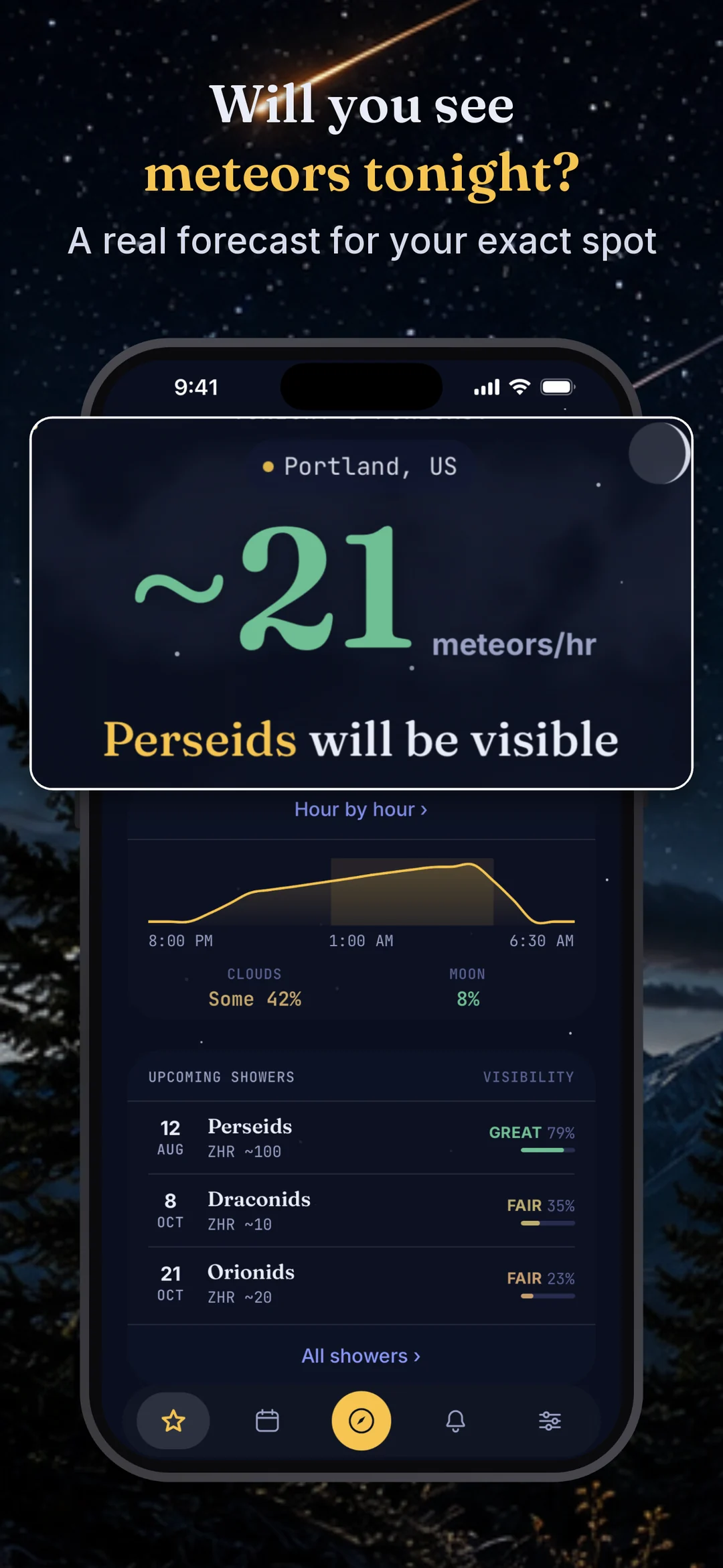
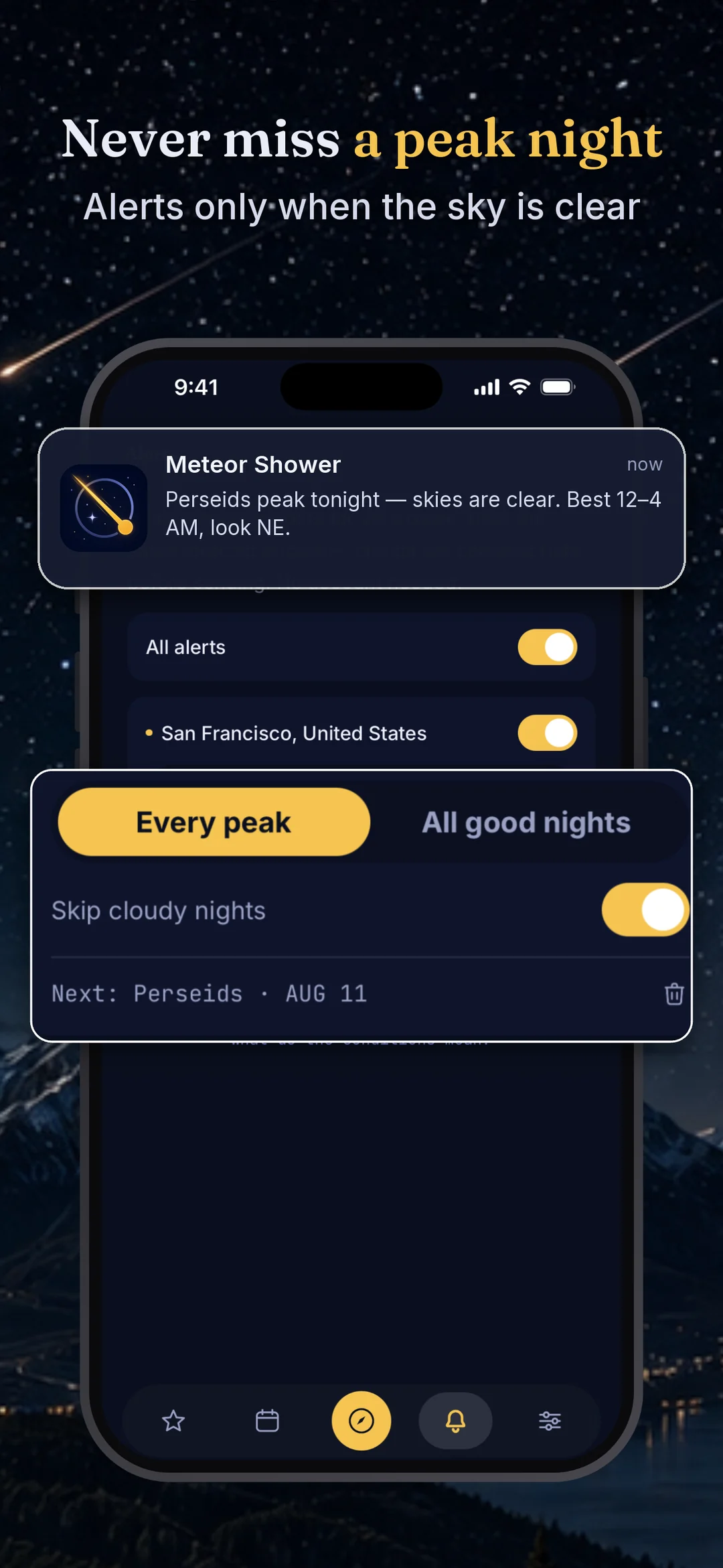
An alert in the evening for your exact location, and a second one when it's time to look up. Every alert checks the clouds first, so you know whether to bother.
- Tonight's forecast for your spot, hour by hour
- Peak-night alerts with a cloud check, free
- More places, widgets and an AR sky scanner with Premium