Active Dec 4 – Dec 20, 2026
Geminid meteor shower 2026
The Geminids peak on the night of December 13–14, 2026. From a dark site at 40° N you can count 75–175 meteors an hour around 2 AM, and the 25% Moon is down by then.
Slow, bright meteors from an asteroid rather than a comet, and the richest shower of the year. The radiant rises around nightfall, so the Geminids are one of the few major showers worth watching in the evening.
- Peak night
- max
- You'll count
- 75–175/hr
- dark site · 30–70 from suburbs
- Best time
- 2 AM
- radiant 83° up, S
- Moon
- Excellent
- 25% lit, down in the best hours
For 40° N (New York, Madrid, Beijing), local time. Other latitudes are in the table below; tonight's sky for your own place is on the home page. Updated .
Why the Geminids burn slow and bright
Geminids enter the atmosphere at about 35 km/s, half the speed of a Leonid, so each one stays in view long enough to follow across the sky. They are also bright on average, and the reason is the material. Geminid meteoroids are dense, compact grains, around 2,600 kg per cubic meter in one study of their light curves and deceleration, far denser than the fluffy dust shed by icy comets. Many look white or yellowish; green tints are commonly reported, red or blue ones less often.
With a ZHR of about 150 this is the strongest of the annual showers, and its peak is generous. Rates hold near maximum for roughly half a day, so most longitudes get a good night. Activity builds slowly through the preceding week and drops away faster afterward. The meteors also get brighter on average toward and just after maximum, because the larger particles are concentrated slightly later in the stream than the small ones.
Under a dark rural sky casual observers commonly report 40 to 100 an hour in the best hours, experienced observers more; a suburb gives roughly a third of a dark site. The latitude table has this year’s numbers. December nights at mid-northern latitudes run close to 15 hours from sunset to sunrise, and they are cold.
A rock comet called Phaethon
The parent is 3200 Phaethon, an asteroid 5 to 6 km across, spotted in images from the IRAS satellite taken on October 11, 1983. Fred Whipple soon pointed out that its orbit matched the Geminid stream, the first time an asteroid had been tied to a meteor shower. Every 1.4 years Phaethon swings from 2.4 AU, beyond the orbit of Mars, to within 0.14 AU of the Sun, less than half Mercury’s closest distance. At perihelion its surface reaches about 1,000 K, far too hot for ice to survive.
That orbit runs the same way around the Sun as Earth’s and is tilted only 22°, so Geminid meteoroids cross our path at a glancing angle instead of head-on. Hence the modest entry speed.
Phaethon does not behave like a normal asteroid. In 2009 the STEREO spacecraft caught it doubling in brightness near perihelion, and it happened again in 2012, leading David Jewitt and Jing Li to call it a “rock comet” that sheds dust as the heat cracks its surface. In 2023 Qicheng Zhang and colleagues used color-filtered images from the SOHO observatory, and records from 18 perihelion passages since 1997, to show that the brightening and tail are glowing sodium gas, not dust.
Either way, today’s activity cannot explain the stream. The Geminids hold roughly 10¹³ kg of material, while Phaethon now loses about a million kilograms of sodium per orbit and no detectable dust. Recent studies point instead to a past disruptive event, a breakup or violent resurfacing, thousands of years ago. Two smaller asteroids, 2005 UD and 1999 YC, travel similar orbits and may be pieces of the same original body. The Quadrantids also come from an asteroid-like parent, and their meteoroids share the Geminids’ high density.
A shower that starts in the evening
Many showers are best after midnight because their radiants lie toward the direction Earth is heading, which is highest around dawn. The Geminid radiant sits well to the side of that point, in Gemini, which in December stands opposite the Sun. At mid-northern latitudes it rises in the northeast around nightfall and stays up all night. From 40°N it is about 30° high in the east-northeast by 9 p.m., 65° at midnight and nearly overhead around 2 a.m., when rates are best. That makes this one of the best showers for children.
The radiant lies about a degree from Castor, the fainter of the Twins’ two bright stars, with golden Pollux nearby. In the late evening, while it is still low, watch for earthgrazers: slow Geminids that skim the atmosphere almost horizontally and cross much of the sky.
Southern observers get a reduced version. From around 35°S the radiant rises late in the evening and climbs only about 22° above the northern horizon, highest in the middle of the short summer night, so counts run at roughly a third of northern ones. From the equator the radiant still climbs to nearly 60°.
The Monocerotids and sigma Hydrids peak about five days before the Geminids from radiants south of Gemini, but each adds only a few meteors an hour. A meteor that traces back to Castor and moves at a stately pace is almost certainly a Geminid. For general preparation see how to watch a meteor shower, and for cameras, photographing meteor showers.
A young shower that keeps getting stronger
The Geminids have no long written history. Observers in England and the United States independently noticed a December radiant in Gemini in the early 1860s, when rates were perhaps 10 to 20 an hour, a fraction of today’s.
In the 1930s, photographs taken from two stations at once let astronomers, including Whipple, work out the stream’s orbit: a perihelion of just 0.14 AU and a period of less than two years. No known comet traveled such a path, and the shower remained without a parent for nearly half a century, until Phaethon turned up in 1983.
The rise has continued into the modern era. Galina Ryabova and Jürgen Rendtel showed that visual counts climbed steadily from 1985 to 2016, by about 20 percent after 2000 alone, matching models in which the core of the stream drifts toward Earth’s orbit. Their model has Phaethon’s orbit crossing Earth’s around 2200 and the stream’s core some time later, after which the shower should decline.
Visibility by latitude
How high the Gemini radiant climbs during darkness on the 2026 peak night, and what an observer can realistically count at that hour. Times are local solar time.
| Latitude | HeightRadiant height | Best hour | Dark site | Suburbs |
|---|---|---|---|---|
| 60° NAnchorage, Oslo, Helsinki | 63° | 65–155 | 25–60 | |
| 51° NLondon, Calgary, Prague | 72° | 70–165 | 30–65 | |
| 40° NNew York, Madrid, Beijing | 83° | 75–175 | 30–70 | |
| 30° NHouston, Cairo, Shanghai | 87° | 75–175 | 30–70 | |
| 19° NMexico City, Mumbai, Honolulu | 77° | 75–170 | 30–70 | |
| 0°Quito, Nairobi, Singapore | 58° | 65–145 | 25–60 | |
| 23° SSão Paulo, Alice Springs | 35° | 40–100 | 17–40 | |
| 34° SSydney, Cape Town, Buenos Aires | 24° | 30–70 | 12–30 | |
| 45° SDunedin, Queenstown | 12° | 16–40 | 6–15 |
Rates are meteors per hour on the peak night at the radiant's best hour, including this year's moonlight, as a range because real counts scatter. "Not visible" means the radiant never clears 10° in darkness. How this is computed.
Activity, night by night
The next three peaks
The waxing crescent Moon (25% lit) is below the horizon during the best hours — moonlight is not a factor.
| Year | Maximum (UTC) | Moon | At 40° N |
|---|---|---|---|
| 2026 | Dec 14, 13:41 UTC | 25% waxing crescent | Excellent |
| 2027 | Dec 14, 19:54 UTC | 98% full | Poor |
| 2028 | Dec 14, 01:57 UTC | 5% waning crescent | Excellent |
Shower facts
- Peak rate (ZHR)
- 150 /hr what's this?
- Active
- Dec 4 – Dec 20
- Speed
- 35 km/s · medium
- Radiant
- Gemini · 7h 29m +33°
- Parent body
- 3200 Phaethon · asteroid (an unusual parent)
- Best from
- Both, best from the north
Geminids: questions
When is the Geminid meteor shower in 2026?
Maximum is Dec 14, 13:41 UTC, which makes the night of December 13–14 the one to watch in North America (the dates at the top of this page switch to your own time zone). The shower is active from Dec 4 to Dec 20.
Is the night before or after the Geminid peak worth it?
The night before the peak runs at about 67% of peak strength and the night after at about 52%. The run-up is the better spare night. If the peak night is cloudy, either is worth a try.
Will the Moon interfere with the Geminids in 2026?
The waxing crescent Moon (25% lit) is below the horizon during the best hours — moonlight is not a factor.
Can you see the Geminids before midnight?
Yes. At mid-northern latitudes the radiant near Castor rises around nightfall and is about 30° up by 9 p.m., so meteors appear from mid-evening. Rates are best around 2 a.m., when the radiant is nearly overhead.
Why do the Geminids come from an asteroid?
Their parent, 3200 Phaethon, is a rocky body that passes within 0.14 AU of the Sun. Today it sheds far too little material to have built the stream, which most likely formed in a past disruptive event on Phaethon.
How many Geminids per hour can I really see?
The ZHR of about 150 assumes a perfect sky with the radiant overhead. Under a dark rural sky, casual observers commonly report 40 to 100 an hour around the peak, and experienced observers more; a suburb gives roughly a third of a dark site. The latitude table on this page has this year's range.
Can you see the Geminids from the Southern Hemisphere?
Yes, at reduced rates. From around 35°S the radiant rises late in the evening and gets only about 20° above the northern horizon, so counts run at roughly a third of what mid-northern observers see.
Are the Geminids getting stronger?
Yes. Rates were around 10 to 20 an hour when the shower was first noticed in the 1860s, and visual counts from 1985 to 2016 show a continuing rise as the core of the stream drifts toward Earth's orbit.
Sources: NASA, L. Neslušan, Ryabova & Rendtel, Zhang et al. and more · reviewed October 13, 2026Show
- NASA — Geminids
- L. Neslušan (2015) — A summary of the research of the Geminid meteoroid stream
- Ryabova & Rendtel — Increasing Geminid meteor shower activity (MNRAS Letters)
- Zhang et al. (2023) — Sodium brightening of (3200) Phaethon near perihelion
- D. Jewitt — Phaethon, the rock comet (UCLA)
Dates, rates and moon figures are recomputed on every build — see the methodology.
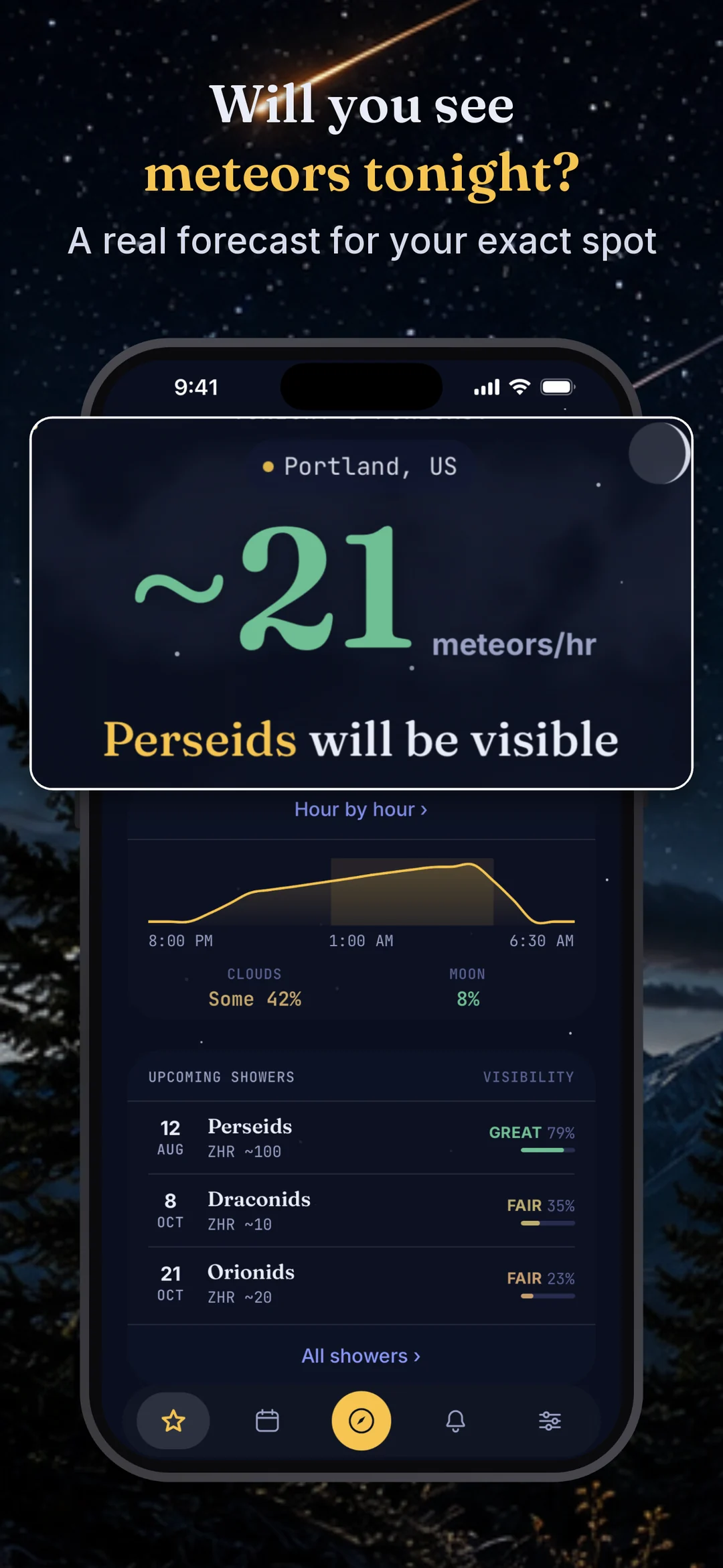
Free app · iPhone & Android
Get told when the Geminids are worth it
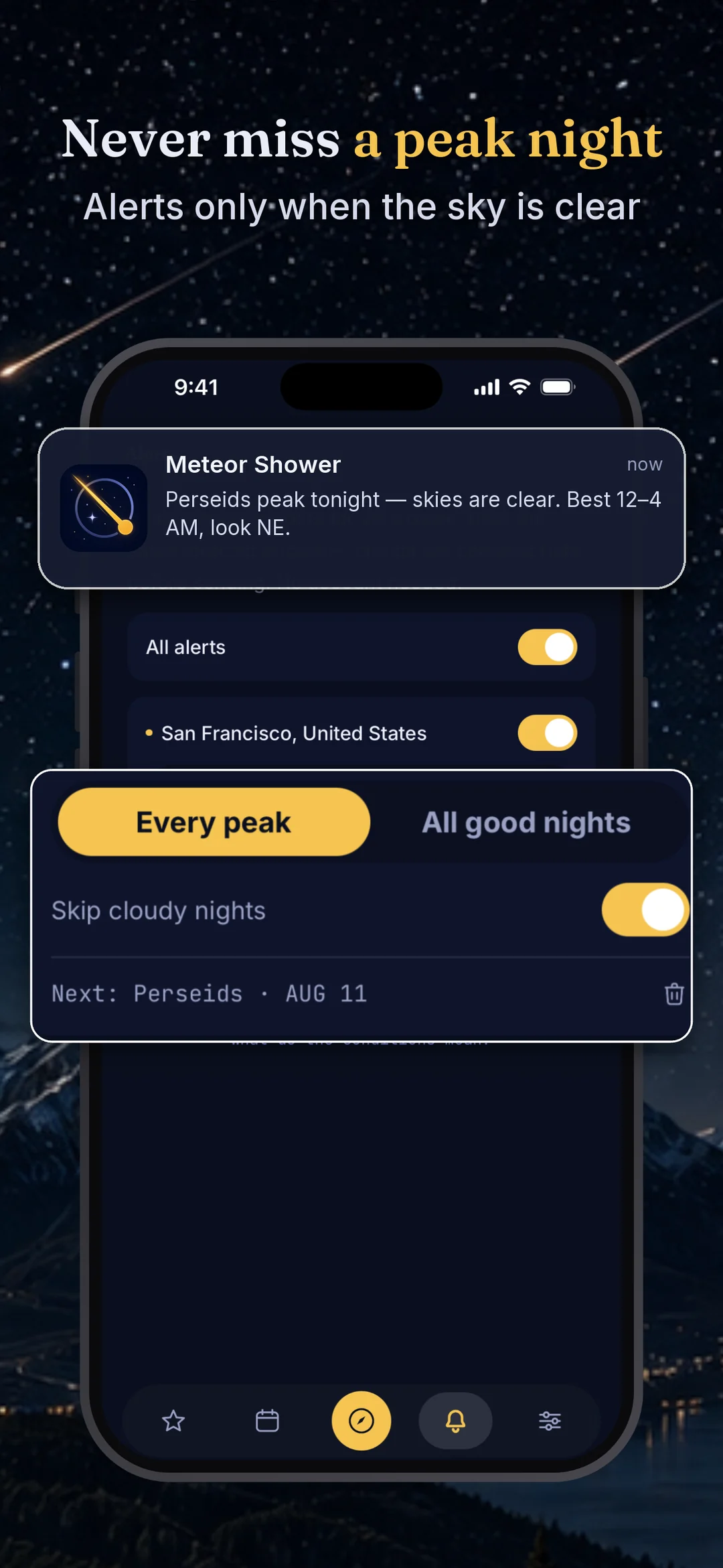
An alert in the evening for your exact location, and a second one when it's time to look up. Every alert checks the clouds first, so you know whether to bother.
- Tonight's forecast for your spot, hour by hour
- Peak-night alerts with a cloud check, free
- More places, widgets and an AR sky scanner with Premium