Guide · 5 min read
What ZHR really means
Every shower forecast quotes a ZHR, and almost everyone counts fewer meteors than it suggests. The number isn't wrong; it describes a standard sky that almost no one stands under. Here is how to translate it.
By Ilsur Gabdulkhakov · updated
Contents · 6 sections Show
What the ZHR measures
The zenithal hourly rate is defined by the International Meteor Organization (IMO) as the number of meteors an ideal observer would see in one hour under perfectly clear skies, with stars down to magnitude +6.5 visible and the shower’s radiant directly overhead. It is a standard, set so that counts made from different places, by different people, in different decades can be compared and combined.
None of those standard conditions is normal. The radiant is almost never at the zenith. A sky showing magnitude 6.5 stars exists only well away from towns. The moon is up for part of most nights. So the ZHR is not a forecast of your night. It is closer to a shower’s engine rating: useful precisely because it strips your local circumstances away.
That is also why it is the right number for comparing showers. The Geminids’ ZHR of about 150 against the Lyrids’ 18 says something true and stable about the two streams, in a way no single person’s count can.
How a ZHR is worked out
Nobody counts a ZHR directly. Observers record how many meteors they saw, for how long they watched, how faint their faintest stars were, and how much of their view was blocked by clouds or trees. Each count is then corrected to the standard conditions:
ZHR = (meteors counted ÷ hours watched) × F × r^(6.5 − limiting magnitude) ÷ sin(radiant altitude)
Here F corrects for the obstructed part of the view, and r is the shower’s population index. The IMO and its observers have pooled counts this way since 1988. A published ZHR for a shower is a typical peak value from recent returns, not a guarantee for the next one.
Run the same formula backward and you get the honest version for your own sky:
Expected rate ≈ ZHR × sin(radiant altitude) ÷ r^(6.5 − your limiting magnitude)
The three discounts between the ZHR and your count
1. Radiant altitude
Meteors stream out from the radiant in every direction. When it is low, much of the shower is below your horizon, and the visible rate scales with the sine of the radiant’s altitude:
| Radiant altitude | 10° | 20° | 30° | 45° | 60° | 90° |
|---|---|---|---|---|---|---|
| Share of the ZHR | 17% | 34% | 50% | 71% | 87% | 100% |
This is the discount you can’t buy back by driving anywhere dark. It is set by your latitude and the hour, which is why observers wait until a radiant is at least 30 degrees up before counting.
2. Sky brightness and the population index
Every shower produces many more faint meteors than bright ones. The population index r says how many times more numerous the meteors become with each magnitude fainter, so each magnitude of sky you lose divides the count by r. For the major showers, the IMO lists values from 2.1 to 2.8. Lower values mean a larger share of bright meteors, which also means less damage from light pollution:
| Faintest star you can see | r = 2.1 (Lyrids, Quadrantids) | r = 2.5 (Orionids, Leonids) | r = 2.8 (Ursids) |
|---|---|---|---|
| 6.0, rural | 69% | 63% | 60% |
| 5.3, suburban | 41% | 33% | 29% |
| 4.3, city | 20% | 13% | 10% |
3. Moonlight
Moonlight is the second discount in disguise: it works by brightening your sky and lowering your limiting magnitude. How much it costs depends on the moon’s phase, its height and how close it sits to where you are looking. A bright moon can take a magnitude or more off a dark sky, which by the same arithmetic hides more than half the meteors. That is why the moon on the peak night matters more than a difference of 20 or 30 in ZHR.
Two smaller factors push the same way. Trees, buildings or cloud covering part of your view cut the count, and the ZHR’s ideal observer is experienced and watches without breaks. A casual group chatting under the sky will miss some meteors that observer would have counted.
Two worked examples
The Perseids, ZHR 110, r = 2.2. From a suburb where the faintest stars are magnitude 5.3, with the radiant 50 degrees up: 110 × 0.77 ÷ 2.2^1.2 = 110 × 0.77 ÷ 2.58 ≈ 33 meteors an hour. From a dark site at magnitude 6.3, at 4 a.m. from 40°N, with the radiant near 58 degrees: 110 × 0.85 ÷ 1.17 ≈ 80 an hour. Add a bright moon that costs that dark site 1.5 magnitudes, and the same night drops to about 25.
The Lyrids, ZHR 18, r = 2.1. Their radiant passes close to overhead before dawn at mid-northern latitudes, about 76 degrees up at 4 a.m. from 40°N. From a dark site at magnitude 6.3: 18 × 0.97 ÷ 1.16 ≈ 15 an hour. From the suburbs at magnitude 5.3, about 7. For a weaker shower, a dark site doesn’t just add meteors; it decides whether the night is worth it.
All three discounts push in one direction. Unless you are under an exceptionally dark sky with the radiant nearly overhead, or the shower has an outburst, expect your count to come in below the ZHR.
Using the ZHR: a ranking, not a promise
Read the ZHR as a ranking. Around 100 or more, the Geminids, the Perseids and, if you catch their brief peak, the Quadrantids, means a shower worth planning a night around. About 20 to 50, such as the Eta Aquariids, Southern Delta Aquariids and Orionids, means a good show for someone already at a dark site with the radiant well up. Below 20 means a few meteors an hour for most people.
Then check, in this order:
- How high the radiant climbs from your latitude during dark hours. If it never clears about 20 degrees, no clear sky will save the night.
- The moon on the peak night, and whether it is up during the hours that matter.
- Your sky. Moving from a suburb to a dark site roughly doubles to triples your count; how to find dark skies covers how.
- The weather. If the first three are favorable, a doubtful forecast is worth gambling on.
The rate estimates on this site start from this same model; methodology lists the exact inputs.
Outbursts and storms
A ZHR describes a stream’s usual behavior. Streams aren’t uniform, though, and when Earth passes through a dense trail of debris, rates can jump far above it. Even a major shower varies: the IMO notes that the Quadrantids’ peak ZHR can range from about 60 to 200 from one year to the next.
At the extreme is a meteor storm, which NASA defines as at least 1,000 meteors an hour. The best-known is the Leonid storm of 1966, when, according to NASA, thousands of meteors a minute fell during a 15-minute period. No standard ZHR anticipates that. Storms are forecast from models of individual debris trails, which is why the forecast for a known stream can change from year to year.
Questions
Is the ZHR the number of meteors I will see?
No. It is a standardized rate for one observer under a perfectly dark sky with the radiant overhead. Real counts are lower: often a quarter to a half of the ZHR from a good dark site with the radiant well up, and a tenth or less from a city.
What is a good ZHR for a meteor shower?
Around 100 or more (the Geminids, Perseids and Quadrantids) is worth planning a night around. About 20 to 50 (the Eta Aquariids, Southern Delta Aquariids and Orionids) rewards a dark site. Below 20 means a few meteors an hour for most people, unless the shower has an outburst.
What is the population index of a meteor shower?
It describes how quickly a shower's meteors become more numerous as they get fainter: each magnitude fainter, there are r times as many. Typical values run from about 2 to 3, and showers with a low r are richer in bright meteors and hold up better under light pollution.
Does a shower's ZHR change from year to year?
Yes. A quoted ZHR is a typical peak from recent returns. Real peaks vary, sometimes widely, and a stream can occasionally produce an outburst far above its usual rate when Earth crosses a dense trail of debris.
Sources: IMO, ALPO Meteors Section, NASA, EarthSky · reviewed October 13, 2026Show
- IMO — 2027 Meteor Shower Calendar (PDF)
- ALPO Meteors Section — Observing Guide (PDF)
- NASA — Leonids
- EarthSky — How to shoot photos of meteors
Dates, rates and moon figures are recomputed on every build — see the methodology.
Free app · iPhone & Android
Get told when to look up
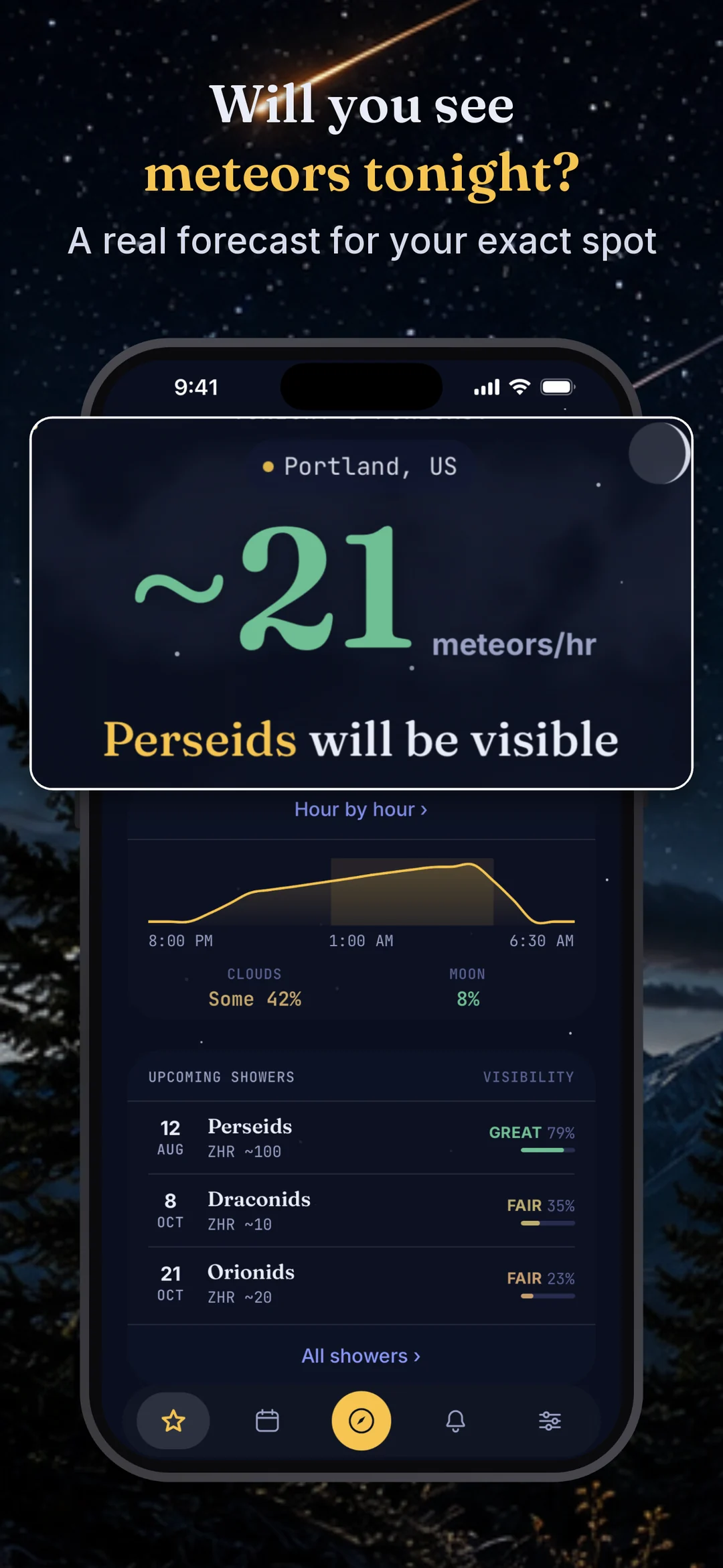
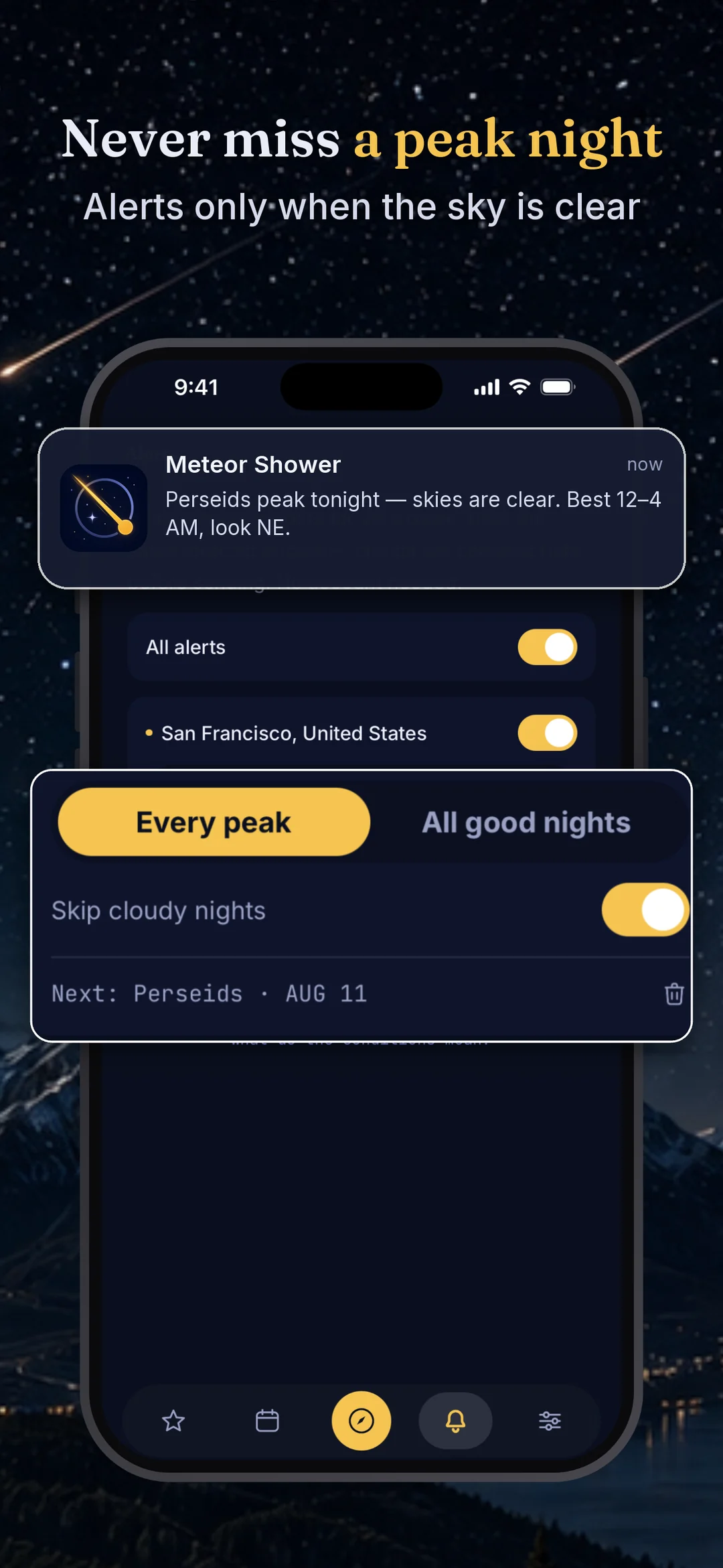
An alert in the evening for your exact location, and a second one when it's time to look up. Every alert checks the clouds first, so you know whether to bother.
- Tonight's forecast for your spot, hour by hour
- Peak-night alerts with a cloud check, free
- More places, widgets and an AR sky scanner with Premium