Guide · 10 min read
How to watch a meteor shower
Watching a meteor shower takes no equipment, but it does take a dark sky, dark-adapted eyes, the right hours and at least an hour of patience. This guide covers each one, with the numbers behind them.
By Ilsur Gabdulkhakov · updated
Contents · 12 sections Show
- You need less gear than you think
- Give your eyes 30 minutes, and protect them
- Where to look
- How many meteors to expect
- Pick the right hours
- Moonlight and clouds
- Stay at least an hour
- Dress for a colder night than the forecast
- Counting what you see
- Watching with children
- Your first shower: start with the Geminids
- Checklist
You need less gear than you think
A meteor shower is a naked-eye event. Meteors cross the sky at roughly 3 to 25 degrees per second and are usually gone in under a second, and nothing tells you in advance where the next one will appear. Binoculars show a patch of sky about 6 or 7 degrees wide; a telescope, often less than 1 degree. Your eyes register meteors across a circle roughly 100 degrees wide, an area more than 200 times larger than a binocular view.
What you do need is an open view of the sky, something to lie back on, more warm clothing than seems reasonable, and time. The checklist at the end covers the rest.
Give your eyes 30 minutes, and protect them
Night vision belongs to the rod cells of your retina, and they are slow. In the first few minutes of darkness, your cone cells improve only modestly. The rods take over after about 5 to 8 minutes, and their sensitivity keeps climbing for roughly 40 minutes before it levels off. NASA’s advice is to allow about 30 minutes; the American Meteor Society says at least 20 to 30. Most of a shower’s meteors are faint, and they only start to show once this has happened.
Bright white light undoes the work. A phone at normal brightness, a flashlight, sweeping headlights or a motion-sensor porch light each set you back, and the brighter or longer the exposure, the longer the recovery. Switch off your car’s interior light before you open the door, and park facing away from where others will pull in.
Red light is the exception, because rods respond very weakly to deep red. A dim red flashlight, or a white one under a few layers of red cellophane, lets you find the thermos without paying much for it. Keep it dim and pointed at the ground.
For the faintest meteors and stars, use averted vision. The very center of your gaze has no rods, so faint things show up better slightly off to the side of where you are looking directly.
Turn your phone red
On an iPhone, open Settings > Accessibility > Display & Text Size > Color Filters. Turn Color Filters on, choose Color Tint, and slide both the intensity and hue controls all the way to the right; the screen turns deep red. Then add Color Filters under Settings > Accessibility > Accessibility Shortcut, and a triple-click of the side button switches it on and off. Reduce White Point, in the same Display & Text Size menu, and minimum brightness dim it further.
On Android the options depend on the manufacturer. Look for a color filter in the Accessibility settings, or use the red night mode built into most planetarium apps. Warm “night light” or “eye comfort” settings shift the screen toward amber, which helps less than true red.
This site has the same thing built in: the eye button at the top of every page switches it to red on black, and it remembers the choice.
Even a red screen is a light source. Look at it as little as possible.
Where to look
Meteors can appear anywhere in the sky. The radiant, the point a shower’s meteors seem to stream from, tells you which way they travel, not where they show up, and meteors close to it look short because they are heading nearly toward you. So don’t stare at the radiant. Center your view on a dark part of the sky about halfway between the horizon and overhead, with the radiant 20 to 40 degrees off to one side, the range the International Meteor Organization (IMO) recommends to its observers. Then hold that view instead of scanning around.
Your roughly 100-degree field of view covers about a third of the visible sky at once, and you catch meteors near its center more reliably than those at its edges. Point it at the darkest, most open part of your sky, usually away from the nearest town, and use the radiant direction on each shower page to decide which side to keep the radiant on.
Lie back. Sitting up with your head tilted back gets uncomfortable fast. A reclining lawn chair or a zero-gravity chair holds you at the right angle for an hour or more; a foam pad on the ground works too. In a group, face different directions and call out meteors as you see them; together you cover far more sky than one person can.
How many meteors to expect
Shower forecasts quote a ZHR, or zenithal hourly rate: the number of meteors one experienced observer would see in an hour under a perfectly dark sky with the radiant directly overhead. You will nearly always see fewer, because your radiant is lower, your sky is brighter and the moon may be up. What ZHR means explains the number and how to turn it into an estimate for your own sky.
The biggest factor you control is how dark your sky is. Faint meteors far outnumber bright ones, so each step of light pollution erases a large share of the shower:
| Your sky | Faintest stars visible | Share of a dark-site count | Geminid peak, radiant high |
|---|---|---|---|
| Dark rural site: Milky Way bright, with visible structure | magnitude 6.5 or fainter | all of it | about 40–100 per hour |
| Rural edge: Milky Way plain but washed out near the horizon | about 6.0 | about 60% | about 25–60 |
| Suburb: Milky Way faint, or visible only overhead | about 5.3 | about 30% | about 12–30 |
| City: no Milky Way, only the brighter stars | 4.5 or brighter | 10–15% | about 5–15 |
The shares follow the standard model observers use to correct meteor counts for sky brightness, with the Geminids’ population index of 2.6, and assume a clear, open sky and steady attention. NASA’s Geminid guidance is to expect 40 to 50 an hour under dark skies and up to 120 in perfect conditions, so treat the top of each range as an excellent night. Most other showers are weaker. How to find dark skies covers getting from the bottom rows of this table to the top.
You will also see sporadic meteors, random ones that belong to no shower. From a dark site, expect about 2 or 3 an hour in the evening and anywhere from about 5 to 15 in the last hour before dawn, depending on the season.
Pick the right hours
For most showers, the best hours run from local midnight to the first light of dawn, when your side of Earth faces forward along its orbit and most radiants stand highest. The Geminids are among the exceptions, and the moon can change the best hours from night to night. The best time to see a meteor shower covers timing in full.
Moonlight and clouds
A bright moon lights up the whole sky the way a city does, and the faint meteors go first. If the moon is up, keep it behind you, or better, put a building, a tree line or a hill between you and the moon while keeping a wide stretch of open sky in front of you. Or wait it out: a moon that sets at 1 a.m. leaves the best hours dark. Each shower page shows the moon’s phase and timing for the peak night.
Thin high cloud is the subtler problem: a sky can look clear while a veil of cirrus hides the fainter stars, and the fainter meteors with them. Patchy cloud, on the other hand, is often worth waiting out. Because you catch most meteors near the center of your view, a clear hole 40 degrees in radius covers only half your field but, by the IMO’s reckoning, costs you only about a tenth of the meteors. Check the cloud forecast in the afternoon and again at dusk, and look at a satellite loop to see whether a clearing is heading your way.
Stay at least an hour
Meteor rates are averages of a random process, so quiet spells are normal. At a steady 10 an hour, about one 10-minute stretch in five produces nothing at all, by chance alone. Even at 30 an hour, about one five-minute stretch in twelve is empty. People who give up after 15 quiet minutes have often just reached full dark adaptation.
Plan on 90 minutes: 30 for your eyes and an hour of watching. The Association of Lunar and Planetary Observers (ALPO) asks its observers for at least 60 minutes at a stretch, and recommends a nap beforehand over caffeine.
Dress for a colder night than the forecast
You will be still for an hour or more, often during the coldest part of the night, since temperatures usually bottom out around dawn. Lying down, you also lose heat into the ground beneath you. Plan for both:
- Insulate underneath you first: a foam pad, a folded blanket, or a sleeping bag laid over the recliner.
- Wear more layers than you would for a walk at the same temperature, plus a hat, gloves and warm socks. Even summer nights get chilly by 4 a.m.
- Bring a hot drink and snacks; a cold, hungry observer stops paying attention.
- Clear, calm nights bring dew, so keep blankets and gear under a waterproof layer. In summer, add insect repellent.
- Chemical hand warmers in pockets and boots go a long way on winter nights.
Counting what you see
Counting gives you something to do between meteors and turns a night out into a record. Note when you start, tally meteors in 15-minute blocks, and mark each one as a shower meteor or not. To tell them apart, trace each meteor’s path backward. A shower member lines up with the radiant and moves at that shower’s typical speed; anything else is a sporadic or belongs to another shower. Note the faintest stars you can see, too; that tells you what the sky was costing you.
If you see a fireball, a meteor brighter than magnitude −4 (about as bright as Venus), report it to the American Meteor Society or the IMO. Note the time, where it started and ended in the sky, its color and how long it lasted; reports from several places let researchers work out its path.
Watching with children
- Pick a shower that performs in the evening. NASA calls the Geminids one of the best opportunities for young viewers because activity starts around 9 or 10 p.m.
- Set honest expectations: at a good peak from a dark site, a meteor every minute or two on average, with gaps. A bright one is a reward, not a guarantee.
- Keep sessions short, 30 to 45 minutes after your eyes adapt, with a sleeping bag or the car to retreat to.
- Give each child a job: count meteors, watch one part of the sky, or call out the brightest.
- A red flashlight of their own, snacks and an extra layer prevent most early exits.
Your first shower: start with the Geminids
If you live in the Northern Hemisphere and can watch only one shower a year, make it the Geminids in mid-December. They have the highest rate of the major annual showers, a ZHR of about 150, and NASA calls them one of the best and most reliable. They don’t demand a 3 a.m. alarm: from mid-northern latitudes the radiant is about 30 degrees up by 9 p.m. and nearly overhead around 2 a.m. Their medium-speed meteors, at about 35 km/s, last longer than the streaks of the fastest showers.
The trade-offs are real. December nights in the north are cold, and in some years the moon is bright at the peak. From southern mid-latitudes the radiant rises late and climbs only about 20 to 25 degrees, so rates there are much lower. If cold is a dealbreaker, the Perseids offer warm August nights in the north, though their best hours come after midnight.
Checklist
Before you go
- Check the shower page for the peak night and the moon, and check the cloud forecast that afternoon and again at dusk.
- Choose a site with a dark, open sky where you are allowed to be after dark; scout it in daylight if it is new to you.
- Tell someone where you will be and when you expect to be back.
Pack
- Reclining chair or foam pad, plus a blanket or sleeping bag
- More layers than the forecast suggests; hat, gloves, warm socks
- Red flashlight, and your phone set to a red filter at minimum brightness
- Hot drink, snacks, and insect repellent in summer
- A camera and tripod if you want photos: see how to photograph a meteor shower
On site
- Lights off; 30 minutes for your eyes before you judge the sky
- Darkest open sky, gaze halfway up, radiant 20 to 40 degrees to one side, moon behind you
- Stay at least an hour after your eyes adapt
Questions
Do I need a telescope or binoculars to see a meteor shower?
No. Binoculars show a patch of sky about 6 or 7 degrees across, while your eyes catch meteors across a field roughly 100 degrees wide. Meteors appear without warning anywhere in the sky, so optics only shrink your chances.
How long does it take for your eyes to adjust to the dark?
Allow 20 to 30 minutes for most of the gain; sensitivity keeps improving for about 40 minutes. Any bright white light, including a phone screen at normal brightness, sets you back.
Which direction should I look during a meteor shower?
Not straight at the radiant. Face the darkest, most open part of your sky, center your gaze about halfway up, and keep the radiant 20 to 40 degrees off to one side.
How many meteors will I actually see?
At the peak of a top shower such as the Geminids, roughly 40 to 100 an hour from a truly dark site, about a third of that from a suburb and a tenth or so from a city. Most showers are weaker, and moonlight cuts counts further.
What is the best meteor shower for beginners?
For most Northern Hemisphere watchers, the Geminids in mid-December: the strongest annual shower, with the radiant well up by mid-evening. The catch is the cold. The August Perseids are the warm-weather alternative, but they are best after midnight.
Sources: NASA, American Meteor Society, ALPO Meteors Section, Webvision and more · reviewed October 13, 2026Show
- NASA — Geminids
- American Meteor Society — Meteor FAQ
- ALPO Meteors Section — Observing Guide (PDF)
- Webvision — Light and Dark Adaptation (Kalloniatis & Luu)
- Apple Support — Display and text size preferences on iPhone
Dates, rates and moon figures are recomputed on every build — see the methodology.
Free app · iPhone & Android
Get told when to look up
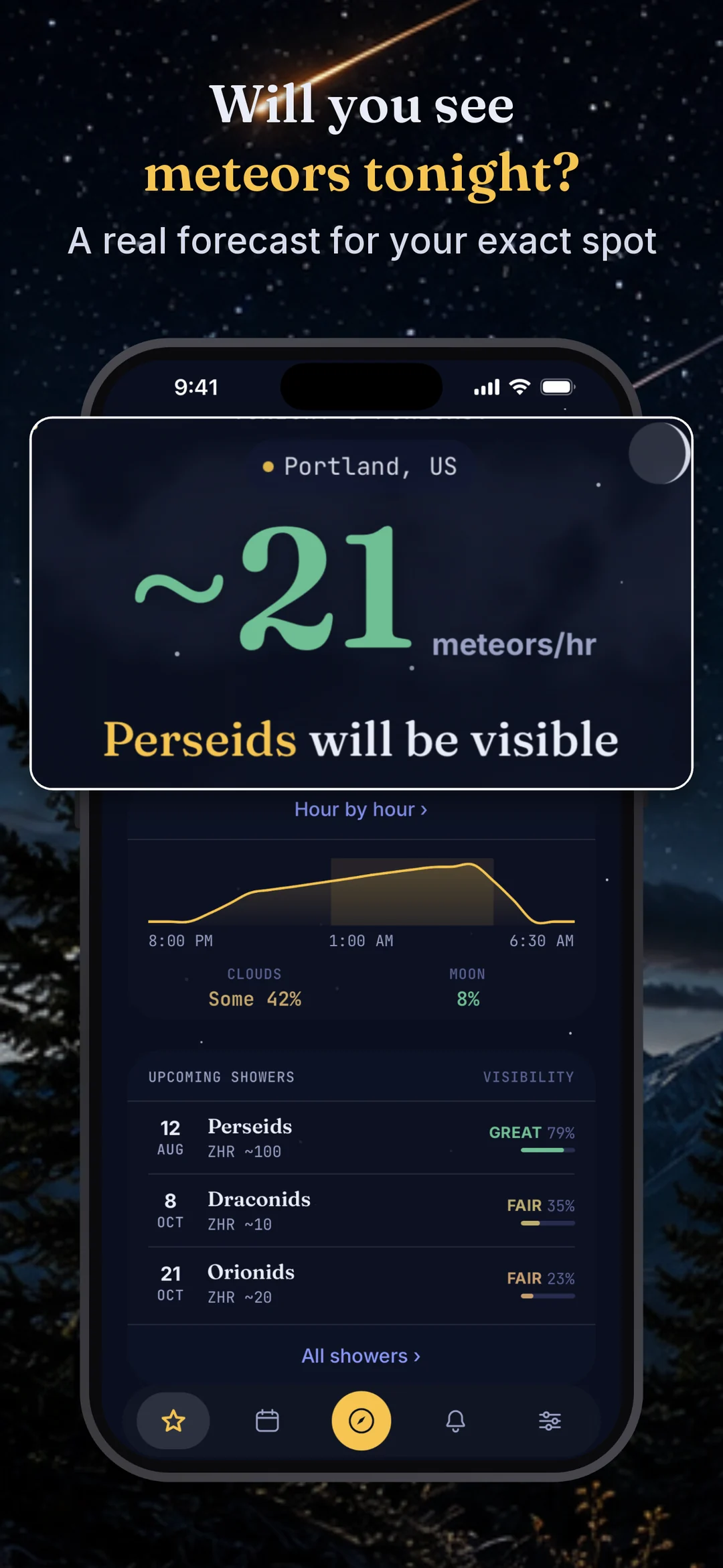
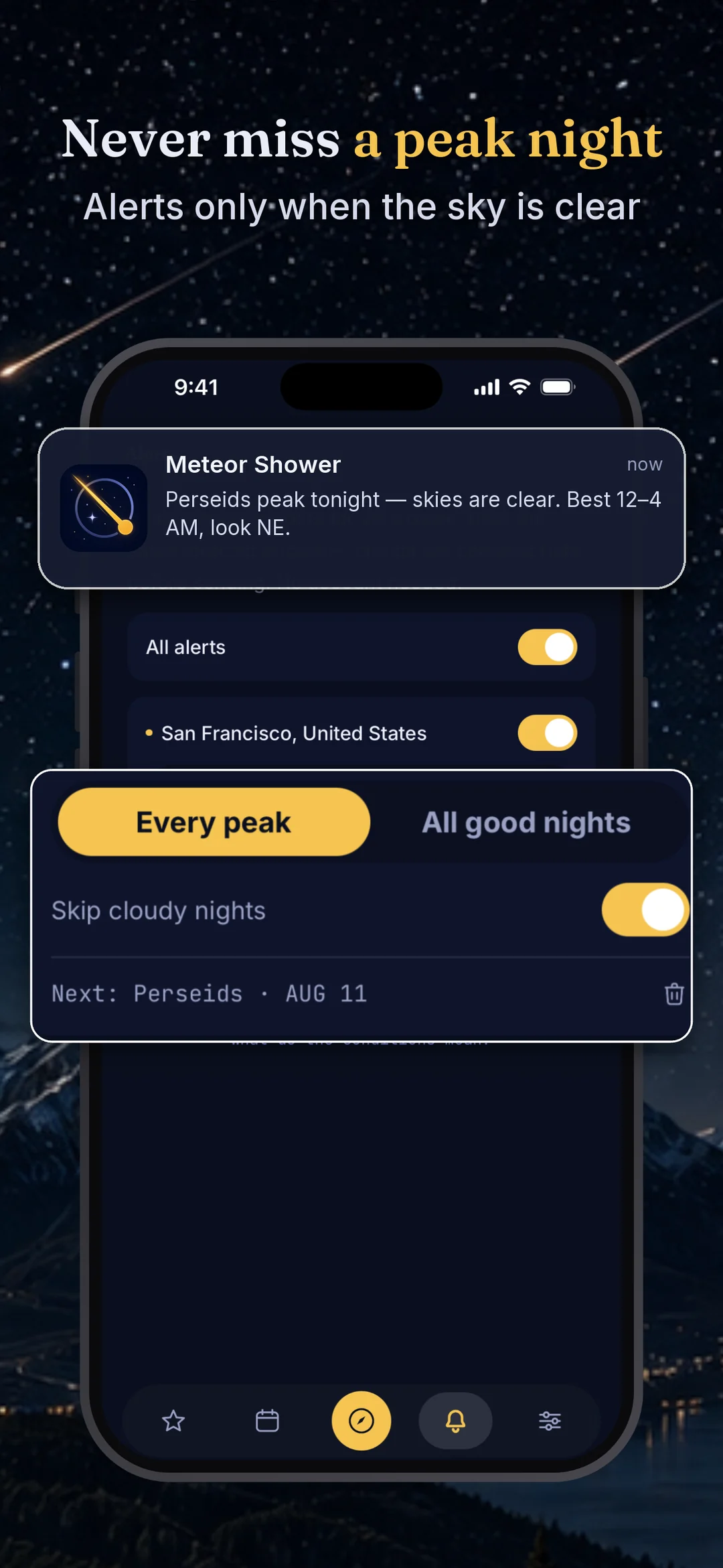
An alert in the evening for your exact location, and a second one when it's time to look up. Every alert checks the clouds first, so you know whether to bother.
- Tonight's forecast for your spot, hour by hour
- Peak-night alerts with a cloud check, free
- More places, widgets and an AR sky scanner with Premium