Active Oct 6 – Oct 10, 2027
Draconid meteor shower 2027
The Draconids peak on the night of October 8–9, 2027. From a dark site at 40° N you can count <1 meteors an hour around 7 PM, though a 67% Moon will wash out the fainter ones.
The Draconids turn the usual advice around: their radiant is highest at dusk, so the evening is the time to watch. Most years bring a trickle of slow meteors, but Comet Giacobini–Zinner's debris has twice produced a full meteor storm.
- Peak night
- max
- You'll count
- <1/hr
- dark site · <1 from suburbs
- Best time
- 7 PM
- radiant 60° up, NW
- Moon
- Poor
- 67% lit, up in the best hours
For 40° N (New York, Madrid, Beijing), local time. Other latitudes are in the table below; tonight's sky for your own place is on the home page. Updated .
Slow meteors at nightfall
Draconids enter the atmosphere at about 20 km/s, roughly a third the speed of a Perseid or an Orionid. The difference is easy to see: a Draconid crawls, and you often have time to turn your head and follow it to the end of its path.
Most are faint. The meteoroids are fragile, low-density grains that break apart easily. During the 2018 outburst, an experienced Belgian observer described mostly faint Draconids with some bright ones that flared, and cameras caught several breaking apart.
In an ordinary year there is little to see. Outside outburst years the IMO puts the zenithal rate at about five per hour, and a few an hour is a typical count. The active window, October 6 to 10, is the shortest of any shower on the calendar. Outbursts are shorter still, lasting hours rather than days, because each one comes from a narrow trail of dust shed on a single return of the comet. The 2018 outburst held near its peak for about four hours.
The setting is unusual. Early October nights at mid-northern latitudes are about twelve hours long and already cool, but you need only the first few hours of darkness. The best Draconid watching ends around the time most people go to bed.
Comet Giacobini–Zinner’s short, nearby orbit
The parent is 21P/Giacobini–Zinner, discovered by Michel Giacobini at the Nice Observatory on December 20, 1900, and recovered by Ernst Zinner in 1913. Its nucleus is only about 2 km across, and it orbits the Sun about every 6.6 years.
The comet’s perihelion lies just outside Earth’s orbit, so its debris passes close to us. Dust from recent passages has not yet spread far along the orbit and stays concentrated in narrow trails; an outburst happens when Earth crosses one. Historically, outbursts have come almost always in or near the comet’s perihelion years, though not every perihelion year brings one.
Comet and planet circle the Sun in the same direction, on orbits tilted about 30° apart. The meteoroids drift in from the side, from near the north pole of the ecliptic, instead of meeting Earth head-on, and the closing speed is only about 20 km/s.
21P also has a place in spaceflight history. On September 11, 1985, NASA’s International Cometary Explorer flew past it, becoming the first spacecraft to encounter a comet.
Watching Draco’s head sink in the northwest
The radiant lies at the western edge of the Head of Draco, the small, lopsided quadrilateral of four stars about 20° from Vega. At dusk in early October, Vega is high in the west from mid-northern latitudes, and the Head of Draco lies high in the northwest.
From 40°N the radiant is about 60° up at the end of evening twilight, around 7 p.m. local standard time. It drops to about 40° by 9 p.m., 20° by midnight and under 10° by 2 a.m. At 50°N it starts a little higher and sinks more slowly, but follows the same pattern. North of about 36°N it never sets, though in the small hours it sits low in the north. Add an hour if your clocks are still on daylight saving time, as they are in early October across most of North America and Europe.
The geometry rules out most of the world south of the equator. From the equator the radiant is about 28° high at nightfall and sets by about 10:30 p.m. From 20°S it is less than 10° up once twilight ends and sets by about 8 p.m. From 30°S southward it stays below the horizon all night.
The Moon matters more for an evening shower. From first quarter to full, it is up through the evening hours when the radiant is highest; after last quarter it rises too late to matter. The calendar shows the Moon’s phase for each year’s peak.
Two other showers are active in the same nights. The Southern Taurids are also slow, but their radiant is low in the east in the evening, so trace each slow meteor back: from the northwest it is a Draconid, from the east a Taurid. Fast meteors from low in the east after about 10 p.m. are early Orionids. For general setup, see how to watch a meteor shower.
The storms of 1933 and 1946, and the outbursts since
As early as 1915, astronomers suggested that Comet Giacobini–Zinner might produce a meteor shower. A modest display was reported in 1926. Then, in October 1933, a largely unexpected storm broke over Europe, and observers at the time counted 2,400 to 5,400 meteors an hour.
The 1946 return was predicted. The storm peaked around 10:00 UT on October 10, when observers in the United States saw 50 to 100 meteors a minute; some later analyses put the zenithal rate above 10,000. It was the first meteor shower ever observed with radar, and it yielded many precise photographs of bright meteors.
Smaller outbursts have followed. In 1985 and 1998 the zenithal rate reached several hundred, and 2005 brought a modest display near 40. A predicted outburst on October 8, 2011, reached a zenithal rate of about 300 over Europe. In 2012 an unexpected outburst appeared mostly on radar, rich in meteors too faint to see. In 2018 the zenithal rate held at roughly 100 to 150 for about four hours as darkness moved from Europe into North America.
Visibility by latitude
How high the Draco radiant climbs during darkness on the 2027 peak night, and what an observer can realistically count at that hour. Times are local solar time.
| Latitude | HeightRadiant height | Best hour | Dark site | Suburbs |
|---|---|---|---|---|
| 60° NAnchorage, Oslo, Helsinki | 65° | 1–2 | <1 | |
| 51° NLondon, Calgary, Prague | 65° | 1–2 | <1 | |
| 40° NNew York, Madrid, Beijing | 60° | <1 | <1 | |
| 30° NHouston, Cairo, Shanghai | 53° | <1 | <1 | |
| 19° NMexico City, Mumbai, Honolulu | 43° | <1 | <1 | |
| 0°Quito, Nairobi, Singapore | 26° | <1 | <1 | |
| 23° SSão Paulo, Alice Springs | 3° | not visible | — | |
| 34° SSydney, Cape Town, Buenos Aires | — | not visible | — | |
| 45° SDunedin, Queenstown | — | not visible | — |
Rates are meteors per hour on the peak night at the radiant's best hour, including this year's moonlight, as a range because real counts scatter. "Not visible" means the radiant never clears 10° in darkness. How this is computed.
Activity, night by night
The next three peaks
A first quarter Moon (67% lit) is up through the best hours and will hide the fainter meteors. Keep it behind you or a building.
| Year | Maximum (UTC) | Moon | At 40° N |
|---|---|---|---|
| 2027 | Oct 9, 07:23 UTC | 67% first quarter | Poor |
| 2028 | Oct 8, 13:36 UTC | 79% waning gibbous | Good |
| 2029 | Oct 8, 19:45 UTC | 2% new | Excellent |
Shower facts
- Peak rate (ZHR)
- 5 /hr what's this?
- Active
- Oct 6 – Oct 10
- Speed
- 20 km/s · slow
- Radiant
- Draco · 17h 32m +56°
- Parent body
- 21P/Giacobini–Zinner · comet
- Best from
- Northern Hemisphere
Draconids: questions
When is the Draconid meteor shower in 2027?
Maximum is Oct 9, 07:23 UTC, which makes the night of October 8–9 the one to watch in North America (the dates at the top of this page switch to your own time zone). The shower is active from Oct 6 to Oct 10.
Is the night before or after the Draconid peak worth it?
The night before the peak runs at about 40% of peak strength and the night after at about 40%. If the peak night is cloudy, either is worth a try.
Will the Moon interfere with the Draconids in 2027?
A first quarter Moon (67% lit) is up through the best hours and will hide the fainter meteors. Keep it behind you or a building. The next peak with a darker sky is in 2028.
When is the best time to watch the Draconids?
From the end of evening twilight until about 10 or 11 p.m. local time. The radiant in Draco's head is highest at dusk and sinks toward the northern horizon through the night, so Draconid rates fall after midnight instead of rising.
How many Draconids will I see in a normal year?
Very few. Outside outburst years the zenithal rate is about ten per hour at best, and many observers count only a handful in an evening.
Why are Draconid meteors so slow?
Comet 21P/Giacobini–Zinner orbits the Sun in the same direction as Earth, on a path tilted only about 30° to ours. Its debris meets the atmosphere at about 20 km/s, roughly a third the speed of a Perseid or an Orionid.
Can you see the Draconids from the Southern Hemisphere?
Hardly. From 20°S the radiant is less than 10° high after twilight and sets by about 8 p.m.; from 30°S southward it stays below the horizon all night. This is a shower for the Northern Hemisphere.
Are the Draconids the same as the Giacobinids?
Yes. Giacobinids is the older name, taken from the parent comet. Today the shower is known as the October Draconids, after its radiant in Draco.
Sources: IMO, Ye et al., NASA, eMeteorNews · reviewed October 13, 2026Show
- IMO — 2027 Meteor Shower Calendar
- Ye et al. (2013), Radar Observations of the 2011 October Draconid Outburst, MNRAS
- NASA — Comet 21P/Giacobini–Zinner
- eMeteorNews — The outburst of the Draconid meteor shower in 2018: an analysis
Dates, rates and moon figures are recomputed on every build — see the methodology.
Free app · iPhone & Android
Get told when the Draconids are worth it
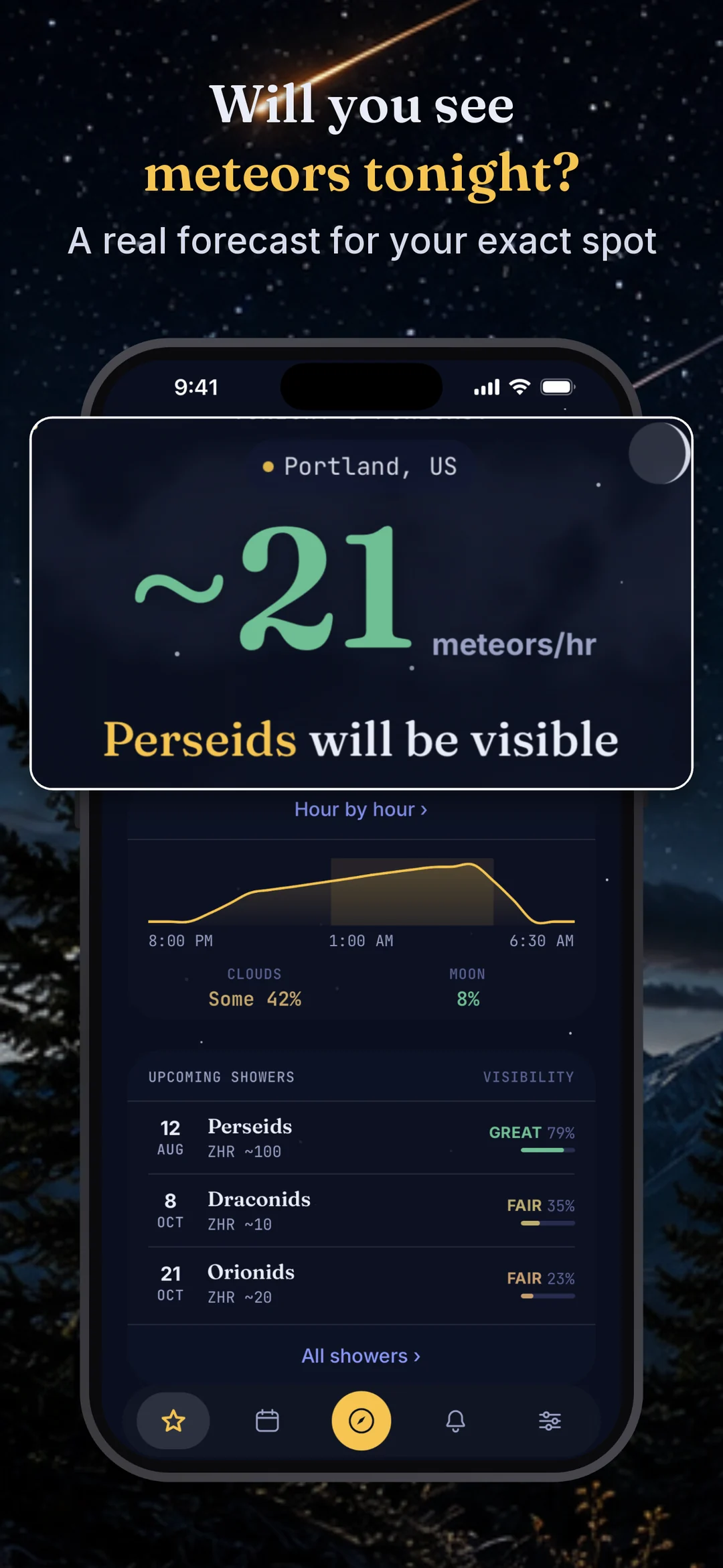
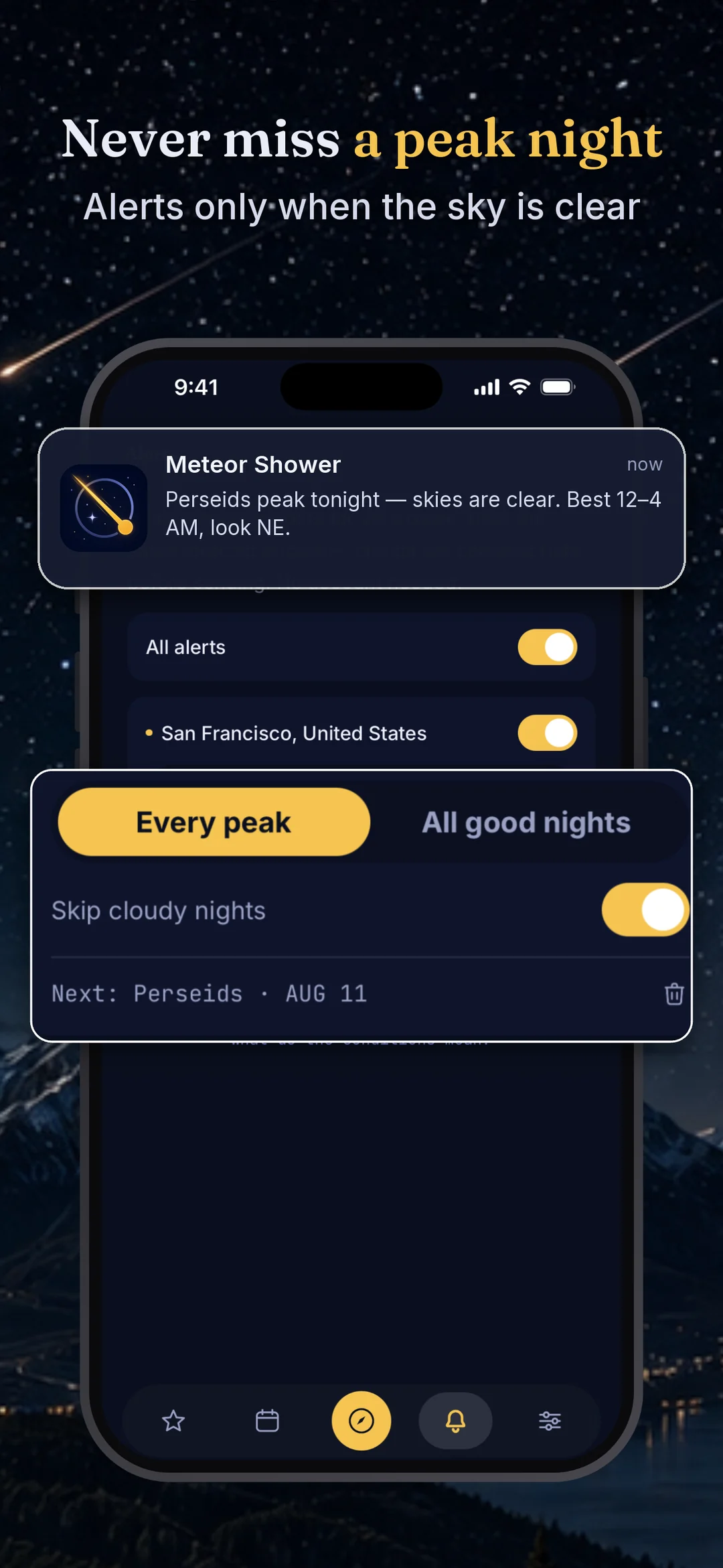
An alert in the evening for your exact location, and a second one when it's time to look up. Every alert checks the clouds first, so you know whether to bother.
- Tonight's forecast for your spot, hour by hour
- Peak-night alerts with a cloud check, free
- More places, widgets and an AR sky scanner with Premium