Guide · 6 min read
How to find dark skies
Light pollution decides more of your meteor count than anything else you control. Trading a suburban sky for a dark rural one typically doubles or triples what you see, and no equipment comes close to that.
By Ilsur Gabdulkhakov · updated
Contents · 6 sections Show
What light pollution costs you
Skyglow, the dome of scattered artificial light over a town, works the way moonlight does: it raises the background brightness a meteor has to stand out against. The faint meteors disappear first, and in every shower the faint ones are the majority. A shower’s population index, typically about 2 to 3, describes how steeply they outnumber the bright ones. At a typical value of 2.5, each magnitude of sky brightness you lose removes about 60% of the meteors you could have seen.
| Faintest star you can see | Typical setting | Share of the count at magnitude 6.5 |
|---|---|---|
| 6.5 | dark rural site | 100% |
| 6.0 | rural, near small towns | about 60% |
| 5.5 | outer suburbs | about 40% |
| 5.0 | suburbs | about 25% |
| 4.5 | city edge | about 15% |
| 4.0 | city center | about 10% |
The observing guide of the Association of Lunar and Planetary Observers (ALPO) puts typical urban counts at under a quarter of the meteors available. That is how two people watching the same peak can honestly report a meteor every minute or two in the countryside and five or so an hour downtown. What ZHR means works through the arithmetic in full.
Reading the Bortle scale
John Bortle’s scale, published in Sky & Telescope in 2001, grades night skies in nine classes from the darkest sites on Earth (class 1) to an inner-city sky (class 9), using what the sky shows to the naked eye:
| Class | Description | Faintest naked-eye stars | Milky Way |
|---|---|---|---|
| 1–2 | excellent to typical truly dark site | 7.1–8.0 | highly structured, even to the unaided eye |
| 3 | rural | 6.6–7.0 | still shows complex structure |
| 4 | rural/suburban transition | 6.1–6.5 | still impressive well above the horizon, but with little structure |
| 5 | suburban | 5.6–6.0 | weak near the horizon, washed out overhead |
| 6 | bright suburban | 5.1–5.5 | visible only near the zenith |
| 7 | suburban/urban transition | 4.6–5.0 | invisible or nearly so |
| 8–9 | city to inner city | 4.5 and brighter | invisible |
For meteors, the scale has three useful steps. At classes 8 and 9, only the brightest meteors break through. At classes 5 and 6, typical suburbs, you see the brighter part of a shower, roughly a quarter to a half of it. At class 4 and darker, you see close to the full population, because the standard sky behind every published shower rate, limiting magnitude 6.5, sits right at the boundary between classes 3 and 4. Going from class 3 to class 1 is a refinement. Going from class 7 to class 4 is the difference that counts.
Testing your sky without equipment
- The Milky Way test. If the Milky Way shows clear structure, with dark lanes and bright patches, you are at class 3 or darker; if it is plainly visible well above the horizon but with little detail, class 4. If it is faint, or visible only overhead, you are around class 5 or 6. If you can’t find it on a clear, moonless night once your eyes have adapted, the sky is class 7 or brighter.
- The Little Dipper test (Northern Hemisphere). Polaris, Kochab and Pherkad are bright enough to see from almost anywhere. The other four stars range from magnitude 4.2 to 4.9, so seeing all seven means your faintest visible stars are around magnitude 5. That is a suburban sky, around Bortle class 6 or 7, not a dark one, so keep going if you can.
- The horizon test. Turn slowly all the way around. Each glowing dome on the horizon marks a town, and its brightness and height tell you how much that side of the sky is worth.
Do these after your eyes have adapted for at least 20 minutes, or you will underrate your sky. The adaptation itself is covered in how to watch a meteor shower.
Using a light-pollution map
Online maps such as lightpollutionmap.info and darksitefinder.com color the landscape by artificial sky brightness. Look at the gradient around your city and find the nearest place where the color steps down by at least one or two levels. Then look at which way the remaining domes lie from that spot, since you want them behind you.
Treat any map as a starting point. More than 51,000 naked-eye sky observations by citizen scientists, analyzed in Science in 2023, found the visible night sky brightening by about 7 to 10% a year between 2011 and 2022. Satellites didn’t capture that trend because the only ones that image the whole planet at night are blind to the blue light that white LEDs emit. A map can make a place look darker than it now is, so confirm it with the tests above.
How far is far enough
Skyglow from a city grows with its population and falls off with roughly the 2.5 power of distance, a relation known as Walker’s law. That has three practical consequences:
- Doubling your distance from a city cuts its glow to under a fifth. The first few miles out of town buy far more darkness than the last few.
- A city ten times larger needs about two and a half times the distance for the same sky. A small town releases its sky quickly; a metro area of several million holds onto it much longer.
- The glow never quite vanishes. The National Park Service has recorded the glow of cities more than 200 miles away from inside national parks. Overhead, the sky recovers long before the last dome drops off the horizon.
Direction matters as much as distance. If you can, leave town on the side of the sky you will face, so the city’s glow ends up behind you and the shower plays out over your darkest sky. Each shower page shows where the radiant sits during the night, so you know which way you will be facing.
Terrain helps. A hill or ridge between you and a town blocks its dome outright, and higher ground can put you above low haze that scatters city light. Clouds work the other way: an overcast sky over a city reflects its light back down, and on nights with low cloud, the area around a town gets much brighter.
Choosing the actual spot
The ideal meteor spot is dark in the direction you will face, open to most of the sky, legal to be at after dark, and safe to be drowsy in. Each of those rules out more places than people expect:
- Check the hours. Many parks, preserves and boat launches close at dusk, even when the land itself is dark. Designated dark-sky parks, campgrounds and astronomy-club observing sites are among the few places built for night use; confirm before you go.
- Avoid single-lamp traps. One security light or motion sensor at a scenic overlook will cost you your dark adaptation every time it trips. Scout the spot in daylight, or on satellite and street-level imagery, for parking without lights.
- Look for open horizons. Fields, ridgetops and shorelines that face away from towns give you the most sky; a lake or sea shore facing away from settlements gives you a horizon with no lights on it.
- Stay off private land unless you have permission, and never park on a roadside where passing traffic will sweep you with headlights.
- Plan for safety. Tell someone where you are going, check that your phone has signal or download offline maps, and for remote sites, bring company.
A spot you will happily stay at until dawn is worth more than a darker one you abandon at midnight.
Questions
How far from a city do I need to go to see meteors?
It depends on the city's size: skyglow fades with roughly the 2.5 power of distance, so a city ten times larger needs about two and a half times the distance for the same sky. Check a light-pollution map, and drive out on the side of town you will face.
What Bortle class do I need to see a meteor shower?
Class 4 or darker shows close to a shower's full population; classes 5 and 6 show the brighter part, roughly a quarter to a half of it; classes 7 to 9 show only the brightest meteors.
How can I tell how dark my sky is?
Look for the Milky Way. If it is plainly visible well above the horizon, you are at Bortle 4 or darker; if it is faint or only overhead, about 5 or 6; if you can't see it, 7 or brighter. In the north, seeing all seven stars of the Little Dipper means your faintest visible stars are around magnitude 5.
Can you see a meteor shower from a city?
Only its brightest members. A city sky typically shows a tenth to a fifth of what a dark site shows, so a strong peak still gives a handful of meteors an hour, and a weak shower gives almost nothing.
Sources: National Park Service, GFZ Potsdam, EarthSky, ALPO Meteors Section and more · reviewed October 13, 2026Show
- National Park Service — Light Pollution
- GFZ Potsdam — Visibility of stars in the night sky is decreasing faster than thought (Kyba et al., Science, 2023)
- EarthSky — Ursa Minor, the Little Dipper
- ALPO Meteors Section — Observing Guide (PDF)
- IMO — 2027 Meteor Shower Calendar (PDF)
Dates, rates and moon figures are recomputed on every build — see the methodology.
Free app · iPhone & Android
Get told when to look up
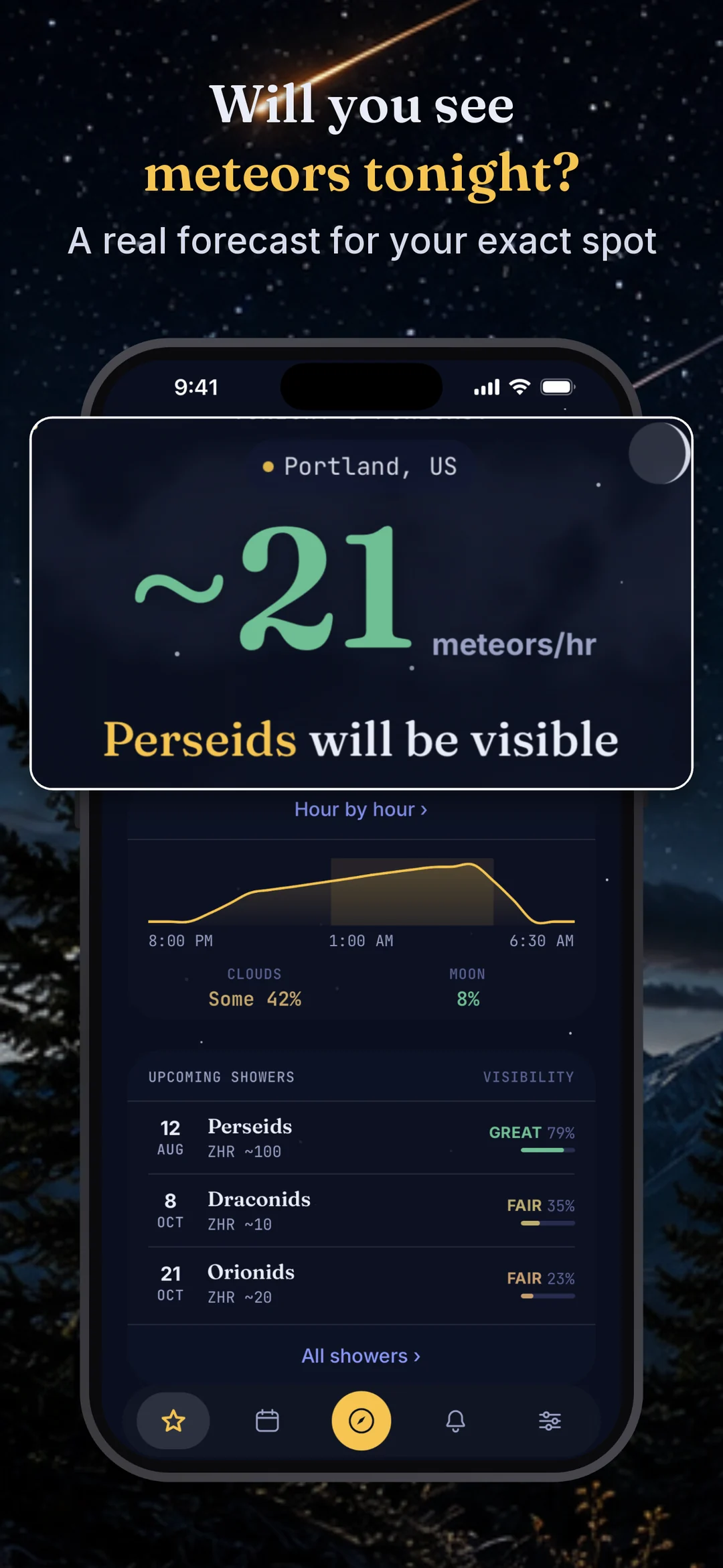
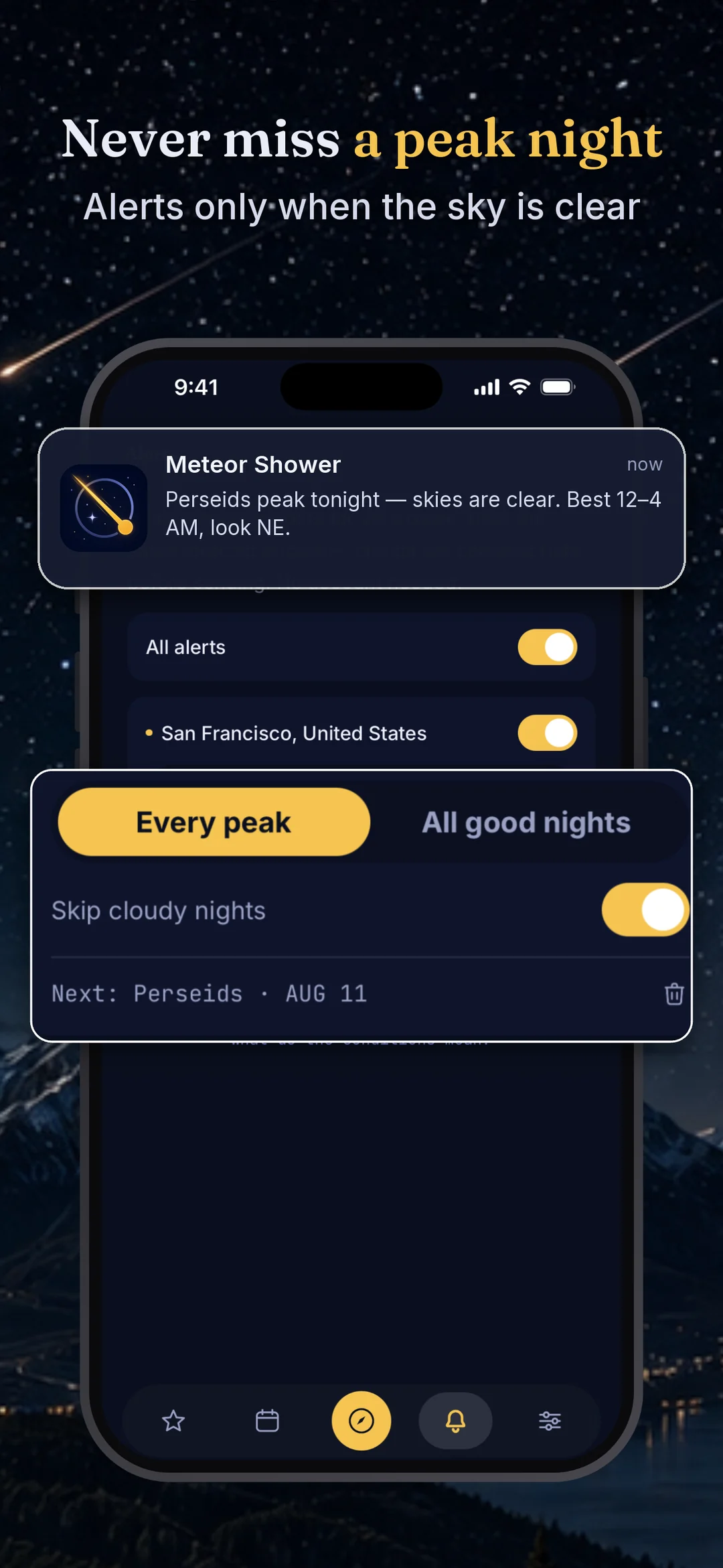
An alert in the evening for your exact location, and a second one when it's time to look up. Every alert checks the clouds first, so you know whether to bother.
- Tonight's forecast for your spot, hour by hour
- Peak-night alerts with a cloud check, free
- More places, widgets and an AR sky scanner with Premium