Guide · 7 min read
What causes a meteor shower
Nearly every shooting star is a grain of comet or asteroid debris, most no bigger than a pebble, burning up 80 to 120 km overhead. A shower is Earth running through a whole stream of them, at the same point of its orbit every year.
By Ilsur Gabdulkhakov · updated
Contents · 8 sections Show
- Meteoroid, meteor, meteorite: one object, three names
- How a grain of dust becomes a streak of light
- Where shower debris comes from
- Why showers come back on the same dates
- The radiant is a trick of perspective
- Why a stream spreads out, and why rates vary
- Sporadic meteors: the background
- What speed does to a meteor
Meteoroid, meteor, meteorite: one object, three names
The words track where the object is. A meteoroid is the solid body in space. The International Astronomical Union (IAU) puts its size at roughly 30 micrometers to 1 meter. Anything smaller counts as interplanetary dust, and the 1-meter upper limit, where meteoroids shade into small asteroids, is a convention rather than a physical boundary.
A meteor is not the object at all. It is the light, and the heat, shock and ionized air that go with it, produced when a meteoroid enters the atmosphere. “Shooting star” and “falling star” are the same thing. A meteorite is whatever survives the trip and reaches the ground; one smaller than a millimeter is a micrometeorite.
Bright meteors have their own vocabulary. The IAU calls a meteor brighter than magnitude −4, about the brilliance of Venus, a fireball or bolide, and one brighter than −17 a superbolide. The American Meteor Society (AMS) uses bolide more narrowly, for a fireball that ends in a bright terminal flash as it breaks apart.
How a grain of dust becomes a streak of light
Most meteors you see come from particles between a grain of sand and a small pebble. What makes something so small visible is speed. Meteoroids enter the atmosphere at about 11 to 72 km/s.
Both limits come from orbital mechanics. Even a particle that drifts up to Earth slowly arrives at about 11 km/s, Earth’s escape velocity, because Earth’s gravity accelerates it on the way in. The fastest hit head-on: Earth’s orbital speed of about 30 km/s plus about 42 km/s, the most a particle can have at Earth’s distance from the Sun and still be bound to it.
At those speeds a tiny grain carries a great deal of energy. A one-gram particle at 60 km/s has about 1.8 million joules, more than the energy released by 400 grams of TNT. Collisions with air molecules strip and vaporize its surface, a process called ablation, and a compact cloud of hot gas glows around it. According to the AMS, about 95 percent of the atoms in that glowing cloud come from the air, not from the meteoroid.
Most of this happens 80 to 120 km up, far above the clouds and many times higher than airliners fly. At that height one bright meteor can be seen from places hundreds of kilometers apart, which is how networks of observers and cameras work out its path.
The same height explains why almost nothing reaches the ground. The AMS notes that particles from dust size up to a few kilograms are usually consumed entirely, and that comet material is especially fragile. A fireball generally has to reach at least magnitude −8 to drop meteorites, and the survivors slow to a few hundred kilometers an hour, falling the last stretch unlit in what researchers call dark flight. Shower or not, the dust adds up: NASA estimates that about 44,000 kg of meteoritic material lands on Earth each day.
Where shower debris comes from
In the IAU’s definition, a meteor shower is a group of meteors produced by meteoroids of the same stream, particles with similar orbits and a common origin. For almost every shower that origin is a comet.
As a comet nears the Sun, its ices turn to gas and drag dust grains off the nucleus. The grains leave slowly compared with the comet’s own orbital speed, so each one follows nearly the comet’s orbit, and over many passages the debris fills a long tube along the comet’s path.
Earth meets a stream only where its orbit passes close to the stream’s. A comet whose orbit comes near Earth’s at two points can give two showers a year: Comet Halley’s debris arrives in May as the Eta Aquariids and in October as the Orionids.
Two major showers come from bodies that look like asteroids: the Geminids from 3200 Phaethon and the Quadrantids from 2003 EH1. Neither is an ordinary inert rock. 2003 EH1 is probably the dormant nucleus of a comet, and Phaethon brightens when it swings close to the Sun; their shower pages tell those stories.
Why showers come back on the same dates
The stream stays in roughly the same place in space from one year to the next, and Earth returns to the same point of its orbit at the same time each year. That is why astronomers time showers not by date but by solar longitude, Earth’s position along its orbit measured in degrees from the March equinox: a peak sits at a fixed solar longitude.
The calendar date drifts because a year runs about a quarter of a day longer than 365 days: each year the peak comes roughly six hours later on the clock, until a leap day pulls it back.
How long a shower lasts tells you how wide the stream is where Earth crosses it. Earth covers about 2.6 million km of its orbit a day, so the Perseids’ five-plus weeks of activity, mid-July to late August, mean nearly 100 million km of travel through the outskirts of one comet’s debris.
The radiant is a trick of perspective
The meteoroids of one stream enter the atmosphere on parallel paths. Seen from the ground, those paths seem to spread from a single point, the radiant, the same way parallel railway tracks seem to meet in the distance. Nothing actually comes from that point; it is simply the direction from which the stream approaches Earth.
That direction combines the meteoroids’ motion with Earth’s own, so it shifts as Earth moves around the Sun. During a shower the radiant creeps eastward against the stars, typically by around a degree a day, which is why radiant charts are drawn for the peak night.
A shower is named after the constellation that holds its radiant, the Perseids for Perseus and the Leonids for Leo. When several showers radiate from one constellation, the name usually adds the nearest star, as with the Eta Aquariids and the Southern Delta Aquariids, both from Aquarius.
Why a stream spreads out, and why rates vary
A new trail of dust is narrow and dense, and it does not stay that way. Grains that leave the comet slightly faster or slower settle into slightly longer or shorter orbits, so they drift ahead of or behind one another along the orbit. Over centuries the planets, above all Jupiter, pull different parts of a stream in different directions, moving some toward Earth’s path and some away.
Streams also end up sorted by particle size, partly because sunlight pushes harder on the smallest grains relative to their mass. The International Meteor Organization notes that in some showers the radar, video and visual maxima fall at different times.
So most showers vary from year to year, and a few vary enormously. Usually Earth passes through the broad, old part of a stream. Now and then it also crosses a narrow trail laid down on a single recent passage of the comet, and rates jump for a few hours or less into an outburst, or even a storm. The Leonids and Draconids are the classic examples, and modeling individual trails now lets astronomers forecast such encounters years in advance.
The end of a stream is gradual. Once its orbits have scattered far enough, its meteoroids no longer arrive from one radiant on predictable dates, and they become part of the sporadic background.
Sporadic meteors: the background
Sporadic meteors are the ones that belong to no recognized stream, and they dominate the flux of meteoroids reaching Earth. The line between a weak shower and the sporadic background is arbitrary, and researchers draw it with thresholds on radiant position and speed that vary from study to study.
Their radiants are not scattered at random. Most fall in six broad patches of sky known as the sporadic sources, each made of meteoroids that have diffused out of old streams. Orbital models tie the apex sources, centered on the direction Earth is heading, mainly to Halley-type comets, and the helion and antihelion sources, roughly toward and opposite the Sun, mainly to Jupiter-family comets, especially Comet Encke, the parent of the Taurids. The International Meteor Organization treats the antihelion patch, about 30 degrees by 15 degrees, as a single source, because the weak minor showers inside it cannot be told apart reliably.
What speed does to a meteor
A shower’s speed is fixed by its geometry: how fast the meteoroids move along their orbit and the angle at which they meet Earth. Streams that meet Earth head-on give the fastest meteors, like the Leonids at 71 km/s. Streams that catch up with Earth from behind give the slowest, like the Draconids at 20 km/s.
Since energy grows with the square of speed, a grain at 70 km/s carries about twelve times the energy of the same grain at 20 km/s. Fast meteors light up and burn out higher in the atmosphere and show as brief, sharp streaks. Slow ones cross the sky unhurriedly enough to follow.
Color comes from what is glowing. The AMS lists sodium as yellow, nickel as green and magnesium as blue-white, and notes that higher energy strengthens some colors relative to others.
A train is light or ionized gas left along a meteor’s path after the meteor has gone. Most last a few seconds and form above about 80 km. Fast showers such as the Orionids are known for them, and trains have long been considered a mark of fast meteors.
A 2024 wide-field camera survey from New Mexico complicates that picture: of 4,726 meteors it recorded, 636 left a long-lasting train, and the slower meteors produced them at a higher rate than the fast ones, with no strong link to fast showers. The longest trains glowed for many minutes, twisted into loops and spirals by upper-atmosphere winds.
To put any of this to use under a real sky, start with how to watch a meteor shower.
Questions
What causes a meteor shower?
Earth passing through a stream of debris shed by a comet, or occasionally by an asteroid. The particles, mostly between a sand grain and a small pebble in size, hit the upper atmosphere at 11 to 72 km/s and vaporize, producing streaks of light.
Why do meteor showers happen at the same time every year?
The debris stream stays in roughly the same place in space, and Earth reaches the same point of its orbit at the same time each year. The peak can shift by about a day because the calendar, with its leap years, does not track Earth's orbit exactly.
What is the difference between a meteor, a meteorite and an asteroid?
A meteoroid is a small natural object in space, up to about a meter across by convention; larger bodies are asteroids. A meteor is the light a meteoroid makes when it enters the atmosphere, and a meteorite is whatever survives that passage and reaches the ground.
What is the radiant of a meteor shower?
The point in the sky that a shower's meteors appear to stream from. The meteoroids actually travel on parallel paths, and perspective makes those paths seem to spread from one point, the way parallel railway tracks seem to meet in the distance.
Do meteor showers create meteorites?
Practically never. Shower meteoroids are small and fragile, most of them comet dust, and the American Meteor Society notes that particles up to a few kilograms are usually consumed completely in the atmosphere. Meteorites come from much larger, sturdier bodies.
Sources: IAU, American Meteor Society, Campbell-Brown & Wiegert, Cordonnier et al. and more · reviewed October 13, 2026Show
- IAU — Meteors and meteorites: definitions
- American Meteor Society — Meteors FAQ
- American Meteor Society — Fireball FAQs
- Campbell-Brown & Wiegert (2009), Seasonal variations in the north toroidal sporadic meteor source, Meteoritics & Planetary Science (PDF)
- Cordonnier et al. (2024), Not So Fast: A New Catalog of Meteor Persistent Trains, JGR Space Physics (arXiv)
Dates, rates and moon figures are recomputed on every build — see the methodology.
Free app · iPhone & Android
Get told when to look up
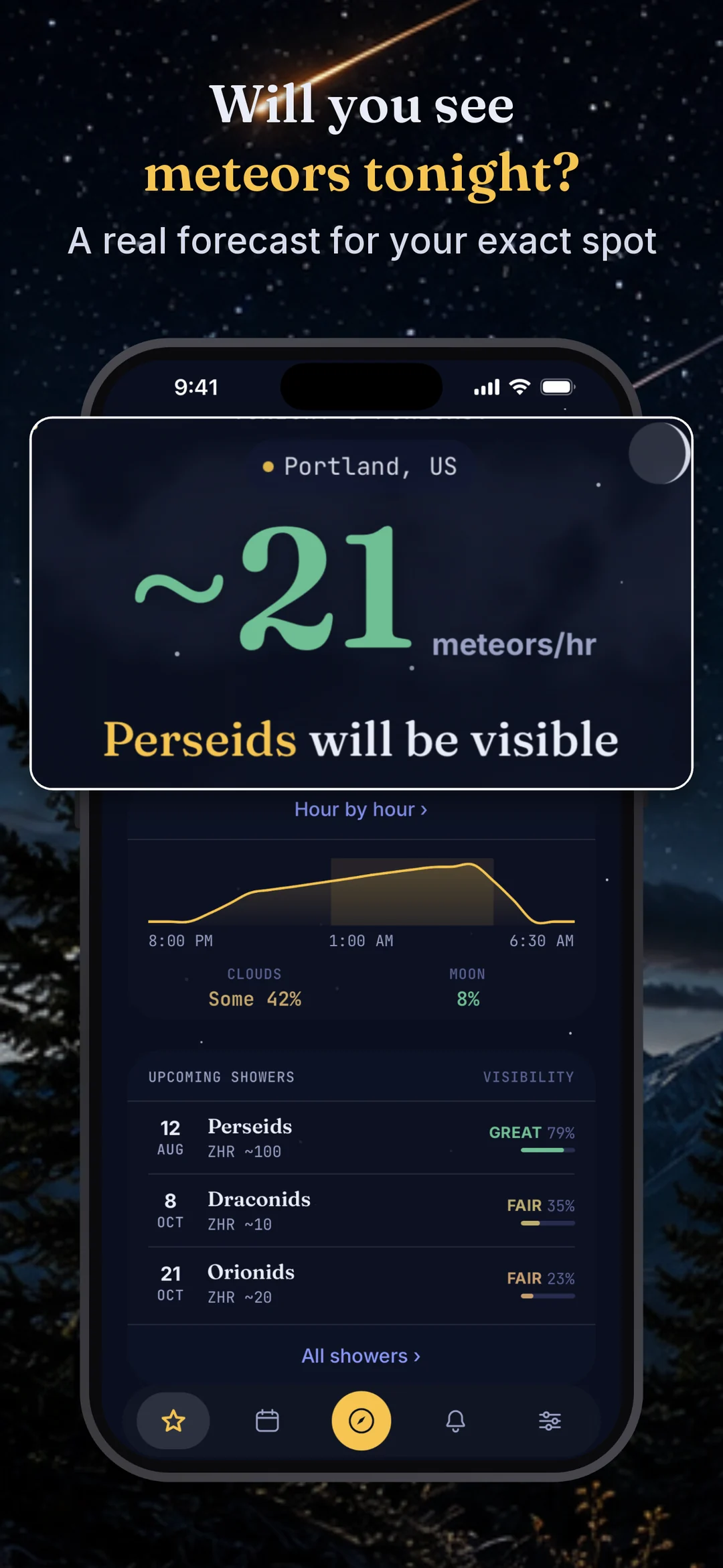
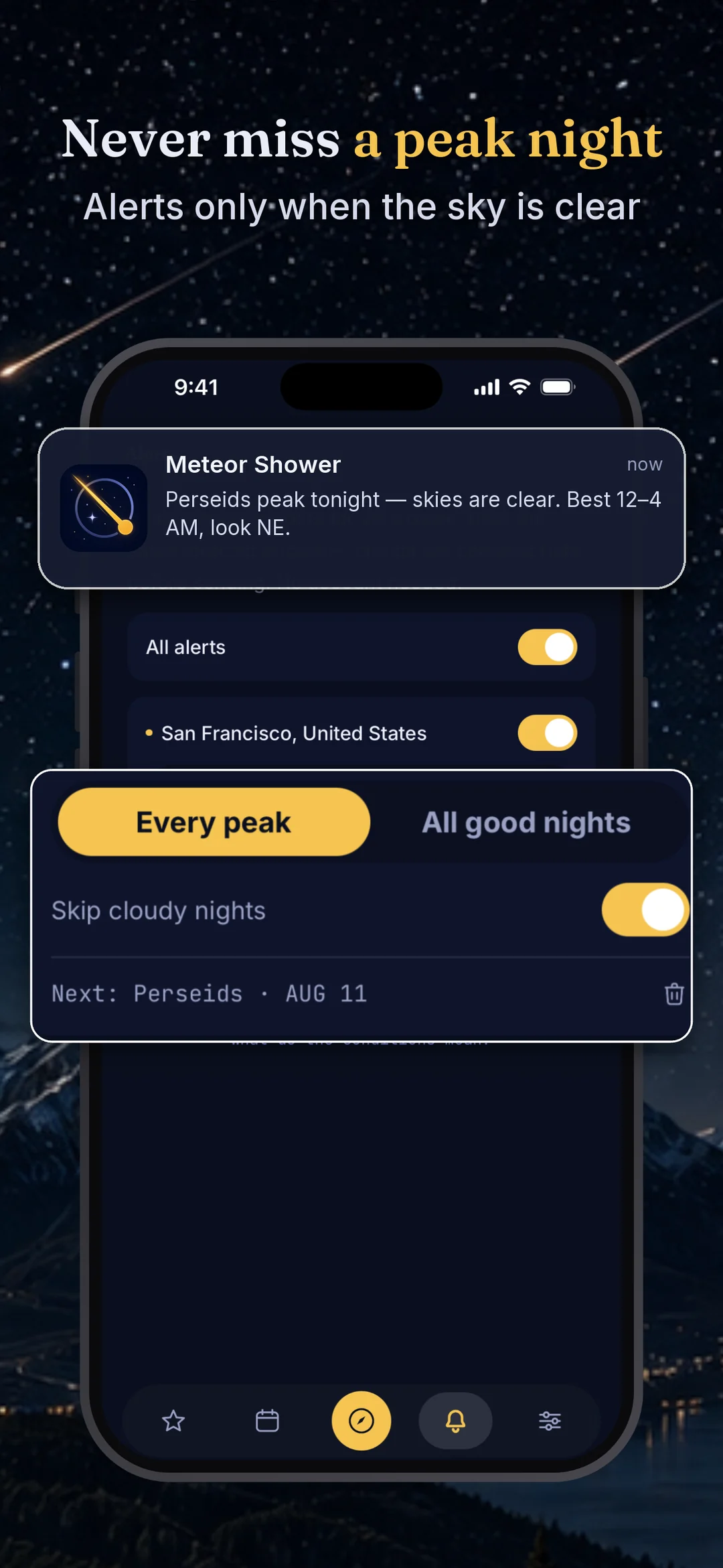
An alert in the evening for your exact location, and a second one when it's time to look up. Every alert checks the clouds first, so you know whether to bother.
- Tonight's forecast for your spot, hour by hour
- Peak-night alerts with a cloud check, free
- More places, widgets and an AR sky scanner with Premium